Why do people watch and root for sports teams, rather than play games themselves? It's not only that people are lazy. It's because watching sports itches the same spot that gambling does: it's a mental investment in an outcome over which you have no control and whose outcome is directly meaningless.
I say directly meaningless, because you may stand to gain or lose indirectly due to the outcome, if you have, for example, wagered money on it (for this post, I define gambling as the mental interest in a directly meaningless outcome over which you have no control, and wagering as the addition of something meaningful as an indirect result of the outcome; by meaningless, I mean that it has no meaning to you). The gain or loss from the wager is an indirect result of the outcome; the direct result is that the players go back to their houses and the ball gets put back on the shelf (i.e. has no meaning). In contrast, the winner or loser of an election, another event beyond your control in which you might have an investment, has direct, meaningful results, even if some of these results might not occur immediately.
Gambling is the mental investment in a directly meaningless outcome over which you have (or no longer have) any control. Rooting for other people playing a game is gambling: rewarding the brain for events beyond its control. You might know that some outcomes are more likely than others. You may have invested effort into raising or lowering the odds of these outcomes. For example, you may have trained your horse to run well or bought better equipment for your team. But once the die is cast, so long as there exists a possibility that either side might triumph (even against the odds), if you care about it, you're a gambler.
The outcome of a game is always directly meaningless (except, perhaps, boxing). If you see people rowing to see who can get to the far shore first, but getting there directly results only in the ability to claim victory, then caring about it is gambling. If the one who gets to the far side first avoids getting eaten by a shark, the result is not meaningless, and caring about it is not gambling: unless you don't care who gets eaten by the shark, in which case it is. You can always add a layer of meaninglessness on top of a meaningful outcome to transform it into a game. You change a competition into a game by adding the words "I win" to it. Succeeding in the competition is not "winning"; it's simply succeeding. The person who doesn't succeed could just as easily claim "I win" if she knows that the goal post is off the edge of a cliff.
When you become invested in the outcome of a game, or even the outcome of a single play, over which you are not exercising skill or talent, you are experiencing gambling. It's natural, because humans are wired for gambling. Even if you don't know who is playing, you want to see an effort rewarded (or punished) or a skillful performance succeed (or skillfully get opposed).
Why do people watch sports and gamble? Because we're wired to assess, but minimize, risks. Gambling provides the safest risk experience there is: we can experience, observe, and learn with no direct meaningful consequences. Wagerers (who bet money, etc) and players experience this risk more intensely, because they have tied real investment to their actions, making it a deeper experience and more primal; investing in the outcome is more educational and more productive.
Another reason we enjoy watching sports is tribalism, if we identify either with the participants or other onlookers; social connections are another primal aspect to being human. Yet another reason: escapism. Watching an event unfold over which we have no control is similar to reading or viewing a story unfold. So long as the game continues to capture our attention, we wonder what's going to happen next. This means that stories, plays, movies, etc also contain elements of gambling: we have a mental investment in a directly meaningless outcome over which we have no control. And we hope for a satisfactory conclusion.
Learning to gamble is a critical skill, exactly because it provides a safe space for evaluating the risks and rewards of taking chances, a skill that we use in non-gambling contexts throughout life.
The problem with gambling - when it is not tied to something meaningful, like wagering money - and sports watching is that it is time spent on something whose actual outcome is meaningless. It's fun: fun is necessary and even meaningless fun is often desirable. But other than sharpening out risk evaluation skills, it doesn't produce anything tangible. That same time and interest could be invested in research, science, creation, developing talent, developing your mind, participating in games where you have control (and thus are gaining or utilizing skills), and any number of other useful activities, many of which also sharpen our risk taking skills in a relatively safe way. Again: some mindlessness can be therapeutic, but it's not the best choice for all or most of the time, even leisure time. It is, after all, lazy.
Showing posts with label luck. Show all posts
Friday, October 24, 2014
Wednesday, October 24, 2012
An Analysis of Monopoly, or Why Monopoly is Worse than Poker
The game of Monopoly (I am considering the four player game played without house rules) is played over four phases that are roughly distinct.
- In the first phase, players are randomly given properties by the roll of the dice. It is unusual that you should not buy a property on which you land, so everyone generally buys everything they land on. (It's possible that, at some point, your opponents have too little money, in which case it may be worth auctioning the property off and buying it for less (just enough to outbid your opponents); I suspect that this is a rare occurrence.)
- In the second phase, players trade properties in order to accumulate monopolies. It is unusual that you receive a monopoly from the first phase through random dice rolling (in a four player game); if you do, you already have a huge advantage. Trading takes some skill, but not a whole lot of skill if you know the actual values and expected ROI of the monopolies. Still, the negotiation can give you a leg up in the next phases.
- In the third phase, players build houses and hotels on their monopolies. It is known that the the sweet spot is three houses, both because of the large rent leap from two to three houses and because of the limitation of houses available to build during the game. The skill in this phase is in managing your cash flow; if you have a row of opponent properties in front of you, you must keep your cash to avoid mortgaging properties. There is a bit of skill in the odds calculation here, but not much.
- In the last phase of the game, players roll the dice repeatedly until all players but one are eliminated from the game. There are - essentially - no interesting decisions in this phase.
In poker, you may have a hand that wins 16.2% of the time and your opponent a hand that wins 12.8% of the time. There is much more left to the game. You don't know what your opponent holds in his hand. You're not playing only against the system, for which the percentage is known, you're also playing against your opponent. You have to play not only the odds of your hand and what you might draw, but also the style of your opponent, a never-ending continuous assessment that continues to challenge right up until the cards are revealed. He might bluff. He might fold. He might call or raise. You only have clues as to the value in his hand, and therefore how to evaluate your own. The power of the cards plays only one part of the game.
Compare this to Monopoly. When the fourth phase is reached, players simply roll and roll and roll until one of them wins. There is nothing left to play; all information is open, there are no more properties or houses to buy, no more resource management, no hidden values to assess. As long as the percentages are close, any property on which you have three houses or more is going to kill or nearly kill you if you land on it. Additional damage is not that relevant. If you have only $50, you are just as dead landing on a property that costs $600 as one that costs $900 or $75.
In Monopoly, the percentages for win/loss in phase four are going to be a few points: 12% vs 16% or something like that. First one to roll badly loses.
Gamewise, there is no real favorite, no unexpected winner or loser, no underdog. On any particular roll, however, the odds will vary wildly. You might be entering at a long stretch of properties owned by an opponent. On this particular roll, your odds of surviving might be 60 to 12.5, in which case survival is a win for the underdog. This is the thrill of gambling; however it is the "low" sort of gambling that allows no choices, not even on whom or how much to bet. The game state is set, you're 100% in and you simply await the outcome. You can't fold and save your money for the next game, or bluff your opponent into not charging rent. You can't bet on another player.
That's why Monopoly ultimately fails as an interesting game, when compared to other luck heavy games such as poker.
Thursday, May 10, 2012
Ignorance Sucks
Not knowing things irritates me. I may be in the minority on this.
Exhibit A: Snaps
Last sukkot I was introduced to the bar puzzle/game Snaps, one of those hilarious "in-the-know" games enjoyed by the people who know the rules and supposedly challenging and frustrating for those who don't. The game is allegedly about trying to guess a word given clues by one player, but it's actually about figuring out how the clue system works. Something to do with snapping fingers.
To some people, this is entertaining; if you're one of those people, don't clink on the above link. I was simply irritated. You would think that a game-player like me would be interested in trying to figure the game out, and I was for about four minutes. After that I got bored and wanted the answer.
The person leading the game was not tuned into this; he thought it was unsporting to give away the answer, so he just kept playing new words. After unsuccessfull trying to persuade him that I was no longer interested in guessing, I used my smart phone and looked up the answer. This might be construed as cheating, except that I never agreed to participate in the game in the first place.
Exhibit B: Books (and films, and other media)
I enjoy books, movies, etc a lot more when they've been "spoiled" for me. To me, the enjoyment from art isn't the anticipation and suspense of not knowing what is going to happen. It's from the artful way it is done. I've downloaded movies just to watch them at home before going to the cinema to see them. I read plot summaries online before reading a book, watching a movie, or even a television episode. If it's good art, I like to watch or read it more than once.
The term itself - "spoil" - implies that I'm out of touch with the common folk on this one. It's not spoiling to me; it's getting the plot out of the way so I can concentrate on the enjoyment of the media.
Exhibit C: Dice
For some, the anticipation of the unknown and uncontrollable is a thrill, for me it's a pain. I feel that the game is over right before the die is tossed: in the planning and the strategy that brought us to that point that matters. Once it's tossed, it doesn't even feel like playing to me anymore; it's like punishment. The win isn't exciting; the loss is irritating. It's a no win scenario for me.
Oddly, I don't mind at all when an opponent does something unexpected. In fact I love it; that's playing. I love talking to people who say unexpected things. In fact, I love the unexpected all over the place: random encounters in the real world, serendipitous discoveries in stores or on the radio.
In other words, I'm happy to continuously discover the interesting and good. Withholding knowledge just for the sake of withholding it is not my idea of fun.
Exhibit A: Snaps
Last sukkot I was introduced to the bar puzzle/game Snaps, one of those hilarious "in-the-know" games enjoyed by the people who know the rules and supposedly challenging and frustrating for those who don't. The game is allegedly about trying to guess a word given clues by one player, but it's actually about figuring out how the clue system works. Something to do with snapping fingers.
To some people, this is entertaining; if you're one of those people, don't clink on the above link. I was simply irritated. You would think that a game-player like me would be interested in trying to figure the game out, and I was for about four minutes. After that I got bored and wanted the answer.
The person leading the game was not tuned into this; he thought it was unsporting to give away the answer, so he just kept playing new words. After unsuccessfull trying to persuade him that I was no longer interested in guessing, I used my smart phone and looked up the answer. This might be construed as cheating, except that I never agreed to participate in the game in the first place.
Exhibit B: Books (and films, and other media)
I enjoy books, movies, etc a lot more when they've been "spoiled" for me. To me, the enjoyment from art isn't the anticipation and suspense of not knowing what is going to happen. It's from the artful way it is done. I've downloaded movies just to watch them at home before going to the cinema to see them. I read plot summaries online before reading a book, watching a movie, or even a television episode. If it's good art, I like to watch or read it more than once.
The term itself - "spoil" - implies that I'm out of touch with the common folk on this one. It's not spoiling to me; it's getting the plot out of the way so I can concentrate on the enjoyment of the media.
Exhibit C: Dice
For some, the anticipation of the unknown and uncontrollable is a thrill, for me it's a pain. I feel that the game is over right before the die is tossed: in the planning and the strategy that brought us to that point that matters. Once it's tossed, it doesn't even feel like playing to me anymore; it's like punishment. The win isn't exciting; the loss is irritating. It's a no win scenario for me.
Oddly, I don't mind at all when an opponent does something unexpected. In fact I love it; that's playing. I love talking to people who say unexpected things. In fact, I love the unexpected all over the place: random encounters in the real world, serendipitous discoveries in stores or on the radio.
In other words, I'm happy to continuously discover the interesting and good. Withholding knowledge just for the sake of withholding it is not my idea of fun.
Monday, December 28, 2009
Some Finer Points on Skill and Luck
Let's say that a game gives me two opportunities: I can try to pick a black card from 2 red cards and 1 black card, or I can try to pick a black card from 99 red cards and 1 black card.
I have a 100% chance of successfully choosing the opportunity that I want [1]. There is no waiting for the results, no possibility of error, and nothing my opponent can do to prevent or overturn my choice.
Nevertheless, the game doesn't end after that choice. Once I have chosen, I must still pick the card and await the result. Between the time that I chose my opportunity and the moment that the card is revealed to me, I contribute nothing to the game. There is no skill I can exercise, no feat I can accomplish. All I can do is await the outcome. [2]
In a game of Chess, when I choose to make a legal move on my turn, there is a 100% chance of my move occurring. Between that move and my next move, my opponent may respond in many different ways. There is no skill I can exercise, no feat I can accomplish [3]. All I can do is await the outcome.
The difference between these two games is that in the former case, I await pure chance to determine the results, while in the latter case, I await the skills of my opponent to determine the results. In either case, I can be lucky or unlucky. Luck in picking cards is obvious. In playing Chess, luck may have to do with my opponent's mental state, somehow having hit a blind spot in his evaluation or knowledge, his having a weakness to which I played [4], and so on.
Here's a third game: I'm shown the location of the black card in a set of three cards, and then I go read a book. Now I come back and have to remember where the black card is. I remember that it's not the right card, but I can't remember if it is the middle or the left card. I decide to pick one of those two cards.
My choice is partially skill and partially luck [5]. My skill has reduced the amount of luck. After my decision, I must again await the result of my choice.
If I play the game a dozen more times, I will win every time - no luck involved. The first time I played, I didn't realize how hard it would be to remember. Or, perhaps, I hadn't yet come up with a workable mnemonic system.
If the first game is luck, and the twelfth game is not luck, when does the game change from being one of luck to one of skill? After all, some people will win every game, even the first one; they have a natural skill. Some will always rely on luck.
I determine from these questions that a) my skill can reduce the amount of luck, or eliminate it entirely, and b) beyond the reach of my skill there is still luck. A wild guess. Or an educated guess. A wild swing. The hope that my opponent will under- or over-estimate my play.
If a game relies entirely on skill, it is a puzzle, or it is a foregone conclusion (e.g. tug-of-war with a baby).
Yehuda
[1] Assuming that I can evaluate the situation correctly, and assuming that my opponent can't cheat or otherwise manipulate the odds as I understood them.
[2] Roman's comment on my last post noted that, though my choice of a card is in fact irrelevant, human nature ascribes importance to the selection of the card; if the card is simply flipped at random, it doesn't feel the same as my "picking" a card. This is true, and a fact of human nature that good games exploit.
[3] Assuming that I cannot influence the decision through meta-game actions, such as trying to make him nervous. I could, however, use the opportunity to plan my next move.
[4] That can also be skill on my part, and not only luck; for instance, I may play moves quickly, thereby rattling him.
[5] Of course, it may actually be the right card, and I remembered incorrectly.
I have a 100% chance of successfully choosing the opportunity that I want [1]. There is no waiting for the results, no possibility of error, and nothing my opponent can do to prevent or overturn my choice.
Nevertheless, the game doesn't end after that choice. Once I have chosen, I must still pick the card and await the result. Between the time that I chose my opportunity and the moment that the card is revealed to me, I contribute nothing to the game. There is no skill I can exercise, no feat I can accomplish. All I can do is await the outcome. [2]
In a game of Chess, when I choose to make a legal move on my turn, there is a 100% chance of my move occurring. Between that move and my next move, my opponent may respond in many different ways. There is no skill I can exercise, no feat I can accomplish [3]. All I can do is await the outcome.
The difference between these two games is that in the former case, I await pure chance to determine the results, while in the latter case, I await the skills of my opponent to determine the results. In either case, I can be lucky or unlucky. Luck in picking cards is obvious. In playing Chess, luck may have to do with my opponent's mental state, somehow having hit a blind spot in his evaluation or knowledge, his having a weakness to which I played [4], and so on.
Here's a third game: I'm shown the location of the black card in a set of three cards, and then I go read a book. Now I come back and have to remember where the black card is. I remember that it's not the right card, but I can't remember if it is the middle or the left card. I decide to pick one of those two cards.
My choice is partially skill and partially luck [5]. My skill has reduced the amount of luck. After my decision, I must again await the result of my choice.
If I play the game a dozen more times, I will win every time - no luck involved. The first time I played, I didn't realize how hard it would be to remember. Or, perhaps, I hadn't yet come up with a workable mnemonic system.
If the first game is luck, and the twelfth game is not luck, when does the game change from being one of luck to one of skill? After all, some people will win every game, even the first one; they have a natural skill. Some will always rely on luck.
I determine from these questions that a) my skill can reduce the amount of luck, or eliminate it entirely, and b) beyond the reach of my skill there is still luck. A wild guess. Or an educated guess. A wild swing. The hope that my opponent will under- or over-estimate my play.
If a game relies entirely on skill, it is a puzzle, or it is a foregone conclusion (e.g. tug-of-war with a baby).
Yehuda
[1] Assuming that I can evaluate the situation correctly, and assuming that my opponent can't cheat or otherwise manipulate the odds as I understood them.
[2] Roman's comment on my last post noted that, though my choice of a card is in fact irrelevant, human nature ascribes importance to the selection of the card; if the card is simply flipped at random, it doesn't feel the same as my "picking" a card. This is true, and a fact of human nature that good games exploit.
[3] Assuming that I cannot influence the decision through meta-game actions, such as trying to make him nervous. I could, however, use the opportunity to plan my next move.
[4] That can also be skill on my part, and not only luck; for instance, I may play moves quickly, thereby rattling him.
[5] Of course, it may actually be the right card, and I remembered incorrectly.
Tuesday, March 11, 2008
The Shortest Games: Selection Games
Selection games are very short games, usually taking no more than a few seconds up to a few minutes to play. They generally incorporate a single play that decides the outcome of the game; one test of skill or one random event. In some selection games, only one player takes a turn while the other player watches. The results of this turn entirely determine the outcome of the game.
Some selection games are random, such as a coin toss, while some apparently random games in theory actually allow psychological tactics to come into play if they are played often enough, such as Rock-Paper-Scissors. These games can even have their own international championship events. Other games are tests of skill, wherein the player who is stronger in that skill will always win.
The use of random selection games goes back to biblical times and earlier.
Selection Games to Determine a Starting Player
In Diplomacy, all players begin negotiating at the same time; after negotiation, all moves are made simultaneously. In the 100 meter dash, all players begin running at the same time.
For many games, however, someone takes the first turn. Unless decided by fiat, who starts is often decided upon, surprisingly enough, by another entirely unrelated game: a selection game.
Determining who goes first using a selection game is nearly universal in culture. Yet using a selection game to determine the starting player can sometimes be problematic.
One unwritten expectation in any game is that the outcome of the game relies on the luck or skill of the players within the game itself. If the starting player gains an advantage or disadvantage over the other players, it seems strange to give this advantage to one player or another based on an entirely unrelated game.
This is not a problem for many games. In some games, the starting player is truly unimportant to the end results. For instance, if two players are shooting at a target, one after another, and the result of the first player's shot is not told to the second player before the second player takes his or her shot, then it doesn't matter who goes first.
In other games, the starting player has an advantage but the advantage is statistically insignificant. For instance, there may be some very slight advantage or disadvantage in serving first in Tennis, but this advantage or disadvantage will quickly be lost among the good plays or mistakes made by the players.
On the other hand, if the second player knows that the first player's shot was poor, the second player has a marked advantage, as his or her shot only has to beat the first player's. Also, the win or loss of the selection game for first serve can have a psychological effect on the players; would you rather go into a Tennis match having just lost your last game?
When the player position in a game matters, something is wrong, regardless of whether the starting player is determined by pure chance or a skill unrelated to the game (such as a staring contest). In order to solve this problem, you can try a more fair method to assign player position.
For instance, going first in Monopoly is an advantage. Instead of rolling to see who goes first, try auctioning off the starting position for starting money; the winner starts the game with the usual amount of starting money less his or her bid. Paying for the position with resources serves to balance any gained advantages. A nearly identical method is the divide and offer method: one player takes a certain amount of money from the bank and offers the other player to choose either going first or the extra money.
In some games, this type of selection is built into the game. I'm not referring to games where the first rule of the game is "determine a starting player" or "roll to see who goes first". In Die Macher, for instance, each round begins with a simultaneous auction for starting player. Players bid their resources, and the highest bidder then selects who goes first.
Other games decide who goes first by fiat. E.g. in some games, the game states that the oldest or youngest player starts, possibly in an attempt to give younger players the slight positional advantage (which doesn't work if the game is being played in a n old-age home). Many recent games have been mocking this type of fiat rule by stating things like the player who has most recently been on a boat goes first (for a nautically-themed game), the player who looks most like Abraham Lincoln goes first (for an election-themed game), or even the first player to grab the die goes first. And so on.
Selection Games for Other Purposes
Selection games are sometimes used to settle disputes when parties can't agree on any other course of action and do not wish to use violence. In certain historical cases, large amounts of money, property, or rights have changed hands as a result. Some tied elections have been decided by a coin toss. Often the suggestion to use a selection game to settle a serious dispute is done facetiously.
In rare cases, these games may also be played by very bored people.
Two-player Selection Games
Coin Toss: Flipping a coin to see who goes first is so ingrained in our culture that the very term "flip a coin" is nearly synonymous with a random selection game. The typical coin toss is Heads or Tails, but another variant includes flipping two coins, with one player going first if they match and the other if they don't.
Most of games of coin toss are played and then forgotten, with some notable exceptions. For instance, the coin used to determine who kicks off the Superbowl is a specially minted coin, replicas of which are sold as souvenirs.
Interestingly, most coins lend themselves to a slight bias when flipping, falling one way of the other a slightly higher percent of the time. This is either due to the differences in weight on either side of the coin, imperfections in the coin, or poor flipping quality. Skilled flippers can sometimes make whichever side they want come up.
Rock Paper Scissors: Also known in many cultures, this is a non-transitive game where both players select one of three possible choices: rock, paper, or scissors. The choice is made by forming your hand into a shape somewhat similar to your choice. When simultaneously revealed, rock beats scissors, scissors beats paper, and paper beats rock.
This simple game is nearly as well known as coin flipping, and nearly as synonymous with making a quick decision in favor of one or more parties. Expanded versions of the games add additional choices, while alternate choices with the same gameplay are used in different cultures.
As I mentioned above, RPS is less random than it appears to be, since humans tend to follow certain rules when trying to emulate random play. Males and females have typical first round choices, tend not to repeat their throws too many times in succession, and tend to choose their next throw based on what happened on the previous throw. Using this information, experienced players can generally beat non-experienced players in the long run.
RPS lends itself to cheating by players who change their selection within a fraction of a second of viewing the other player's selection.
Odds or Evens: is a specific form of Morra, listed below. One player plays "even" and the other "odd". Each player decides on one or two fingers and they simultaneously show them. If they match, "evens" wins, otherwise "odds" does.
Walking forward: Two players stand opposite each other at some non pre-determined distance. They alternate walking forward, toe-to-heel, until one steps on the other players foot.
Stick toss: One player tosses the stick into the air and grasps it with his fist somewhere in the middle when it descends, one end pointing up. The other player places his fist directly above the first player's, who places his other fist above the second's, and so on until one player can no longer do so having run out of stick to grasp. The last to grasp the stick is the winner.
Ah, but how do you know which player tosses the stick? ;-)
Volley: Used in Ping Pong and other net games, this game is even more of a bootstrap problem than the last one. One player begins an easy serve over the net and the ball is volleyed a set minimum number of times. If one player wins the volley after the minimum number of returns were made, that player goes first.
Unlike the above games, this is a skill based game that also utilizes the skills required for the game itself. The person who wins the volley is most likely going to be the person who wins the game. Similarly, in billiards players shoot cue balls against a far cushion, and the player who does so most successfully starts the game.
Another method of deciding who goes first in a net game (other than by convention, such as whose field is being used) is to toss a racket up in the air. After it falls, the player toward whom the handle is pointing goes first.
Arm wrestling: This is a skill based game relying entirely on upper body strength and arm-wrestling technique. After coin flipping and Rock-Paper-Scissors (And possibly rolling a die), this game is most likely to be suggested as a means of settling a dispute, despite the fact that the victor is likely a foregone conclusion with two unequally skilled opponents. An arm wrestle only reveals how good the players are at arm wrestling, after all.
Other selection games of physical skill include staring your opponent down or racing toward some object.
Multi-player Selection Games
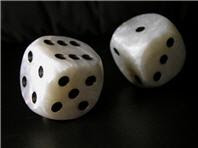
Dice rolling: This is certainly the most commonly used selection game when playing a game that already has dice. In which case, the selection game is often the official first step in the rules of the game.
Ties can often lead to an immediate fight. Do all players re-roll or just the tying players? After the re-roll, are the new rolls compared to previous rolls or only used as settling the tie between the two re-rolling players? Then, do the dice rolls indicate player order, or was the roll to determine the starting player, after which all other players play in clockwise order?
The validity of dice rolls is also a subject of discussion. Do rolls have to be on a flat surface or can they straddle the edge of the playing surface? Do they have to be in the box, on the table, on the board, or on anything flat? And if one die needs to be re-rolled, must (or may) all dice be re-rolled?
A growing number of people are capable of pretending to roll dice as if to obtain a random result but actually producing exactly or generally the numbers they like. Most people would agree that this is cheating, and that the very idea of dice rolling is to produce a random result.
What about "lucky dice" which seem to roll certain numbers with greater than average frequency? This may be all in the head of the player, but many dice may have a statistical bias of some kind. In order to alleviate this problem, all players could throw the same dice.
Dice are incredibly old; versions of dice date back several thousand years or more. In addition to being used for random results, some people enjoy using them in other ways, such as spinning, stacking, or for jewelery.
Games with other randomizers, such as a spinner, often use the randomizer in question to select a starting player.
Card draw: Before playing a game with cards, either the dealer or the teams can be settled by first drawing cards. For starting player, each player draws a card and the highest or lowest deals. Using this method you have the same problem resolving ties as you do for dice.
To select teams, the players with the two highest cards form one team and the two lowest another team. In some cases, four cards such as the four aces or two pairs of kings and queens, may be removed from the deck before this process. In this case, matching colors or pairs play together.
Playing cards date back for hundred of years, and are also used for many things other than playing games or drawing for first.
Drawing Straws: While most selection games are "won", i.e. winning the game indicates a beneficial outcome, this is an example of a selection game that can only be lost, i.e. the selected player is the only "loser" while all of the others have won. It is used to select someone to perform an unwanted chore or fill an undesired position. In classical literature, the results of drawing the short straw can lead to consequences as dire as death, often through being the one chosen to make some sort of noble sacrifice on behalf of the other players.
To play, you must find enough straws or strings for each player, where one is markedly shorter (or longer) than the others. One player arranges them all to be sticking through his fingers in such a way that the odd one out cannot be determined from looking at them from above. All players except the one holding the items select one, leaving the last one for the player who initially held all of them. The player with the short (or long) item is the one selected.
The Nose Game: This is a more devious version of the above, since the last one to know that he is playing loses automatically. In this game, an undesired task becomes known to one or more people, all in the same room, before it becomes known to the rest. Or, the fact that someone will have to attend to the task becomes known only gradually to each person.
The people who realize that some unlucky chap will have to deal with the problem touch their nose (or some equivalent gesture). As others realize that some people are touching their nose, and the implications thereof, they do the same. The last to realize what's going on is automatically the loser.
Of course, this is not properly a game at all, and patently unfair. And the "loser" is only bound to accept his fate if he buys into the spirit of the idea.
Counting Out Games: In this playground ritual, one player chants a well-known rhyme while pointing in turn for each syllable or word at players in a circle in succession. The person pointed to is selected, either as "it" or as "not it". In the latter case, the players are picked off one by one until the last remaining is "it".
The arrangement of the players in the circle, as well as the counting player, should be random, but this is generally overlooked. Furthermore, well-known rhymes have well-known numbers of words and syllables, making the person who will be selected a foregone conclusion before the game starts. Unless the first person pointed to is randomly selected and the rhyme also randomly selected, this is not properly a game but a good way of picking on people.
It tends to lead to arguments as to whether the counting should be done by word or syllable, which words actually belong to the rhyme, and how this whole thing is just so stupid until you've been excluded from playing in every game and have to spend all recess sitting and crying at the far side of the playground until you remember that you brought your mom's Robert Heinlein book with you and didn't really want to play that stupid game anyway. Or so I've heard.
In America, one popular example is Eeny Meeny Miney Moe.
Morra: Morra is a generalized version of Odds and Evens. All players in a circle throw out some number of fingers. Then teams, or a winner, is selected.
For instance, an odd number of fingers might mean one thing while an even something else. Or the player who guessed correctly how many fingers might win. Or all odds are on one team and evens on another. And so on.
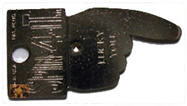
Spin-4-It: Modern board gamers have created special devices such as this one to help them with the chronic problem of who goes first. This device is a small metal pointing hand balanced on a small round bump. Spin it to determine who starts the game.
If spun on a smooth, level surface, it can spin for some time before stopping.
Start Player: Not content with a simple spinning device, a gamer Geek named Ted Alspach created a collectible card game to determine the start player in any game that requires one. Each card has a ridiculous starting condition, such as "the player who owns the most boardgames is the Start Player".
To pick a starting player, shuffle the deck, pick the top most card, and determine the outcome.
Selection Methods entry on Wikipedia
Yehuda
Some selection games are random, such as a coin toss, while some apparently random games in theory actually allow psychological tactics to come into play if they are played often enough, such as Rock-Paper-Scissors. These games can even have their own international championship events. Other games are tests of skill, wherein the player who is stronger in that skill will always win.
The use of random selection games goes back to biblical times and earlier.
Selection Games to Determine a Starting Player
In Diplomacy, all players begin negotiating at the same time; after negotiation, all moves are made simultaneously. In the 100 meter dash, all players begin running at the same time.
For many games, however, someone takes the first turn. Unless decided by fiat, who starts is often decided upon, surprisingly enough, by another entirely unrelated game: a selection game.
Determining who goes first using a selection game is nearly universal in culture. Yet using a selection game to determine the starting player can sometimes be problematic.
One unwritten expectation in any game is that the outcome of the game relies on the luck or skill of the players within the game itself. If the starting player gains an advantage or disadvantage over the other players, it seems strange to give this advantage to one player or another based on an entirely unrelated game.
This is not a problem for many games. In some games, the starting player is truly unimportant to the end results. For instance, if two players are shooting at a target, one after another, and the result of the first player's shot is not told to the second player before the second player takes his or her shot, then it doesn't matter who goes first.
In other games, the starting player has an advantage but the advantage is statistically insignificant. For instance, there may be some very slight advantage or disadvantage in serving first in Tennis, but this advantage or disadvantage will quickly be lost among the good plays or mistakes made by the players.
On the other hand, if the second player knows that the first player's shot was poor, the second player has a marked advantage, as his or her shot only has to beat the first player's. Also, the win or loss of the selection game for first serve can have a psychological effect on the players; would you rather go into a Tennis match having just lost your last game?
When the player position in a game matters, something is wrong, regardless of whether the starting player is determined by pure chance or a skill unrelated to the game (such as a staring contest). In order to solve this problem, you can try a more fair method to assign player position.
For instance, going first in Monopoly is an advantage. Instead of rolling to see who goes first, try auctioning off the starting position for starting money; the winner starts the game with the usual amount of starting money less his or her bid. Paying for the position with resources serves to balance any gained advantages. A nearly identical method is the divide and offer method: one player takes a certain amount of money from the bank and offers the other player to choose either going first or the extra money.
In some games, this type of selection is built into the game. I'm not referring to games where the first rule of the game is "determine a starting player" or "roll to see who goes first". In Die Macher, for instance, each round begins with a simultaneous auction for starting player. Players bid their resources, and the highest bidder then selects who goes first.
Other games decide who goes first by fiat. E.g. in some games, the game states that the oldest or youngest player starts, possibly in an attempt to give younger players the slight positional advantage (which doesn't work if the game is being played in a n old-age home). Many recent games have been mocking this type of fiat rule by stating things like the player who has most recently been on a boat goes first (for a nautically-themed game), the player who looks most like Abraham Lincoln goes first (for an election-themed game), or even the first player to grab the die goes first. And so on.
Selection Games for Other Purposes
Selection games are sometimes used to settle disputes when parties can't agree on any other course of action and do not wish to use violence. In certain historical cases, large amounts of money, property, or rights have changed hands as a result. Some tied elections have been decided by a coin toss. Often the suggestion to use a selection game to settle a serious dispute is done facetiously.
In rare cases, these games may also be played by very bored people.
Two-player Selection Games
Coin Toss: Flipping a coin to see who goes first is so ingrained in our culture that the very term "flip a coin" is nearly synonymous with a random selection game. The typical coin toss is Heads or Tails, but another variant includes flipping two coins, with one player going first if they match and the other if they don't.Most of games of coin toss are played and then forgotten, with some notable exceptions. For instance, the coin used to determine who kicks off the Superbowl is a specially minted coin, replicas of which are sold as souvenirs.
Interestingly, most coins lend themselves to a slight bias when flipping, falling one way of the other a slightly higher percent of the time. This is either due to the differences in weight on either side of the coin, imperfections in the coin, or poor flipping quality. Skilled flippers can sometimes make whichever side they want come up.
Rock Paper Scissors: Also known in many cultures, this is a non-transitive game where both players select one of three possible choices: rock, paper, or scissors. The choice is made by forming your hand into a shape somewhat similar to your choice. When simultaneously revealed, rock beats scissors, scissors beats paper, and paper beats rock.This simple game is nearly as well known as coin flipping, and nearly as synonymous with making a quick decision in favor of one or more parties. Expanded versions of the games add additional choices, while alternate choices with the same gameplay are used in different cultures.
As I mentioned above, RPS is less random than it appears to be, since humans tend to follow certain rules when trying to emulate random play. Males and females have typical first round choices, tend not to repeat their throws too many times in succession, and tend to choose their next throw based on what happened on the previous throw. Using this information, experienced players can generally beat non-experienced players in the long run.
RPS lends itself to cheating by players who change their selection within a fraction of a second of viewing the other player's selection.
Odds or Evens: is a specific form of Morra, listed below. One player plays "even" and the other "odd". Each player decides on one or two fingers and they simultaneously show them. If they match, "evens" wins, otherwise "odds" does.
Walking forward: Two players stand opposite each other at some non pre-determined distance. They alternate walking forward, toe-to-heel, until one steps on the other players foot.
Stick toss: One player tosses the stick into the air and grasps it with his fist somewhere in the middle when it descends, one end pointing up. The other player places his fist directly above the first player's, who places his other fist above the second's, and so on until one player can no longer do so having run out of stick to grasp. The last to grasp the stick is the winner.
Ah, but how do you know which player tosses the stick? ;-)
Volley: Used in Ping Pong and other net games, this game is even more of a bootstrap problem than the last one. One player begins an easy serve over the net and the ball is volleyed a set minimum number of times. If one player wins the volley after the minimum number of returns were made, that player goes first.
Unlike the above games, this is a skill based game that also utilizes the skills required for the game itself. The person who wins the volley is most likely going to be the person who wins the game. Similarly, in billiards players shoot cue balls against a far cushion, and the player who does so most successfully starts the game.
Another method of deciding who goes first in a net game (other than by convention, such as whose field is being used) is to toss a racket up in the air. After it falls, the player toward whom the handle is pointing goes first.
Arm wrestling: This is a skill based game relying entirely on upper body strength and arm-wrestling technique. After coin flipping and Rock-Paper-Scissors (And possibly rolling a die), this game is most likely to be suggested as a means of settling a dispute, despite the fact that the victor is likely a foregone conclusion with two unequally skilled opponents. An arm wrestle only reveals how good the players are at arm wrestling, after all.Other selection games of physical skill include staring your opponent down or racing toward some object.
Multi-player Selection Games
Dice rolling: This is certainly the most commonly used selection game when playing a game that already has dice. In which case, the selection game is often the official first step in the rules of the game.Ties can often lead to an immediate fight. Do all players re-roll or just the tying players? After the re-roll, are the new rolls compared to previous rolls or only used as settling the tie between the two re-rolling players? Then, do the dice rolls indicate player order, or was the roll to determine the starting player, after which all other players play in clockwise order?
The validity of dice rolls is also a subject of discussion. Do rolls have to be on a flat surface or can they straddle the edge of the playing surface? Do they have to be in the box, on the table, on the board, or on anything flat? And if one die needs to be re-rolled, must (or may) all dice be re-rolled?
A growing number of people are capable of pretending to roll dice as if to obtain a random result but actually producing exactly or generally the numbers they like. Most people would agree that this is cheating, and that the very idea of dice rolling is to produce a random result.
What about "lucky dice" which seem to roll certain numbers with greater than average frequency? This may be all in the head of the player, but many dice may have a statistical bias of some kind. In order to alleviate this problem, all players could throw the same dice.
Dice are incredibly old; versions of dice date back several thousand years or more. In addition to being used for random results, some people enjoy using them in other ways, such as spinning, stacking, or for jewelery.
Games with other randomizers, such as a spinner, often use the randomizer in question to select a starting player.
Card draw: Before playing a game with cards, either the dealer or the teams can be settled by first drawing cards. For starting player, each player draws a card and the highest or lowest deals. Using this method you have the same problem resolving ties as you do for dice.
To select teams, the players with the two highest cards form one team and the two lowest another team. In some cases, four cards such as the four aces or two pairs of kings and queens, may be removed from the deck before this process. In this case, matching colors or pairs play together.
Playing cards date back for hundred of years, and are also used for many things other than playing games or drawing for first.
Drawing Straws: While most selection games are "won", i.e. winning the game indicates a beneficial outcome, this is an example of a selection game that can only be lost, i.e. the selected player is the only "loser" while all of the others have won. It is used to select someone to perform an unwanted chore or fill an undesired position. In classical literature, the results of drawing the short straw can lead to consequences as dire as death, often through being the one chosen to make some sort of noble sacrifice on behalf of the other players.
To play, you must find enough straws or strings for each player, where one is markedly shorter (or longer) than the others. One player arranges them all to be sticking through his fingers in such a way that the odd one out cannot be determined from looking at them from above. All players except the one holding the items select one, leaving the last one for the player who initially held all of them. The player with the short (or long) item is the one selected.
The Nose Game: This is a more devious version of the above, since the last one to know that he is playing loses automatically. In this game, an undesired task becomes known to one or more people, all in the same room, before it becomes known to the rest. Or, the fact that someone will have to attend to the task becomes known only gradually to each person.
The people who realize that some unlucky chap will have to deal with the problem touch their nose (or some equivalent gesture). As others realize that some people are touching their nose, and the implications thereof, they do the same. The last to realize what's going on is automatically the loser.
Of course, this is not properly a game at all, and patently unfair. And the "loser" is only bound to accept his fate if he buys into the spirit of the idea.
Counting Out Games: In this playground ritual, one player chants a well-known rhyme while pointing in turn for each syllable or word at players in a circle in succession. The person pointed to is selected, either as "it" or as "not it". In the latter case, the players are picked off one by one until the last remaining is "it".
The arrangement of the players in the circle, as well as the counting player, should be random, but this is generally overlooked. Furthermore, well-known rhymes have well-known numbers of words and syllables, making the person who will be selected a foregone conclusion before the game starts. Unless the first person pointed to is randomly selected and the rhyme also randomly selected, this is not properly a game but a good way of picking on people.
It tends to lead to arguments as to whether the counting should be done by word or syllable, which words actually belong to the rhyme, and how this whole thing is just so stupid until you've been excluded from playing in every game and have to spend all recess sitting and crying at the far side of the playground until you remember that you brought your mom's Robert Heinlein book with you and didn't really want to play that stupid game anyway. Or so I've heard.
In America, one popular example is Eeny Meeny Miney Moe.
Morra: Morra is a generalized version of Odds and Evens. All players in a circle throw out some number of fingers. Then teams, or a winner, is selected.For instance, an odd number of fingers might mean one thing while an even something else. Or the player who guessed correctly how many fingers might win. Or all odds are on one team and evens on another. And so on.
Spin-4-It: Modern board gamers have created special devices such as this one to help them with the chronic problem of who goes first. This device is a small metal pointing hand balanced on a small round bump. Spin it to determine who starts the game.If spun on a smooth, level surface, it can spin for some time before stopping.
Start Player: Not content with a simple spinning device, a gamer Geek named Ted Alspach created a collectible card game to determine the start player in any game that requires one. Each card has a ridiculous starting condition, such as "the player who owns the most boardgames is the Start Player".To pick a starting player, shuffle the deck, pick the top most card, and determine the outcome.
Selection Methods entry on Wikipedia
Yehuda
Sunday, February 11, 2007
Poker and Gambling
Poker to me is just another card game. Like other card games, I used to play this as a child.
We would play for poker chips. Each player would start the game off with a large stack of white chips, some reds, and some blues. One kid actually had yellow chips, which we would use for 50s. We would play until one of us ran out of chips, or until our parents had to leave, and we with them.
One of my best memories from my first trip to Israel when I was six years old was playing poker around a kitchen table with my brothers and cousins using sweetened cereal as chips. That's the type of poker game where, at the end of the evening when the "chips" are counted, it turns out that everyone has lost.
There are hundreds of variations of poker, and I must have played a large chunk of them: five card stud, blackjack, acey-deucy, high-low. Cards laid out in crosses or boxes, stars, or patterns, one handed, two handed, with wild cards and without. And so-on, unto the limits of our childhood imaginations.
Poker as a Game, Good and Bad
Like any other game, the game of poker has good and bad qualities.
Good:
- Ability to catch up and win at any time as long as you're still playing.
- Low learning curve.
- Cheap components.
- Many variations.
- Balanced play for all players, regardless of seat position.
- Accommodates from 2 to many players with ease and little downtime.
- Each round is very short.
- Players can enter or leave the game between rounds.
- The game's tactics are straightforward, but just difficult enough to keep things interesting.
- There are gradated winning opportunities.; while not all players can win, more than one can, and winning is not an absolute "yes" or "no", but measured in relative terms.
- The opportunity to "play your opponent" and "bluff" are both interesting mechanisms.
- The card mechanics are rather trivial as far as tactics goes, if you're basically good at math.
- There is a whole lot of luck, which can be annoying.
- Rounds are short, which leaves little room for strategy.
- There is early player elimination if you run out of chips.
- Without adding a special rule limiting bet sizes or allowing borrowing, the rich can easily leverage out the poor from ever winning.
Note what I left out of the bad column, which is Poker's biggest drawback: "played for money". Poker played for money is not the same as Poker played for chips, regardless of using the same basic mechanisms and components.
We never played for money. I have a religious objection to doing so, so I never will play for money. If gambling is about winning and losing money, then it's not really fun. As Robert Heinlein said, "There is no such thing as 'social gambling.' Either you are there to cut the other bloke's heart out and eat it -- or you're a sucker."
People who actually try to make a living out of gambling are serious; the more serious, the more they have to forget that they are expending a great deal of effort to accumulate wealth without actually doing something constructive for the world.
Most people get paid, at least allegedly, for building something, contributing, producing, helping, or in some way passing on lasting value to people. Even entertainers fall into that category, since they know that they owe a good time to the people who are parting with money to see them perform. Gamblers don't think of themselves as entertainers, however; if they did, they would owe the people from whom they take money a better show.
Gambling as Entertainment
Poker for money can still be fun, but only if you treat it as entertainment.
If I went to a casino and wanted to play a game of Poker, I would figure out how much money I wanted to spend on this type of entertainment, just as I would if I went to watch a game of football, or to see a movie.
Let's say a hundred dollars is the price that I'm willing to pay. I would take a hundred dollars out of my wallet, leave my wallet with my wife, and bet on the cheapest table there was in the house, allowing me to play for the longest period of time. If I come out having spent less than a hundred dollars, great. Otherwise, I received my entertainment for the price I was willing to spend.
But I know, as everyone else reading this also knows, it's not that simple.
Gambling and Addiction
I can blithely say how I would approach gambling as entertainment because I am not addicted to it.
It's the same way that I approach drinking. I want to drink a glass of wine, I drink a glass, and then I'm done. I understand that there are people who want to do this but can't. One drink, or one gamble, and they can't stop. The fact (or supposition, perhaps) that I am not addicted to gambling means that I am blessed. I realize this.
Gambling and the Law
A strong libertarian opinion asserts that governments should not interfere with people's addictions; that people should take care of themselves. If addiction is really a sickness and not simply irresponsibility, I find this opinion somewhat lacking in moral authority.
Gambling, alcohol, and so on are legally restricted to adults, but beyond that no controls are enforced. There are laws prohibiting these activities in certain places, but nothing prevents people from binging, or from enabling others to binge. Which seems kind of strange to me.
Wouldn't it be logical for limits to be suggested for certain activities? For instance, a limit of no more than X grams of alcohol should be consumed in any 24 hour period. Based on body weight, or what have you. Shops could sell bottles based on this suggested drinking limit per day. Similarly, it would be suggested to not spend over a certain amount of money per day on gambling, or accept or entice others to do the same.
Voluntary enforcement would recognize violations on these limits not as criminal, with fines and so on, but as sickness. Violators would be counseled. This wouldn't force people to comply, but would allow helpers to keep tabs on, and possibly intervene for, abuse situations.
You couldn't really enforce these suggestions as laws without seriously violating privacy issues and fueling criminal activity. Proactively checking people would force people to illegally gamble and drink at home. And think of the cost of legal enforcement.
Some people argue that all gambling should be illegal because some people become sick when exposed to it. That was the same argument made about prohibition of alcohol consumption in the early twentieth century. While not without a small amount of merit, I don't think such a position is warranted.
Gambling and Blogging
I bring up the subject of gambling as I have been receiving an increased number of contacts from people to host ads on my site, which is flattering. One of them was from the site Learn Texas Holdem.
LTH isn't itself a gambling site, although they link to gambling sites and earn a cut from doing so. They have an excellent collection of articles about Texas Holdem, which I think would be interesting to people who play the game. Owing to the quality of the articles, I was prepared to accept an advertisement from them.
Only then did I learn two things: The first is that Google Ad-Words may not be displayed on any site that "contains or displays adult content, promotes gambling, involves the sale of tobacco or alcohol to persons under twenty-one years of age, or otherwise violates applicable law." The other is that my wife objects to my hosting ads having to do with gambling (something about a reckless relative from her family's past).
With regards to Google's restriction, is it illegal to promote playing Poker to people under twenty-one if not encouraging them to play for money? Isn't it more immoral to promote gambling to people who are over 21 who are addicted? Do children who start playing cards for chips at an early age become more addicted later in life? Or do they learn the lessons of gambling early on?
Gambling and Gaming
Gaming was once synonymous with gambling, and in some blog-site listings it still is. Other sites variously link games with toys, sports, or entertainment.
Gambling is a gaming mechanism, and apparently a popular one. I don't like it as a mechanism when I'm playing a strategy game; I prefer my longer games to be less about player psychology and luck, and more about deep thinking and inspiration.
Playing Poker for "chips" takes a lot out of the game. For one thing, it is easy to bet 500 Cheerios without experiencing any real tension should you lose, especially on the last hand of the night. You can't do that with real cash.
But as a play mechanism, it's still fun. Especially when played with sweetened cereal.
Yehuda
Tuesday, November 14, 2006
Undefining Games
I haven't yet insulted Raph enough with my review of A Theory of Games, so I would like to address his recent speech at Project Horseshoe called Influences. Raph was kind enough to provide a transcript of the speech.
A Summary
Raph begins by noting that he is only one of many who are trying to break down the structure of the game experience into atoms of grammar. In doing so, he came to the conclusion that "just about all games were about math", and specifically NP-hard or NP-complete problems and/or probabilities.
He describes a simulation he created about flapping wings in order to fly a bird. It was enjoyable and soothing. "But it wasn’t what I would really call a game. You know, it was a toy, an amusement." So he created a goal for the game, as well as a scoring mechanism, and as a result, "it ceased being fun because the math came in big time."
This isn't what he wants. "I’ve been dreaming about making games that make you feel what’s it’s like to be a wolf living in the winter scrounging scraps from a nearby mining town. A game about the sensation of a kaleidoscope. A game that exudes 'treeness.' ... I think that these aren’t things that reduce down to math."
But every time a scoring mechanism is added to a game, it reduces to math again.
How can we create experiences beyond math in games?
My Take
I think the answer is staring us in the face: every time a scoring mechanism is added to a game, it reduces to math.
On the Gone Gaming blog, I wrote a few articles that examine how to eliminate the concept of winning and losing from games (here and here). In my latest, admittedly hastily written article, I take my first shot at why we define games as game, anyway (here).
Look at what we have from Raph's post:
Raph writes at one point: It wasn’t what I would really call a game. You know, it was a toy, an amusement.
Wolfe in a comment writes (about what, doesn't matter): This is not a game, it is a toy with which a higher understanding of things can be made accessible. A Game is by the definition of its word not this machine. A game is if I remember correctly a system which determine some winner between two or more competing actors. Of all the emotions you can sense only a tiny amount will be stimulated by competition.
Matt in a comment writes: It sounds to me that you want a game without logic, or at least not about logic: a game of expression and feeling. There arises a conflict. The very act of constructing a game imbues it with logic. If it has rules, then it has a defined logic.
And so on.
Why does game have to have such a strict definition. Scratch that. A better question: who cares if game has this definition? What is the difference between creating a video game and creating a video activity? Why do "game designers" have to be limited? Why do gamers have to be limited?
If we are using the interactive video medium to create, create! You don't have to get stuck on "scores" and "points". Of course everything will reduce to math if you have to achieve X point with Y resources. That's math. But not all games are about that. Certainly not all activities are about that.
More than Mechanics
It also doesn't surprise me that so many game designers or game enthusiasts reduce games to mechanics. After all, game mechanics are what makes a game from a designer's point of view. Not from a player's point of view.
Not every player is going to reduce his or her experience through repetitions of game play to the underlying mechanics, unless points are all that matters. That's simply not the case.
Earlier this week I posted to a perfect example of a game where the mechanics are totally irrelevant (here). The mechanics are important in keeping the game moving, but not in the lesson that the game teaches. The game teaches an experience, lessons about fear and anger, love and responsibility. Sure, there are dumb games that try to do this, but background mechanics with a beautiful theme doesn't automatically make a dumb game. I could very well see someone playing this game and concretizing the lessons of the game simply by virtue of having seen the pieces move from here to there and focusing on the theme.
Want to make a game about the smell of peaches? Include heady text, colors, and picture about peaches in fall. Walk through the experience. Winning the game is irrelevant.
It's an activity. It's a game. Does that make one more boring than the other? One less in need of design than the other? One less replayable than the other?
Challenges
And by the way: I still greatly disagree that opponents, self-mastery, and luck have anything to do with learning patterns. In the latter case, I know very well that my odds of winning by rolling one die versus your die are 50/50. It's still fun to play. It has nothing to do with not having absorbed the lesson. It's not simply about math.
Yehuda
A Summary
Raph begins by noting that he is only one of many who are trying to break down the structure of the game experience into atoms of grammar. In doing so, he came to the conclusion that "just about all games were about math", and specifically NP-hard or NP-complete problems and/or probabilities.
He describes a simulation he created about flapping wings in order to fly a bird. It was enjoyable and soothing. "But it wasn’t what I would really call a game. You know, it was a toy, an amusement." So he created a goal for the game, as well as a scoring mechanism, and as a result, "it ceased being fun because the math came in big time."
This isn't what he wants. "I’ve been dreaming about making games that make you feel what’s it’s like to be a wolf living in the winter scrounging scraps from a nearby mining town. A game about the sensation of a kaleidoscope. A game that exudes 'treeness.' ... I think that these aren’t things that reduce down to math."
But every time a scoring mechanism is added to a game, it reduces to math again.
How can we create experiences beyond math in games?
My Take
I think the answer is staring us in the face: every time a scoring mechanism is added to a game, it reduces to math.
On the Gone Gaming blog, I wrote a few articles that examine how to eliminate the concept of winning and losing from games (here and here). In my latest, admittedly hastily written article, I take my first shot at why we define games as game, anyway (here).
Look at what we have from Raph's post:
Raph writes at one point: It wasn’t what I would really call a game. You know, it was a toy, an amusement.
Wolfe in a comment writes (about what, doesn't matter): This is not a game, it is a toy with which a higher understanding of things can be made accessible. A Game is by the definition of its word not this machine. A game is if I remember correctly a system which determine some winner between two or more competing actors. Of all the emotions you can sense only a tiny amount will be stimulated by competition.
Matt in a comment writes: It sounds to me that you want a game without logic, or at least not about logic: a game of expression and feeling. There arises a conflict. The very act of constructing a game imbues it with logic. If it has rules, then it has a defined logic.
And so on.
Why does game have to have such a strict definition. Scratch that. A better question: who cares if game has this definition? What is the difference between creating a video game and creating a video activity? Why do "game designers" have to be limited? Why do gamers have to be limited?
If we are using the interactive video medium to create, create! You don't have to get stuck on "scores" and "points". Of course everything will reduce to math if you have to achieve X point with Y resources. That's math. But not all games are about that. Certainly not all activities are about that.
More than Mechanics
It also doesn't surprise me that so many game designers or game enthusiasts reduce games to mechanics. After all, game mechanics are what makes a game from a designer's point of view. Not from a player's point of view.
Not every player is going to reduce his or her experience through repetitions of game play to the underlying mechanics, unless points are all that matters. That's simply not the case.
Earlier this week I posted to a perfect example of a game where the mechanics are totally irrelevant (here). The mechanics are important in keeping the game moving, but not in the lesson that the game teaches. The game teaches an experience, lessons about fear and anger, love and responsibility. Sure, there are dumb games that try to do this, but background mechanics with a beautiful theme doesn't automatically make a dumb game. I could very well see someone playing this game and concretizing the lessons of the game simply by virtue of having seen the pieces move from here to there and focusing on the theme.
Want to make a game about the smell of peaches? Include heady text, colors, and picture about peaches in fall. Walk through the experience. Winning the game is irrelevant.
It's an activity. It's a game. Does that make one more boring than the other? One less in need of design than the other? One less replayable than the other?
Challenges
And by the way: I still greatly disagree that opponents, self-mastery, and luck have anything to do with learning patterns. In the latter case, I know very well that my odds of winning by rolling one die versus your die are 50/50. It's still fun to play. It has nothing to do with not having absorbed the lesson. It's not simply about math.
Yehuda
Sunday, July 23, 2006
More on the Topic of Luck
After playing Winner's Circle, I admit that my basic conceptions about luck vs randomness are overly simplistic.
My current definitions are:
- Randomness: something random happens.
- Luck: your fate is determined without any control on your part.
When randomness happens before players take their actions, there is generally little or no luck as a result. When randomness happens after players take their actions, it is all luck. Of course, better strategic or tactical play before the random event occurs can swing the odds of the forthcoming event in your favor by a great margin. Nevertheless, once the actions are finished and the die rolls begin, it is senseless to lose because you rolled a 1 on a d100, just as it is senseless to win if you rolled 2-100.
I'm gradually coming to believe that there is something in between these two extremes.
I don't mean that "luck will always even out over time," if you play a thousand games or so, for instance. I don't have the patience to wait 1000 games for it to even out. Losing the first three games due to poor luck is enough to discourage me from continuing, even if this is not anomalous.
I also don't mean to consider a multitude of dice rolls as any different from a single die roll. Ten red dice versus three white dice is reducible to one die roll, however much you may lose the "excitement" and "theme" by doing so.
In Winner's Circle, there are seven horses that can be moved at the start of each turn. Each horse moves 4 different space amounts, depending on the results of the die. E.g. one horse will move 7 spaces on a 1-3, 2 spaces on a 4, 6 spaces on a 5, and 5 spaces on a 6, while another horse will move 2 spaces on a 1-3, 15 spaces on a 4, 1 space on a 5, and 5 spaces on a 6.
After you move a horse, it cannot be moved again until all horses have been moved this turn. At the beginning of the next turn, all horses are flipped back up and the next player to roll has a choice of all seven horses again.
Is this simply a luck game? After all, the results of the dice determine who will win quite often. Or is this a randomness game, where after the dice are rolled, the player's choose how to react to the rolls? Or something in between?
A purely strategic game would go as follows: the dice are rolled fifty times, and the results marked in order. Each player then chooses to bet on the horses. Then, the players begin to resolve the horses' movements one by one. Lots of randomness, no luck. Still challenging, because each player can choose horses in unexpected ways.
A purely lucky game would go as follows: the players choose which horses will be moved in which order, constantly rotating. Then the dice are rolled, applying to each horse in order. You can still mitigate your chances by calculating which horses are more likely to win, and which will pay off more. But after you are done, the dice take over.
So what is this space in the middle? At the end of the turn, when you have only one horse to move, the die roll is simply luck. At the beginning of the turn, after rolling the die, you have seven options from which to choose. You can choose to advance your own horse if the die is a good result for that horse. Or, you could choose to advance another horse that you don't want to see win if the die is a bad result for that horse, thus preventing another player from moving it more spaces later in the turn.
These choices only exist if the die result is not already the favorable one for your opponent's horse. In this situation, bad luck gives you no choice, and good luck gives you a choice; or good luck gives you the one result you need to move your horse a great distance before someone else can move it less. So there is certainly luck, enough to ruin the game if you run into a bad string of it. Hopefully, the possibility of this string of bad luck is low enough that it won't happen very often. If bad luck doesn't reign, then you are left with the usual strategy as a result of randomness.
This quasi-middle ground can make a light game still a tactical game without luck dominating overly much. In the case of Winner's Circle, my opinion is that it falls a bit over the wrong side of the line. As the number of horses you can move gets reduced, you're just rolling dice to see who wins, which is not that exciting for me. Still, enough of the game is interesting to warrant some replay. Of course, if you feel differently about this sort of luck in games, you will like it more.
Yehuda
My current definitions are:
- Randomness: something random happens.
- Luck: your fate is determined without any control on your part.
When randomness happens before players take their actions, there is generally little or no luck as a result. When randomness happens after players take their actions, it is all luck. Of course, better strategic or tactical play before the random event occurs can swing the odds of the forthcoming event in your favor by a great margin. Nevertheless, once the actions are finished and the die rolls begin, it is senseless to lose because you rolled a 1 on a d100, just as it is senseless to win if you rolled 2-100.
I'm gradually coming to believe that there is something in between these two extremes.
I don't mean that "luck will always even out over time," if you play a thousand games or so, for instance. I don't have the patience to wait 1000 games for it to even out. Losing the first three games due to poor luck is enough to discourage me from continuing, even if this is not anomalous.
I also don't mean to consider a multitude of dice rolls as any different from a single die roll. Ten red dice versus three white dice is reducible to one die roll, however much you may lose the "excitement" and "theme" by doing so.
In Winner's Circle, there are seven horses that can be moved at the start of each turn. Each horse moves 4 different space amounts, depending on the results of the die. E.g. one horse will move 7 spaces on a 1-3, 2 spaces on a 4, 6 spaces on a 5, and 5 spaces on a 6, while another horse will move 2 spaces on a 1-3, 15 spaces on a 4, 1 space on a 5, and 5 spaces on a 6.
After you move a horse, it cannot be moved again until all horses have been moved this turn. At the beginning of the next turn, all horses are flipped back up and the next player to roll has a choice of all seven horses again.
Is this simply a luck game? After all, the results of the dice determine who will win quite often. Or is this a randomness game, where after the dice are rolled, the player's choose how to react to the rolls? Or something in between?
A purely strategic game would go as follows: the dice are rolled fifty times, and the results marked in order. Each player then chooses to bet on the horses. Then, the players begin to resolve the horses' movements one by one. Lots of randomness, no luck. Still challenging, because each player can choose horses in unexpected ways.
A purely lucky game would go as follows: the players choose which horses will be moved in which order, constantly rotating. Then the dice are rolled, applying to each horse in order. You can still mitigate your chances by calculating which horses are more likely to win, and which will pay off more. But after you are done, the dice take over.
So what is this space in the middle? At the end of the turn, when you have only one horse to move, the die roll is simply luck. At the beginning of the turn, after rolling the die, you have seven options from which to choose. You can choose to advance your own horse if the die is a good result for that horse. Or, you could choose to advance another horse that you don't want to see win if the die is a bad result for that horse, thus preventing another player from moving it more spaces later in the turn.
These choices only exist if the die result is not already the favorable one for your opponent's horse. In this situation, bad luck gives you no choice, and good luck gives you a choice; or good luck gives you the one result you need to move your horse a great distance before someone else can move it less. So there is certainly luck, enough to ruin the game if you run into a bad string of it. Hopefully, the possibility of this string of bad luck is low enough that it won't happen very often. If bad luck doesn't reign, then you are left with the usual strategy as a result of randomness.
This quasi-middle ground can make a light game still a tactical game without luck dominating overly much. In the case of Winner's Circle, my opinion is that it falls a bit over the wrong side of the line. As the number of horses you can move gets reduced, you're just rolling dice to see who wins, which is not that exciting for me. Still, enough of the game is interesting to warrant some replay. Of course, if you feel differently about this sort of luck in games, you will like it more.
Yehuda
Thursday, July 20, 2006
The Top Ten Important Aspects of a Game
Tom Vasel asked for my input for the latest Dice Tower episode, which I was happy to provide.
Unfortunately, we couldn't work a Skype hookup, so I had to call from Israel to the U.S. to leave my items on his answering machine, which he then picked up for re-editing in Korea. Tom's answering machine can only hold 2.5 minutes of sound, and my list went on for four messages. Needless to say, it sounds really awful. I'm sorry about that. It was not Tom's fault at all, but mine.
In addition to the poor quality of audio, I was reading from the email I had previously sent him, and I ended up sounding bored, smug, or I don't know what. Anyway, since you may not be able to make out what I was saying, here is the text from which I was reading, my top ten important aspects to look for in a game.
Tom and Sam,
Thank you for the opportunity to participate in your show. You guys are doing a great job, so keep it up. I hope the following list is entertaining and informative. About the only thing I can guarantee is that it will be quite different from Tom's!
10 A Non-Offensive Theme
I suppose that this should really be number one, since I'm not going to play a game with an offensive theme, no matter what else it has going for it. But that would make an anti-climactic list. So I will place it here. If you want to know what I feel is offensive, my Ethics in Gaming 6.0 article should be coming out or have just come out on The Games Journal with more information. Basically, a game that tries to push decency standards, that finds humor in racial, religious, or sexual stereotypes, or whose mechanics include explicit violence, rape, or humiliation, would be over the line.
Along with a non-offensive theme, I would also probably not play any games from an offensive company, i.e. one that practiced racial, sexual, or gender discrimination, offensive politics, or was ecologically irresponsible.
09 Limited Decisions on Each Turn
Probably my biggest problem with war and grand scale civilization games is the vast amount of decision opportunities on each round. For instance, I enjoy Civilization up until the point where you have 50 units on the board that all have to be moved each round. Aside from the massive amount of downtime and analysis paralysis this causes, it just gives me a headache.
I don't think that this means that a game is bad if it has it, only that this is not my thing.
08 Heaviness, without Dragging
I cannot help but say that I like middle-weight to heavy games better than light games. That's who I am. A game to me is a meal; I want it to be full and satisfying. It's almost impossible to get that feeling without spending an hour or two playing. Less than that is fine and appropriate for many situations, but not what I'm looking for in a game. More than that and you get into dangerous territory where the game begins to feel more like work than play.
Really good play adds to the bearable length of the game, but it is a vastly sharp drop off. Caylus is 5% over the line at 2.5 to 3 hours. Die Macher is 20% over the line at 4 to 5 hours.
07 Multiple Strategic Goals
For this I have to explain, because this is a very tough balance to achieve. Some games have only one basic strategic goal, and they be fine but boring.
Some games have multiple strategic goals, but they are all essentially equal, which makes them just as boring. Just having multiple paths doesn't make them good. There has to be a reason to assess why in one game, a particular path is going to be better than another. Both Goa and Thurn and Taxis appear to fail here. The best you can hope for is to achieve a one or two point difference, and it will be mostly by luck.
Other games appear to have multiple paths, but one or more of the paths are simply flawed, which leaves you with only one real path. If you still have multiple paths, fine, but if you end up with only one, bad. I feel that St Petersburg falls into this category.
Which leaves the truly balanced games, such as Puerto Rico, Tigris and Euphrates, Princes of Florence, Age of Steam, and so on. Great games, with multiple meaningful strategic paths. (Naturally, I disagree with those who feel that PR is purely a tactical game, a subject for another discussion.)
06 Randomness, without Luck
I have written extensively on the difference between what I call "randomness" and "luck". Randomness is when something random happens, and then everyone uses that as a starting condition to play. Luck is when everyone does their thing, and then something random happens to determine the winner.
Regardless of whether proper strategic play can achieve you odds of winning at 100 to 1, it is simply boring to me to roll dice, flip the cards, or whatever to see whether or not you win. You have already won. Rolling a 1 on a d100 doesn't make you suddenly a loser, just like rolling 2-100 makes you suddenly a winner.
Luck is gambling, pure and simple. Cheering good dice rolls or flipped tiles appeals to people because gambling appeals to people. Lovely, if that's what you like. I don't.
What I like is when every game is different because the initial starting conditions are different every game, or because a very small random event occurs at the beginning of each round, like goods available in Age of Steam, or plantations in Puerto Rico. It happens, it makes the game different, and the tactics begin after the event has occurred, so barring huge anomalies, from there on it is skill versus skill. Note that in some games, bad "luck" can also be mitigated by good play, such as trading or negotiation, so it is not always so bad.
05 Interaction, without extensive negotiation
The best prominent feature of Eurogames is constant player involvement; not that we never had such a thing before. After all there was always Hungry Hungry Hippos.
This involvement is due to staggering the game phases and a lot of player interaction, often in the form of auctioning, trading, or negotiation. Of these three, I like negotiation the least, since some personalities dominate too much, others get left out, and people who are otherwise enjoyable to play with suddenly aren't. Negotiation also always goes on for far too long and rarely stays within the described rules of the game.
Trading is a form of negotiation, but a severely limited form, so more enjoyable to me.
04 Depth, Depth, Depth
All of the previous factors now begin to combine to make the remaining four factors. The first of these is depth.
With limited decisions each round, multiple paths to victory, and random setups, you get an exciting game that has depth. Depth is what it is all about.
Games where you can master the game in one sitting, or where the entire game is tactical, do not achieve the same sort of love from me as ones where game after game, play after play, more of the game becomes revealed. The ideal game will have never ending layers of this, where you get better and better as you play, only to discover that you still have new avenues to explore.
The downside is that games with depth are difficult to play between unequal players, with some exceptions (such as Go). But even then, some great games give new players with radical new ideas a fighting chance, either to win, or to feel that they've played well. After all, games are not only you against your opponent, but you against yourself. Good play is a victory, regardless of the winning scores.
03 Extensibility
I am a massive game tinkerer. A game that can be broken into parts and that provides an opportunity to add or modify the parts makes me excited. That is why I love PR (because I can make new buildings), Cosmic Encounter (new races), Magic (new cards), and so on.
A good game is an entire game system. It is a springboard to a whole new set of game designs and ideas. Which leads me to ...
02 The Game Experience
The reasons that most great games are great is that they offer an entire game experience. I wrote an article about this on Gone Gaming once.
It is a combinations of depth, uniqueness, and extensibility, that makes this happen. An RPG is not just a game for a few hours, but weeks of immersion in creating the game, creating the characters, and discussing the results. CCGs are days of deck tuning and discussion on on-line boards. Bridge is weeks of working on bidding systems and discussing hand results. Online computer game worlds also provide this experience.
Not every game with that type of immersion appeals to me, nor do I necessarily have the time anymore to immerse myself. But when I do, the game becomes a way of life far beyond a simple "game". It becomes brilliance.
01 Replayablility for a Lifetime
Maybe this is now redundant after all, but the best game is not a game that makes you say "Oh, that's clever" a few times and then sits in a corner collecting dust. The best game offers you a good experience every time you play it, whether a hundred times or ten thousand times, and whether you are young or old, male or female.
My best game is a game for a lifetime.
Thanks, and I hope you enjoyed,
Yehuda
Unfortunately, we couldn't work a Skype hookup, so I had to call from Israel to the U.S. to leave my items on his answering machine, which he then picked up for re-editing in Korea. Tom's answering machine can only hold 2.5 minutes of sound, and my list went on for four messages. Needless to say, it sounds really awful. I'm sorry about that. It was not Tom's fault at all, but mine.
In addition to the poor quality of audio, I was reading from the email I had previously sent him, and I ended up sounding bored, smug, or I don't know what. Anyway, since you may not be able to make out what I was saying, here is the text from which I was reading, my top ten important aspects to look for in a game.
Tom and Sam,
Thank you for the opportunity to participate in your show. You guys are doing a great job, so keep it up. I hope the following list is entertaining and informative. About the only thing I can guarantee is that it will be quite different from Tom's!
10 A Non-Offensive Theme
I suppose that this should really be number one, since I'm not going to play a game with an offensive theme, no matter what else it has going for it. But that would make an anti-climactic list. So I will place it here. If you want to know what I feel is offensive, my Ethics in Gaming 6.0 article should be coming out or have just come out on The Games Journal with more information. Basically, a game that tries to push decency standards, that finds humor in racial, religious, or sexual stereotypes, or whose mechanics include explicit violence, rape, or humiliation, would be over the line.
Along with a non-offensive theme, I would also probably not play any games from an offensive company, i.e. one that practiced racial, sexual, or gender discrimination, offensive politics, or was ecologically irresponsible.
09 Limited Decisions on Each Turn
Probably my biggest problem with war and grand scale civilization games is the vast amount of decision opportunities on each round. For instance, I enjoy Civilization up until the point where you have 50 units on the board that all have to be moved each round. Aside from the massive amount of downtime and analysis paralysis this causes, it just gives me a headache.
I don't think that this means that a game is bad if it has it, only that this is not my thing.
08 Heaviness, without Dragging
I cannot help but say that I like middle-weight to heavy games better than light games. That's who I am. A game to me is a meal; I want it to be full and satisfying. It's almost impossible to get that feeling without spending an hour or two playing. Less than that is fine and appropriate for many situations, but not what I'm looking for in a game. More than that and you get into dangerous territory where the game begins to feel more like work than play.
Really good play adds to the bearable length of the game, but it is a vastly sharp drop off. Caylus is 5% over the line at 2.5 to 3 hours. Die Macher is 20% over the line at 4 to 5 hours.
07 Multiple Strategic Goals
For this I have to explain, because this is a very tough balance to achieve. Some games have only one basic strategic goal, and they be fine but boring.
Some games have multiple strategic goals, but they are all essentially equal, which makes them just as boring. Just having multiple paths doesn't make them good. There has to be a reason to assess why in one game, a particular path is going to be better than another. Both Goa and Thurn and Taxis appear to fail here. The best you can hope for is to achieve a one or two point difference, and it will be mostly by luck.
Other games appear to have multiple paths, but one or more of the paths are simply flawed, which leaves you with only one real path. If you still have multiple paths, fine, but if you end up with only one, bad. I feel that St Petersburg falls into this category.
Which leaves the truly balanced games, such as Puerto Rico, Tigris and Euphrates, Princes of Florence, Age of Steam, and so on. Great games, with multiple meaningful strategic paths. (Naturally, I disagree with those who feel that PR is purely a tactical game, a subject for another discussion.)
06 Randomness, without Luck
I have written extensively on the difference between what I call "randomness" and "luck". Randomness is when something random happens, and then everyone uses that as a starting condition to play. Luck is when everyone does their thing, and then something random happens to determine the winner.
Regardless of whether proper strategic play can achieve you odds of winning at 100 to 1, it is simply boring to me to roll dice, flip the cards, or whatever to see whether or not you win. You have already won. Rolling a 1 on a d100 doesn't make you suddenly a loser, just like rolling 2-100 makes you suddenly a winner.
Luck is gambling, pure and simple. Cheering good dice rolls or flipped tiles appeals to people because gambling appeals to people. Lovely, if that's what you like. I don't.
What I like is when every game is different because the initial starting conditions are different every game, or because a very small random event occurs at the beginning of each round, like goods available in Age of Steam, or plantations in Puerto Rico. It happens, it makes the game different, and the tactics begin after the event has occurred, so barring huge anomalies, from there on it is skill versus skill. Note that in some games, bad "luck" can also be mitigated by good play, such as trading or negotiation, so it is not always so bad.
05 Interaction, without extensive negotiation
The best prominent feature of Eurogames is constant player involvement; not that we never had such a thing before. After all there was always Hungry Hungry Hippos.
This involvement is due to staggering the game phases and a lot of player interaction, often in the form of auctioning, trading, or negotiation. Of these three, I like negotiation the least, since some personalities dominate too much, others get left out, and people who are otherwise enjoyable to play with suddenly aren't. Negotiation also always goes on for far too long and rarely stays within the described rules of the game.
Trading is a form of negotiation, but a severely limited form, so more enjoyable to me.
04 Depth, Depth, Depth
All of the previous factors now begin to combine to make the remaining four factors. The first of these is depth.
With limited decisions each round, multiple paths to victory, and random setups, you get an exciting game that has depth. Depth is what it is all about.
Games where you can master the game in one sitting, or where the entire game is tactical, do not achieve the same sort of love from me as ones where game after game, play after play, more of the game becomes revealed. The ideal game will have never ending layers of this, where you get better and better as you play, only to discover that you still have new avenues to explore.
The downside is that games with depth are difficult to play between unequal players, with some exceptions (such as Go). But even then, some great games give new players with radical new ideas a fighting chance, either to win, or to feel that they've played well. After all, games are not only you against your opponent, but you against yourself. Good play is a victory, regardless of the winning scores.
03 Extensibility
I am a massive game tinkerer. A game that can be broken into parts and that provides an opportunity to add or modify the parts makes me excited. That is why I love PR (because I can make new buildings), Cosmic Encounter (new races), Magic (new cards), and so on.
A good game is an entire game system. It is a springboard to a whole new set of game designs and ideas. Which leads me to ...
02 The Game Experience
The reasons that most great games are great is that they offer an entire game experience. I wrote an article about this on Gone Gaming once.
It is a combinations of depth, uniqueness, and extensibility, that makes this happen. An RPG is not just a game for a few hours, but weeks of immersion in creating the game, creating the characters, and discussing the results. CCGs are days of deck tuning and discussion on on-line boards. Bridge is weeks of working on bidding systems and discussing hand results. Online computer game worlds also provide this experience.
Not every game with that type of immersion appeals to me, nor do I necessarily have the time anymore to immerse myself. But when I do, the game becomes a way of life far beyond a simple "game". It becomes brilliance.
01 Replayablility for a Lifetime
Maybe this is now redundant after all, but the best game is not a game that makes you say "Oh, that's clever" a few times and then sits in a corner collecting dust. The best game offers you a good experience every time you play it, whether a hundred times or ten thousand times, and whether you are young or old, male or female.
My best game is a game for a lifetime.
Thanks, and I hope you enjoyed,
Yehuda
Tuesday, May 23, 2006
No Dice
Dice have fallen into disfavor among Eurogame designers, with singular exceptions such as Settlers of Catan.

But these designers haven't eliminated all chance in favor of pure strategy. Ignoring random elements, which I define as elements that change initial play but thereafter allow all players equal opportunity to win, luck remains a factor in these games.
It appears that most designer's intentions are to choose a "some luck" route. Gone are the dice or cards that completely determine what happens to you, such as in Monopoly and Sorry. Instead they add luck elements that determine how just a few things happen, while the remaining aspects of the game are chosen directly by the player.
It is as if the game is split into two sets of parts: the parts of the game where you simply do things as you choose, and the parts where you flip or draw and see what happens. The theory is that a greater proportion of non-luck actions to luck-actions correlates to a more strategic game. Also, that if the luck elements are of minor effect, or occur early in each round, then they serve only to change the flow of the game and do not greatly determine winning or losing.
In practice, designers are more or less successful in implementing this theory. But they do go wrong. And not only because they don't perfectly implement the theory, but because the theory itself has a hole in it.
Using this theory as a guide, poorly implemented games are the ones where the card draw or flipped tile can result in a swing of points far in excess of any similar action performed by skill alone. If the element is optional, then you would be foolish not to take it because someone else will and then win without much effort. If the element is required, same difference.
The hole in the theory, however, applies even when the point swing from the luck elements are not excessively large. It is when the skill elements of the game are not strong enough or challenging enough to produce a sufficiently large point differential between closely skilled players.
If the decisions are basically trivial, all players are going to choose functionally equivalent paths and end up within a point of each other. That part of the game may have added theme or fun, but can be eliminated as far as affecting the outcome of the game. The effect of the remaining element, the luck element, is now greatly amplified and overshadows that of what can be acquired by skill.
One wonders if the simple elimination of dice may have blinded some designers to this fact. Instead of dice we have action cards, tile flips, cube towers, and so on. They look neat, and their results may be non-intuitive. But the game needs to be solidly designed, first. A bunch of action cards that tell you what to do is no better than a bunch of dice rolls that tell you what to do.
Yehuda
Technorati tags: board game, board games, dice, luck
But these designers haven't eliminated all chance in favor of pure strategy. Ignoring random elements, which I define as elements that change initial play but thereafter allow all players equal opportunity to win, luck remains a factor in these games.
It appears that most designer's intentions are to choose a "some luck" route. Gone are the dice or cards that completely determine what happens to you, such as in Monopoly and Sorry. Instead they add luck elements that determine how just a few things happen, while the remaining aspects of the game are chosen directly by the player.
It is as if the game is split into two sets of parts: the parts of the game where you simply do things as you choose, and the parts where you flip or draw and see what happens. The theory is that a greater proportion of non-luck actions to luck-actions correlates to a more strategic game. Also, that if the luck elements are of minor effect, or occur early in each round, then they serve only to change the flow of the game and do not greatly determine winning or losing.
In practice, designers are more or less successful in implementing this theory. But they do go wrong. And not only because they don't perfectly implement the theory, but because the theory itself has a hole in it.
Using this theory as a guide, poorly implemented games are the ones where the card draw or flipped tile can result in a swing of points far in excess of any similar action performed by skill alone. If the element is optional, then you would be foolish not to take it because someone else will and then win without much effort. If the element is required, same difference.
The hole in the theory, however, applies even when the point swing from the luck elements are not excessively large. It is when the skill elements of the game are not strong enough or challenging enough to produce a sufficiently large point differential between closely skilled players.
If the decisions are basically trivial, all players are going to choose functionally equivalent paths and end up within a point of each other. That part of the game may have added theme or fun, but can be eliminated as far as affecting the outcome of the game. The effect of the remaining element, the luck element, is now greatly amplified and overshadows that of what can be acquired by skill.
One wonders if the simple elimination of dice may have blinded some designers to this fact. Instead of dice we have action cards, tile flips, cube towers, and so on. They look neat, and their results may be non-intuitive. But the game needs to be solidly designed, first. A bunch of action cards that tell you what to do is no better than a bunch of dice rolls that tell you what to do.
Yehuda
Technorati tags: board game, board games, dice, luck
Tuesday, January 03, 2006
Followup on an Old Thread: Luck
Follow up to an old thread on Gathering of Engineers:
1. Dave Wilson, like me, distinguished between "after" and "before" luck. This follow-up is meant to clarify this.
Consider the following two games:
A) Each player tosses a beanbag onto a rectangle with ten squares numbered 1-10. Then a card is drawn from cards numbered 1-10. If your beanbag is on the square picked, you win.
B) A card is drawn from cards numbered 1-10. Each player tosses a beanbag onto a rectangle with ten squares numbered 1-10. If your beanbag is on the square picked, you win.
Game A is entirely luck. Game B is entirely skill. What's the difference?
In Game A, players have no information on what card will be drawn, nor any control over what card will be drawn, nor any ability to plan probabilistically for the card draw. After the card is drawn, there is no opportunity to respond. The game is already decided. Your initial toss, therefore is not the result of any meaningful decision.
In Game B, the randomness only serves to vary the game each time, after which each player can react as they like; the randomness does not determine any hardship or boon for any player. The game is entirely about meaningful decision and skill.
Now consider the following games:
C) As in game A, but the deck contains 1 of each card numbered 1, 2 numbered 2, and so on.
D) As in game B, but the field is large enough so that some of the squares are closer to some people than to others.
In game C, the results are still luck, but enough probabilistic information is given that players can make a meaningful decision to try to hit areas 9 or 10. As a Eurogamer, I would then be happy to end the game after the bags are thrown and just say that the players who hit 10 are the winners. Nevertheless, many games then require you to flip the card to determine the results (e.g. Louis XIV).
In Game D, the random draw has hindered some people and has helped others, but each player still has the opportunity to win. It's just that some have an advantage. If the advantages and boons are slight, and the game were extended to a long series of such draws, and the determination of exactly who benefited and who didn't were more hazy, the game would still interesting to the players (e.g. Puerto Rico).
2. Greg Aleknevicus said about the possibilities for cards vs dice:
Much better are the games in which no single card can be said to be better than another. Consider Titan: The Arena. Is the 10-Titan better than the 5-Titan? Not absolutely; in some circumstances it will be better but in others it will be worse
Consider the following Game X: A player must draw one of ten cards. After drawing the first card, the cards are shuffled together and the player must again draw the same card in order to win.
In Game X, each card is of equal value, but the value of a card depends on the circumstances. Yet, Game X is entirely luck.
It makes no difference that some cards are better than others in certain circumstances. All that matters is that you do or don't get the cards you need when you need them due to luck of the draw, and whether you can do anything about it; either by planning to increase your odds of success, or by reacting to the draw without undue advantage or disadvantage.
To be fair, I know nothing about Titan: The Arena, but I assume a mitigating fact is that you can draw the cards and hold onto them until you need them, so that it is less a matter of which cards and more a matter of timing.
Yehuda
Previous post by me on this topic: Dice, Luck, Bah Humbug
Technorati Tags: luck, randomness, game design, games,
1. Dave Wilson, like me, distinguished between "after" and "before" luck. This follow-up is meant to clarify this.
Consider the following two games:
A) Each player tosses a beanbag onto a rectangle with ten squares numbered 1-10. Then a card is drawn from cards numbered 1-10. If your beanbag is on the square picked, you win.
B) A card is drawn from cards numbered 1-10. Each player tosses a beanbag onto a rectangle with ten squares numbered 1-10. If your beanbag is on the square picked, you win.
Game A is entirely luck. Game B is entirely skill. What's the difference?
In Game A, players have no information on what card will be drawn, nor any control over what card will be drawn, nor any ability to plan probabilistically for the card draw. After the card is drawn, there is no opportunity to respond. The game is already decided. Your initial toss, therefore is not the result of any meaningful decision.
In Game B, the randomness only serves to vary the game each time, after which each player can react as they like; the randomness does not determine any hardship or boon for any player. The game is entirely about meaningful decision and skill.
Now consider the following games:
C) As in game A, but the deck contains 1 of each card numbered 1, 2 numbered 2, and so on.
D) As in game B, but the field is large enough so that some of the squares are closer to some people than to others.
In game C, the results are still luck, but enough probabilistic information is given that players can make a meaningful decision to try to hit areas 9 or 10. As a Eurogamer, I would then be happy to end the game after the bags are thrown and just say that the players who hit 10 are the winners. Nevertheless, many games then require you to flip the card to determine the results (e.g. Louis XIV).
In Game D, the random draw has hindered some people and has helped others, but each player still has the opportunity to win. It's just that some have an advantage. If the advantages and boons are slight, and the game were extended to a long series of such draws, and the determination of exactly who benefited and who didn't were more hazy, the game would still interesting to the players (e.g. Puerto Rico).
2. Greg Aleknevicus said about the possibilities for cards vs dice:
Much better are the games in which no single card can be said to be better than another. Consider Titan: The Arena. Is the 10-Titan better than the 5-Titan? Not absolutely; in some circumstances it will be better but in others it will be worse
Consider the following Game X: A player must draw one of ten cards. After drawing the first card, the cards are shuffled together and the player must again draw the same card in order to win.
In Game X, each card is of equal value, but the value of a card depends on the circumstances. Yet, Game X is entirely luck.
It makes no difference that some cards are better than others in certain circumstances. All that matters is that you do or don't get the cards you need when you need them due to luck of the draw, and whether you can do anything about it; either by planning to increase your odds of success, or by reacting to the draw without undue advantage or disadvantage.
To be fair, I know nothing about Titan: The Arena, but I assume a mitigating fact is that you can draw the cards and hold onto them until you need them, so that it is less a matter of which cards and more a matter of timing.
Yehuda
Previous post by me on this topic: Dice, Luck, Bah Humbug
Technorati Tags: luck, randomness, game design, games,
Tuesday, November 22, 2005
d6 or not d6
To play, or not to play: that is not the question.
But whether 'tis nobler to play games that suffer
The cards and dice of outrageous fortune,
Or to take a stand against games of luck,
And by not playing, end them? To dice is to weep;
The heart-ache of a thousand natural sixes
rolled by my opponents, when, despite more careful planning
I have rolled only ones. To dice makes me sleep;
For chance has wrecked my dreams: oh look! Another "one";
For in that roll of dice what pride may come
For having killed my last battalion,
Through no fault of your own: where's the respect
For winning such an unbalanced game;
For who would bear the losses, and even gains,
The useless card fatally drawn, the fist turned over wrong,
The enemy dying by an ivory cube, or spinner stuck,
The insolence of crowing over a victory,
Poorly played, yet still the unworthy takes,
When would have lost if only random chance
Would have played fairly? Who could ever bear,
To sweat and struggle through strategic thought,
When the dread of knowing all will come to naught,
By losing through a careless toss of bone?
I'd rather play solitaire, or solve puzzles if I will;
I'd rather bear the ills of knowing loss
By playing 'gainst a more strategic foe.
Thus rolling dice make cowards of us all;
When we fear to strive and win resolution
By working hard by theory and by thought,
And victories hard won, strategies planned
regardless of how some minor elements turn awry,
Or lose to my own unworthy actions.
But whether 'tis nobler to play games that suffer
The cards and dice of outrageous fortune,
Or to take a stand against games of luck,
And by not playing, end them? To dice is to weep;
The heart-ache of a thousand natural sixes
rolled by my opponents, when, despite more careful planning
I have rolled only ones. To dice makes me sleep;
For chance has wrecked my dreams: oh look! Another "one";
For in that roll of dice what pride may come
For having killed my last battalion,
Through no fault of your own: where's the respect
For winning such an unbalanced game;
For who would bear the losses, and even gains,
The useless card fatally drawn, the fist turned over wrong,
The enemy dying by an ivory cube, or spinner stuck,
The insolence of crowing over a victory,
Poorly played, yet still the unworthy takes,
When would have lost if only random chance
Would have played fairly? Who could ever bear,
To sweat and struggle through strategic thought,
When the dread of knowing all will come to naught,
By losing through a careless toss of bone?
I'd rather play solitaire, or solve puzzles if I will;
I'd rather bear the ills of knowing loss
By playing 'gainst a more strategic foe.
Thus rolling dice make cowards of us all;
When we fear to strive and win resolution
By working hard by theory and by thought,
And victories hard won, strategies planned
regardless of how some minor elements turn awry,
Or lose to my own unworthy actions.
Tuesday, September 20, 2005
Dice, Luck, Bah Humbug
What is the difference between teaching your child to play Chutes and Ladders the regular way, and teaching your child to play Chutes and Ladders where each player has two pieces and they have to choose which one to move each time they roll?
The difference is that the former is the child's first introduction to the great world of gambling, while the second is an introduction to using your brain.
Dice? Feh.
Why do people enjoy dice and luck in games? Because people are addicted to gambling. Really, what is the excitement in that two second period between the time you roll the dice and the time it lands and you discover what will happen to you in the game? Why do you enjoy that?
I think it must be something to do with entering a place where it is not you vs. him anymore, but you vs. the world. The world is more arbitrary than an opponent. Two people are treated equally when they face the world. Either one can win. Two people against each other are not equal. The more skilled one is usually going to win.
Without that die roll, the only way to consistently win is to work at it. Even if your opponent hands you advice and insight into his or her own strategy, you still have to absorb it, make it part of yourself and become a better player. And this takes work and time.
Sure, better players will win Risk more often than worse players. But really: when you play against a better Risk player, and the other player outmaneuvers you, but you win anyway because of lucky dice - did you really "win"? When playing against a worse player and you play better and still lose because of a few dice rolls - did you "lose"? We all know that if you play the game 1000 times, and you are twice as good as your opponent, you will be winning twice as many games. What is the point, then, of a single win or loss? A die roll rolled up good - oh boy, I win. It rolled up bad - oh darn, I lose.
On Luck vs. Randomness.
Yehuda
The difference is that the former is the child's first introduction to the great world of gambling, while the second is an introduction to using your brain.
Dice? Feh.
Why do people enjoy dice and luck in games? Because people are addicted to gambling. Really, what is the excitement in that two second period between the time you roll the dice and the time it lands and you discover what will happen to you in the game? Why do you enjoy that?
I think it must be something to do with entering a place where it is not you vs. him anymore, but you vs. the world. The world is more arbitrary than an opponent. Two people are treated equally when they face the world. Either one can win. Two people against each other are not equal. The more skilled one is usually going to win.
Without that die roll, the only way to consistently win is to work at it. Even if your opponent hands you advice and insight into his or her own strategy, you still have to absorb it, make it part of yourself and become a better player. And this takes work and time.
Sure, better players will win Risk more often than worse players. But really: when you play against a better Risk player, and the other player outmaneuvers you, but you win anyway because of lucky dice - did you really "win"? When playing against a worse player and you play better and still lose because of a few dice rolls - did you "lose"? We all know that if you play the game 1000 times, and you are twice as good as your opponent, you will be winning twice as many games. What is the point, then, of a single win or loss? A die roll rolled up good - oh boy, I win. It rolled up bad - oh darn, I lose.
On Luck vs. Randomness.
Yehuda
Sunday, December 12, 2004
Luck vs Randomness
Too often I see people mistakenly confuse the two concepts of luck and randomness. Here are my definitions:
Luck: an event that occurs beyond any player control that has direct effect on victory. A series of lucky or unlucky events will decide the game, regardless of your skill.
Randomness: an event that occurs beyond player control that can be planned for, or whose effect requires an adaptation of strategic or tactical play.
An example of luck: roll a die. whoever rolls highest wins. A series of lucky events will even out over time, in therory. In practice however ...
An example of randomness: a series of random math problems, all numbers between 1 and 10, problems involve multiplication and/or division. No matter what numbers you actually get, you can be assured that the higher the skill of the person solving these problems, the more he will get correct. There is no preparation that can help you here.
Now, there is luck in randomness. In the above example, if a person is better at multiplication than division, than more division problems will be unlucky for him. In this case, the luck is praying on his lack of skill. Better preparation for the exam will diminish the effect of this luck.
Next case: let's say that in the luck example, a person can prepare events such that he will win the die rolls on 1-4, instead of 1-3, giving him a 66% chance of victory, instead of 50% chance. The net result is that he will win 2/3 of the time, or perhaps 2/3 of the games. Does this really matter? Is there any glory to winning, or losing, because you have increase your odds of an event entirely dependent on luck? If you win an event with 1/6 chance of winning, is that exciting? If you lose with a 1/6 chance, is that fun? If you win on a 5/6 chance, is that fun?
I'm sure a lot of people will answer the above questions differently than I do. Yes, they say, if the theme is intense, and the story arc exciting. Yes, since a player can decide to withdraw from bad odds and try again at a different area where he has a better chance. Such is the excitement of the war-gamer. More power to you.
Next case: Puerto Rico plantation tiles get flipped up. A player, depending on player order, may decide to take the Settler for first choice of these plantations, if there is on he wants. Or he may encourage his RHO to do this. Or he may calculate the odds of getting what he needs in the next Settler phase after these plantations are gone. It could be, that his RHO keeps taking all the coffees before he can get them, and he loses the game to a solid coffee monopoly. OK, that's a bi of a strech, but even with that kind of strech, the luck element in the plantation draw does not determine your success in the game unless you have planned so badly that it is the only thing that can help.
Now, when you lose a game of PR, or win a game of PR, the finger is pointed at the players. The randomness is there, and even a smidgen of luck, perhaps. The games always unfold differently because of it. IMHO, winning or losing in this situation is a more rich experience.
Games without either luck or randomness, such as Go, Chess, etc... are very good games. The beauty of randomness is that the games can never be analyzed with perfection for several levels. The beauty of luck is the inherent gambling nature in many of us. I just prefer to keep gambling out of my multiplayer gaming
Luck: an event that occurs beyond any player control that has direct effect on victory. A series of lucky or unlucky events will decide the game, regardless of your skill.
Randomness: an event that occurs beyond player control that can be planned for, or whose effect requires an adaptation of strategic or tactical play.
An example of luck: roll a die. whoever rolls highest wins. A series of lucky events will even out over time, in therory. In practice however ...
An example of randomness: a series of random math problems, all numbers between 1 and 10, problems involve multiplication and/or division. No matter what numbers you actually get, you can be assured that the higher the skill of the person solving these problems, the more he will get correct. There is no preparation that can help you here.
Now, there is luck in randomness. In the above example, if a person is better at multiplication than division, than more division problems will be unlucky for him. In this case, the luck is praying on his lack of skill. Better preparation for the exam will diminish the effect of this luck.
Next case: let's say that in the luck example, a person can prepare events such that he will win the die rolls on 1-4, instead of 1-3, giving him a 66% chance of victory, instead of 50% chance. The net result is that he will win 2/3 of the time, or perhaps 2/3 of the games. Does this really matter? Is there any glory to winning, or losing, because you have increase your odds of an event entirely dependent on luck? If you win an event with 1/6 chance of winning, is that exciting? If you lose with a 1/6 chance, is that fun? If you win on a 5/6 chance, is that fun?
I'm sure a lot of people will answer the above questions differently than I do. Yes, they say, if the theme is intense, and the story arc exciting. Yes, since a player can decide to withdraw from bad odds and try again at a different area where he has a better chance. Such is the excitement of the war-gamer. More power to you.
Next case: Puerto Rico plantation tiles get flipped up. A player, depending on player order, may decide to take the Settler for first choice of these plantations, if there is on he wants. Or he may encourage his RHO to do this. Or he may calculate the odds of getting what he needs in the next Settler phase after these plantations are gone. It could be, that his RHO keeps taking all the coffees before he can get them, and he loses the game to a solid coffee monopoly. OK, that's a bi of a strech, but even with that kind of strech, the luck element in the plantation draw does not determine your success in the game unless you have planned so badly that it is the only thing that can help.
Now, when you lose a game of PR, or win a game of PR, the finger is pointed at the players. The randomness is there, and even a smidgen of luck, perhaps. The games always unfold differently because of it. IMHO, winning or losing in this situation is a more rich experience.
Games without either luck or randomness, such as Go, Chess, etc... are very good games. The beauty of randomness is that the games can never be analyzed with perfection for several levels. The beauty of luck is the inherent gambling nature in many of us. I just prefer to keep gambling out of my multiplayer gaming
Subscribe to:
Posts (Atom)