Boggle is the second most well-known word game after Scrabble.
Of course, just because something is well known doesn't make it the best. There are any number of word games on the market that some people enjoy more than Scrabble, such as WildWords and Buy Word, but are less well-known owing to a) the stranglehold Hasbro holds over the toy market and game shelves in America, b) the name brand factor: adults buy the games they know as presents for kids, as well as other reasons.
It so happens that Scrabble is a pretty good game; I can't compare it to its competition having never played them. And Boggle is, too.
There are two main versions of the boggle game: regular and "big".
Rules
In regular Boggle, you have a tray with 16 cubes, each of which has one letter on each face. The tray is covered with a plastic lib and the entire apparatus shaken noisily. The cubes then fall (with a little prompting) into the tray spaces and the tray is uncovered.
A sand timer gives each player three minutes to find and write down as many words as he or she can in using the letters in the tray. Words can be found starting at any face and moving one letter at a time either up, down, sideways or diagonally, with the caveat that the same letter cannot be used twice, and you cannot jump over cubes. Plurals and variations of the same words are permitted. The minimum length word is three letters.
When time runs out, players compare word lists. Any word appearing on more than one list is crossed out. For the remaining words on your list, you score points for the length of the word, with progressively more points the longer the word.
Results
The game has many great things going for it: it is lightning quick, plays equally well with almost any number of players, the rules are simple, and the game is fun. Finding interesting words in a scrambled tray of letters is an "aha" experience, which other games would do well to duplicate.
It has a few things against it, of course. It makes an awful racket when you shake up the letters. People with "Scrabble" like vocabulary are always going to wipe the floor with other players. And it requires pen and paper.
I never found a solution for the first problem, but I have worked around both of the other problems in my time.
Variants
For varying levels of skill, you can permit the better players to only listing four or even five letter words or greater. Alternatively, you can give them less time.
The pen and paper issue is probably not a problem for most people, but it is a slight drawback for me in that I can't play the standard game on shabbat (when writing is not permitted). To get around this, we played a simple "round the table" version, where each player called out a word. If you couldn't call out a word that was already said, you were out. Play continued until all but one player was out, who had to call out a final word or the game was a tie.
One story about this variant: I once played shabbat Boggle with a Haredi woman, a neighbor of mine, and the only words I could see on my initial pass were sexual slang words. She thought I was having a hard time coming up with words, but I was actually having a hard time not blurting out the words that I saw.
Big Boggle is almost the same as regular Boggle, except that the tray holds 25 cubes, the minimum length of letters in a word is four, and you have four minutes to find words.
Boggle Jr is nothing like neither of these and is to be avoided. It's an annoying early learning tool where you have to find the letters on a cube and match them to a card. There were also at some points a Boggle Bowl (buckets of dice and anagramming) and Body Boggle (like Twister with a Boggle grid.
Online
I used to play online for free at games.com, but they no longer have a free version (you can buy one from them for $20, however). There are several other downloadable or electronic versions you can buy.
As of today, you can still play online for free at WEBoggle. Unfortunately, it can be hard to compete against people using the online Boggle Solver.
On Wikipedia. On Board Game Geek.
Yehuda
Showing posts with label variants. Show all posts
Showing posts with label variants. Show all posts
Wednesday, May 16, 2007


Monday, May 14, 2007
Power Cards for Rummy Games
 Rummy games
You can find dozens of rummy games on Pagat. Typical Rummy games include the following mechanics:
- Draw the top card from the discard pile or deck, and then discard a card.
- Meld sets of cards from your hand onto the table, either three of a kind or a three or four card straight flush.
- After melding, you may add additional cards to your own or your opponent's melds.
- First one out scores the remaining cards left in opponent's hand. Melds may also score points for each player.
The following variant can be used to jazz up almost any Rummy game.
Materials needed
blank cards (or pieces of paper), pen.
Setup
Create the following cards:
- DRAW: Draw three cards, choose one, and put the other two back on top of, or at the bottom of, the deck.
- DRAW: Pick any single card from the discard pile.
- OPP: Prevent an opponent from drawing either from the deck or discard pile this turn.
- TURN: Name a card. Hand opponent a card from your hand. Opponent must give you the named card in exchange for yours, if he or she has it. Otherwise, opponent gives you any card in exchange for yours.
- TURN: Take another turn.
- PLAY: Change the suit of one of your cards.
- PLAY: Shift one card up or down up to two ranks (e.g. from 9 to jack, or vice versa)
- OPP: Prevent your opponent from melding this turn.
- PLAY: Add 50% value to one of your melds.
- TURN: On your first turn only, name a rank. Cards of that rank do not score points this round.
- TURN: On your first turn only, name a suit. All cards melded of that suit this round net you an additional two points.
- DRAW: Opponent flips a coin. You call it. If you called correctly, draw an additional card. Continue flipping and calling until you lose a toss. Discard down to the correct hand size at the end of your turn.
- TURN: Discard all of your cards and pick the same number of new ones. Opponent does the same.
- TURN: Mix hands with opponent. Each player takes back as many cards as he or she started with.
- TURN: Look at the bottom card of the deck and show it to all players. Remix and cut the deck. Opponent may not meld with that card. You may use that card as a wild card.
- TURN: Look at opponent's hand.
Rules
Deal each player one Power card before each round (two, if you're feeling wild). Each card may be used once and is then discarded. Unused cards at the end of the round are discarded. Reshuffle and deal again for the next round.
Alternatively, you can hold on to unused cards for the next round, thereby accumulating several.
Alternatively, before each round flip open N+1 cards, where N is the number of players. Hold an auction for first pick, second pick, and so on. The last player to pick takes his or her choice of card for free. Payment is in points.
DRAW: this card replaces your regular draw.
TURN: this card is used any time on your turn.
OPP: this card is used in response to an opponent's action on his turn.
PLAY: this card is used when you play a meld.
Yehuda
Saturday, March 24, 2007
Weekend Gaming
First of all, I would like to apologize to the writer of most-expensive.net . He wrote a small post about the two most expensive chess sets that got Dugg about a zillion times, while my post about the top ten most expensive board games got Dugg only 6 times (now 9 times).
In a fit of frustration, bad manners, and probably envy, I called his site a "spam" site after a cursory glance at his post (it looked like a spam site to me), and then proceeded to wonder out loud on Digg as to why his post would get Dugg a zillion times and mine didn't.
My attack was inexcusable and rude. Most-expensive.net is not a spam site, and I'm very sorry for writing that. Furthermore, if I don't get Dugg, that's my problem, not his.
Scrabble
We'll start with a game of Scrabble I played earlier in the week with Rachel. I got the Z, Q, X, J, K, two S's, and both blanks, the last two at the same time. I'm assuming that you can guess the results of that game.
Let's move on to the game I played Friday night with both Rachel and Tal, my 14 year old. Tal is still a beginner to Scrabble, and thus she and I decided to play without points.
Rachel was aghast. I think her brain began to explode.
She kept wondering what the point of the game was if she didn't know if she was winning or not. She put down words and tried to taunt me that it wasn't her best word because it didn't matter, and then she was confused when that didn't seem to bother me. In case you couldn't figure this out, she's kind of competitive.
I was happy that my first word was HACKER.
Tal's Gang
Tal had a gang of friends over and they played Apples to Apples, and then followed it up with The Menorah Game. They all like the game wished that I wasn't changing the theme.
Puerto Rico
Rachel and I played as shabbat went out. We played with:
--
JSGC Games Day is being planned for Wed, April 4. Come one come all.
Yehuda
In a fit of frustration, bad manners, and probably envy, I called his site a "spam" site after a cursory glance at his post (it looked like a spam site to me), and then proceeded to wonder out loud on Digg as to why his post would get Dugg a zillion times and mine didn't.
My attack was inexcusable and rude. Most-expensive.net is not a spam site, and I'm very sorry for writing that. Furthermore, if I don't get Dugg, that's my problem, not his.
Scrabble
We'll start with a game of Scrabble I played earlier in the week with Rachel. I got the Z, Q, X, J, K, two S's, and both blanks, the last two at the same time. I'm assuming that you can guess the results of that game.
Let's move on to the game I played Friday night with both Rachel and Tal, my 14 year old. Tal is still a beginner to Scrabble, and thus she and I decided to play without points.
Rachel was aghast. I think her brain began to explode.
She kept wondering what the point of the game was if she didn't know if she was winning or not. She put down words and tried to taunt me that it wasn't her best word because it didn't matter, and then she was confused when that didn't seem to bother me. In case you couldn't figure this out, she's kind of competitive.
I was happy that my first word was HACKER.
Tal's Gang
Tal had a gang of friends over and they played Apples to Apples, and then followed it up with The Menorah Game. They all like the game wished that I wasn't changing the theme.
Puerto Rico
Rachel and I played as shabbat went out. We played with:
- Assembly Line 1/1 - All your production buildings have additional circle.
- Poorhouse 2/1 - +1 GP if you have 0 or 1 GP after building.
- Small Fashion District 2/1 - +2 GP for trading indigo.
- Small Warehouse 3/1 - Store all barrels of one good.
- Irrigation 4/2 - +1 barrel of one good you produced.
- Commodity Exporters 5/2 - +1 VP when shipping indigo or sugar.
- Large Market 5/2 - +2 GP for trade.
- Discretionary Hold 6/2 - 1. Store 3 barrels of any combination of goods. 2. Place 1 barrel on each full ship for +1 VP.
- Factory 7/3 - +0/1/2/3/5 GP for producing 1/2/3/4/5 goods.
- Large General Workhouse (2 circles) 8/3 - Produce any barrels with matching plantations.
- Large Business 8/3 - 1. -1 GP cost for each building. 2. +1 VP if you ship, once per Captain phase.
- Wharf 9/3 - Load once onto your own ship of infinite capacity.
- Metalworkers 10/4 - +2 GP/quarry.
- Reserves 10/4 - +2 VP/good on your board.
- Fortress 10/4 - +1 VP/3 colonists.
- City Hall 10/4 - +1 VP/indigo building.
- Custom's House 10/4 - +1 VP/4 shipping points.
--
JSGC Games Day is being planned for Wed, April 4. Come one come all.
Yehuda
Tuesday, February 06, 2007
Board and Card Game Patents, January 2007
Welcome to a new year of board and card game patents.
Patents are government-granted, internationally-recognized monopolies on an invented process, mechanism, or design/theme combination. They cost several thousand dollars and about two years to obtain, and last for only ten or twenty years or so, although they can be renewed.
For this reason, most game inventors don't bother with them, instead relying on the cheaper and easier alternatives of copyrights and trademarks, which protect only the execution of the game, but not the idea. Most games are stupid anyway, so this is not a problem.
Spurious Patents
Patents are only supposed to be granted when the submitted item is original, non-obvious, and non-trivial. Unfortunately, patent examiners have been sorely lax in their duties over the last several years, accepting all types of frivolous patents by lazily assuming that corrections can be made if someone bothers to challenge them.
Unfortunately, this means that the party with the most money and the fanciest lawyer wins, since smaller and less wealthy companies or individuals can't compete. And unfortunately, even the threat of a lawsuit over a patent, existing or non-existing, can scare people enough to make them drop any association with something that should not have been subject to legal threat to begin with.
Obfuscated Language
In order to cause the most damage, patents are deliberately worded as vaguely as possible so that any possible present or future process or implementation that sounds even vaguely like what is being submitted will fall under the patent, should the patent be accepted.
The simplest of ideas are worded with strange and arcane legal terminology so as to make it all sound official and complex, running on for ten, twenty, or more pages, picture after diagram after drawing, when all that is actually being claimed is something like "the game of Blackjack where each player plays three hands, and wins if two out of three of his hands do", or something similar.
Board and Card Game Patents
The vast majority of board and card game patents granted cover casino game mechanisms or variations on poker games. I don't bother describing most of the former. Most of the latter are so obvious and trivial as to surely deserve no patent protection. That's a major source of my amusement.
Following at a distant second are game designs or themes, usually educational or occupational, where those who believe that they are the first person in the world to create a game that teaches children about toilet cleaning spend hard earned cash to protect an idea that will never sell enough to make up the money spent on the patent, let alone the production, marketing, and distribution of the game itself.
I know you feel the same eager anticipation that I do to know what brilliant mechanisms, processes, ideas, and designs are in store for us in the coming year, so let's get started.
Board and Card Game Patents for January, 2007
Method and system for weighting odds to specific gaming entities in a shared bonus event: Essentially, (yet another) system of changing the odds of one game based on the outcome of a previous game. I think it's limited to casino games, in some fashion.
Mediacube : This patent looks like its for those little glass cubes we saw on the picture of the long-awaited Phillips Entertaible. In other words, something, that when placed on a surface, refracts something from the surface for some purpose.
System and method for playing a table and electronic card game: Appears to be a simple poker game. You flip a card. High card wins. Duh. A 2 always loses and an Ace always wins 3:2. Exactly how this is an "electronic card game" is greatly obfuscated, but basically it implies the same game, when done electronically.
Interactive game: A strange abstract board game played on a 12x12 board, where each player puts down 6 contiguous pieces on each turn, and your score at the end is the square of the sizes of your spaces. A little more complicates than that, but there you go. Much is also made of the numbers printed on the board, for reasons that I couldn't fathom.
Puzzle game incorporating a rotational element and methods of playing thereof: A puzzle game where you have to rotate and slide the pieces to match a design.
Poker game with dealer disqualifying hand: Poker, where the dealer gets a second hand if the first goes over, and where you can also win if a specific type of hand appears.
Systems and methods for card games that simulate non-card casino table games: A card game that simulates a roulette wheel, and a roulette wheel that simulates a card game.
Game for stimulating reading interest: A game board where each part of the board has a piece of story which must be read aloud. Furthermore, players essentially bet what part of the story the next die roll will indicate, winning or losing points as a result of their bet. This is supposed to "stimulate reading interest".
Five card high-low wagering games and methods thereof: A variant of Acey-Deucey.
Sports related board game: A basketball board game that allows a player to act as the owner of a basketball franchise, where the object is to become the wealthiest owner at the end of the game (as opposed to scoring the most points).
Combination pool table/ping pong table: I could swear I've seen these before, like say here, among others. Apparently the patent is on parts of the mechanism that lower and raise the playing surface to regulation height.
Systems and methods for resolving a hand of blackjack that results in a push: Laura Mercy, this is unbelievable. Essentially, it's rolling a die to resolve ties in Blackjack.
Card game and deck for use therewith: Bridge, played with twenty-four cards of values 9 through A, where each card can function as one of two cards, and a strange card ranking system is introduced.
Bonus feature on starting hands: Poker, where you can get an additional hand to play if your first hand is already a good poker draw.
Table game: Mancala, with colored pieces and multiple players, where placing certain color combinations requires you to reverse direction.
Truth be told, variants on Mancala using stones with different abilites sounds rather cool, and could make an excellent Eurogame.
Fishing board game: A roll-and-move set-collection "educational" board game about fish in Australia.
That's all, folks.
Yehuda
Patents are government-granted, internationally-recognized monopolies on an invented process, mechanism, or design/theme combination. They cost several thousand dollars and about two years to obtain, and last for only ten or twenty years or so, although they can be renewed.
For this reason, most game inventors don't bother with them, instead relying on the cheaper and easier alternatives of copyrights and trademarks, which protect only the execution of the game, but not the idea. Most games are stupid anyway, so this is not a problem.
Spurious Patents
Patents are only supposed to be granted when the submitted item is original, non-obvious, and non-trivial. Unfortunately, patent examiners have been sorely lax in their duties over the last several years, accepting all types of frivolous patents by lazily assuming that corrections can be made if someone bothers to challenge them.
Unfortunately, this means that the party with the most money and the fanciest lawyer wins, since smaller and less wealthy companies or individuals can't compete. And unfortunately, even the threat of a lawsuit over a patent, existing or non-existing, can scare people enough to make them drop any association with something that should not have been subject to legal threat to begin with.
Obfuscated Language
In order to cause the most damage, patents are deliberately worded as vaguely as possible so that any possible present or future process or implementation that sounds even vaguely like what is being submitted will fall under the patent, should the patent be accepted.
The simplest of ideas are worded with strange and arcane legal terminology so as to make it all sound official and complex, running on for ten, twenty, or more pages, picture after diagram after drawing, when all that is actually being claimed is something like "the game of Blackjack where each player plays three hands, and wins if two out of three of his hands do", or something similar.
Board and Card Game Patents
The vast majority of board and card game patents granted cover casino game mechanisms or variations on poker games. I don't bother describing most of the former. Most of the latter are so obvious and trivial as to surely deserve no patent protection. That's a major source of my amusement.
Following at a distant second are game designs or themes, usually educational or occupational, where those who believe that they are the first person in the world to create a game that teaches children about toilet cleaning spend hard earned cash to protect an idea that will never sell enough to make up the money spent on the patent, let alone the production, marketing, and distribution of the game itself.
I know you feel the same eager anticipation that I do to know what brilliant mechanisms, processes, ideas, and designs are in store for us in the coming year, so let's get started.
Board and Card Game Patents for January, 2007
Method and system for weighting odds to specific gaming entities in a shared bonus event: Essentially, (yet another) system of changing the odds of one game based on the outcome of a previous game. I think it's limited to casino games, in some fashion.
Mediacube : This patent looks like its for those little glass cubes we saw on the picture of the long-awaited Phillips Entertaible. In other words, something, that when placed on a surface, refracts something from the surface for some purpose.
System and method for playing a table and electronic card game: Appears to be a simple poker game. You flip a card. High card wins. Duh. A 2 always loses and an Ace always wins 3:2. Exactly how this is an "electronic card game" is greatly obfuscated, but basically it implies the same game, when done electronically.
Interactive game: A strange abstract board game played on a 12x12 board, where each player puts down 6 contiguous pieces on each turn, and your score at the end is the square of the sizes of your spaces. A little more complicates than that, but there you go. Much is also made of the numbers printed on the board, for reasons that I couldn't fathom.
Puzzle game incorporating a rotational element and methods of playing thereof: A puzzle game where you have to rotate and slide the pieces to match a design.
Poker game with dealer disqualifying hand: Poker, where the dealer gets a second hand if the first goes over, and where you can also win if a specific type of hand appears.
Systems and methods for card games that simulate non-card casino table games: A card game that simulates a roulette wheel, and a roulette wheel that simulates a card game.
Game for stimulating reading interest: A game board where each part of the board has a piece of story which must be read aloud. Furthermore, players essentially bet what part of the story the next die roll will indicate, winning or losing points as a result of their bet. This is supposed to "stimulate reading interest".
Five card high-low wagering games and methods thereof: A variant of Acey-Deucey.
Sports related board game: A basketball board game that allows a player to act as the owner of a basketball franchise, where the object is to become the wealthiest owner at the end of the game (as opposed to scoring the most points).
Combination pool table/ping pong table: I could swear I've seen these before, like say here, among others. Apparently the patent is on parts of the mechanism that lower and raise the playing surface to regulation height.
Systems and methods for resolving a hand of blackjack that results in a push: Laura Mercy, this is unbelievable. Essentially, it's rolling a die to resolve ties in Blackjack.
Card game and deck for use therewith: Bridge, played with twenty-four cards of values 9 through A, where each card can function as one of two cards, and a strange card ranking system is introduced.
Bonus feature on starting hands: Poker, where you can get an additional hand to play if your first hand is already a good poker draw.
Table game: Mancala, with colored pieces and multiple players, where placing certain color combinations requires you to reverse direction.
Truth be told, variants on Mancala using stones with different abilites sounds rather cool, and could make an excellent Eurogame.
Fishing board game: A roll-and-move set-collection "educational" board game about fish in Australia.
That's all, folks.
Yehuda
Saturday, January 27, 2007
Chess as a Euro-game
Hive
Friday evening we went to Nadine's house. Nadine had made a homemade version of the game Hive, because she doesn't like the bugs on the game's pieces.
So instead of beetles and crickets, etc, she had dogs, cats, horses, sheep, and a barn (the queen bee).
We played two games, switching sides, and I won both times. Nadine isn't actually a big fan of abstract games, so I'm not sure why she made it.
Chess
I haven't played chess in a number of years. Our non-playing guest after lunch said that he was willing to play a game.
Now, when you come back to chess after playing hundreds of Euro-games, you approach the game quite differently. Instead of seeing the game of chess as "chess", which has its own rules, patterns, and history, you approach the game like you approach any other tactical, area-control game.
Actually, not area-control. I approached the game as a resource game. Each turn I had one action resource, and I had sixteen meeples to play with, each with its own movement actions. The game ends when someone is about to lose their king meeple.
So my approach to the game was from an action point point-of-view. I figured that whenever I had more meeples, and more available actions from which to choose, then I was probably winning. And that meant that I could exchange pieces so long as I kept the upper-hand. Furthermore, when my opponent had less actions available, they were more likely to make bad ones.
That's how I played, and given that my opponent wasn't very strong, it worked quite well. After gaining a few pawns advantage, I swapped at every opportunity. When I couldn't swap, I worked to limit the number of possible moves that my opponent could make, regardless of whether the position was more or less helpful to me.
In the end, I could see his moves to a reasonable depth because he had few available options, so I was easily able to set up more piece swaps.
Once we got to the end game, I was ahead about five pawns and a rook, and then it was simply a matter of forcing his king into a corner while ensuring he couldn't snatch any of my pieces by mistake. A simple checkmate ensued.
(Speaking of chess as a Euro-game, Trabsact continues to put out interesting abstract game variations, by the way, including this one on Alternating Weapon Chess.)
Puerto Rico
At the end of the day, Nadine stuck around after Rachel's shiur on Job and we played a game of Puerto Rico. This time I was first, Rachel second, and Nadine third. Nadine and I discussed alternative starting plantations for three player, such as indigo-sugar-indigo, corn-sugar-indigo, and so on, without coming to any definitive conclusions. The truth is, taking out the Small Market is already a big step toward a solution, but third player still wins often.
Not this time, as between Rachel and I both taking Harbor, the VP supply drained very quickly. Nadine had the only big building, but she wasn't even able to man it.
Nadine was pumping out huge amounts of corn and tobacco, but we kept denying her boat space. I had a coffee monopoly, but the trading house emptied only once during the entire game. So I locked a boat, instead. Rachel still managed to trump me, once again with good Hospice play, taking a few corns and quarries when necessary, and then ending the game tied for me in shipping points (31 each), and 1 point ahead in building points. She won 44 to 43, while Nadine had 32 or so.
Monopoly Madness is an event to benefit the British Columbia Paraplegic Association and Boys & Girls Club Services of Greater Victoria. Saturday, February 24, 2007 at the Victoria Conference Centre, Canada.
Hasbro finally announced that it would be releasing various board games to play online on RealNetworks, including Trivial Pursuit, Monopoly, Game of Life, and Yahtzee.
Board Game News points us to the world record for Carcassonne playing - 42 hours and 48 minutes - with pictures.
And Slashdot informs us that eBay is delisting all virtual goods from Second Life, due to ownership clarification issues. Which may have an economic impact. On Second Life. Or eBay. Not sure which.
Yehuda
Friday evening we went to Nadine's house. Nadine had made a homemade version of the game Hive, because she doesn't like the bugs on the game's pieces.
So instead of beetles and crickets, etc, she had dogs, cats, horses, sheep, and a barn (the queen bee).
We played two games, switching sides, and I won both times. Nadine isn't actually a big fan of abstract games, so I'm not sure why she made it.
Chess
I haven't played chess in a number of years. Our non-playing guest after lunch said that he was willing to play a game.
Now, when you come back to chess after playing hundreds of Euro-games, you approach the game quite differently. Instead of seeing the game of chess as "chess", which has its own rules, patterns, and history, you approach the game like you approach any other tactical, area-control game.
Actually, not area-control. I approached the game as a resource game. Each turn I had one action resource, and I had sixteen meeples to play with, each with its own movement actions. The game ends when someone is about to lose their king meeple.
So my approach to the game was from an action point point-of-view. I figured that whenever I had more meeples, and more available actions from which to choose, then I was probably winning. And that meant that I could exchange pieces so long as I kept the upper-hand. Furthermore, when my opponent had less actions available, they were more likely to make bad ones.
That's how I played, and given that my opponent wasn't very strong, it worked quite well. After gaining a few pawns advantage, I swapped at every opportunity. When I couldn't swap, I worked to limit the number of possible moves that my opponent could make, regardless of whether the position was more or less helpful to me.
In the end, I could see his moves to a reasonable depth because he had few available options, so I was easily able to set up more piece swaps.
Once we got to the end game, I was ahead about five pawns and a rook, and then it was simply a matter of forcing his king into a corner while ensuring he couldn't snatch any of my pieces by mistake. A simple checkmate ensued.
(Speaking of chess as a Euro-game, Trabsact continues to put out interesting abstract game variations, by the way, including this one on Alternating Weapon Chess.)
Puerto Rico
At the end of the day, Nadine stuck around after Rachel's shiur on Job and we played a game of Puerto Rico. This time I was first, Rachel second, and Nadine third. Nadine and I discussed alternative starting plantations for three player, such as indigo-sugar-indigo, corn-sugar-indigo, and so on, without coming to any definitive conclusions. The truth is, taking out the Small Market is already a big step toward a solution, but third player still wins often.
Not this time, as between Rachel and I both taking Harbor, the VP supply drained very quickly. Nadine had the only big building, but she wasn't even able to man it.
Nadine was pumping out huge amounts of corn and tobacco, but we kept denying her boat space. I had a coffee monopoly, but the trading house emptied only once during the entire game. So I locked a boat, instead. Rachel still managed to trump me, once again with good Hospice play, taking a few corns and quarries when necessary, and then ending the game tied for me in shipping points (31 each), and 1 point ahead in building points. She won 44 to 43, while Nadine had 32 or so.
Monopoly Madness is an event to benefit the British Columbia Paraplegic Association and Boys & Girls Club Services of Greater Victoria. Saturday, February 24, 2007 at the Victoria Conference Centre, Canada.
Hasbro finally announced that it would be releasing various board games to play online on RealNetworks, including Trivial Pursuit, Monopoly, Game of Life, and Yahtzee.
Board Game News points us to the world record for Carcassonne playing - 42 hours and 48 minutes - with pictures.
And Slashdot informs us that eBay is delisting all virtual goods from Second Life, due to ownership clarification issues. Which may have an economic impact. On Second Life. Or eBay. Not sure which.
Yehuda
Monday, December 25, 2006
Eighth Set of Puerto Rico Buildings
This is my eighth set. See here for other sets. See here for information about the game Puerto Rico.
Buyer's Market
1
1
Trader
At the end of the Trader phase, you may buy one barrel (except corn)
from the supply for market cost.
Poorhouse
2
1
Builder
+1 GP if you have 0 or 1 GP after building.
Reckless Miners
2
1
Settler
Turn over any one plantation. Flip a coin. If it comes up heads, the
plantation is now a quarry. If not, the land is destroyed; in this
case, move any colonist that was on the plantation to San Juan.
Schooner's Dock
3
1
Captain
You have a "wharf" with a capacity of 1 barrel.
Construction District
4
2
Builder
+1 VP for building.
Commodity Exporters
5
2
Captain
+1 VP when shipping indigo or sugar.
Mercantile District
5
2
Trader
+1 VP per trade.
Warlords
6
2
Captain
Pick any full ship. Flip a coin. If it comes up heads, take all but
one barrel from the ship onto your board; the remaining barrel is
returned to the supply, as usual. If not, lose 1 VP.
Workyard (no circles)
7
3
Mayor
+1 GP/colonist on San Juan at the end of Mayor. Max +5. Workyard does
not have to be manned to function.
Bulk Producers
8
3
Craftsman
+1 VP per three barrels of the same type you produce.
Business District
8
3
Builder
Pay 1 less for a building for each building you already own from the
same column.
Zoning Board
9
3
Mayor
Choose a plantation from the supply for each colonist you receive.
Mall
10
4
End Game
+2 VP per building from the first column.
Casino
10
4
End Game
Flip a coin twice. Add +1 VP to your score for each head that flips up.
Repeat as many times as you want. If you ever flip two tails, you lose
all of these points and may not flip again.
Monty's Hall
10
4
End Game
You may choose to accept +4 VP or you may choose an opponent. Your
opponent takes three pieces of paper, marks an X on one, and places them
face down without your seeing which is which. Choose one without
revealing it. Your opponent reveals one of other pieces of paper that
does not have an X on it. You may now choose to stick with your original
selection or switch to the other unrevealed paper. After making your
decision, if you have chosen the X, you receive +8 VP. Otherwise, you
receive +2 VP.
Monestary
10
4
Trader
+2 VP every time you could trade and do not.
Castle
12
10
End Game
No further function.
Buyer's Market
1
1
Trader
At the end of the Trader phase, you may buy one barrel (except corn)
from the supply for market cost.
Poorhouse
2
1
Builder
+1 GP if you have 0 or 1 GP after building.
Reckless Miners
2
1
Settler
Turn over any one plantation. Flip a coin. If it comes up heads, the
plantation is now a quarry. If not, the land is destroyed; in this
case, move any colonist that was on the plantation to San Juan.
Schooner's Dock
3
1
Captain
You have a "wharf" with a capacity of 1 barrel.
Construction District
4
2
Builder
+1 VP for building.
Commodity Exporters
5
2
Captain
+1 VP when shipping indigo or sugar.
Mercantile District
5
2
Trader
+1 VP per trade.
Warlords
6
2
Captain
Pick any full ship. Flip a coin. If it comes up heads, take all but
one barrel from the ship onto your board; the remaining barrel is
returned to the supply, as usual. If not, lose 1 VP.
Workyard (no circles)
7
3
Mayor
+1 GP/colonist on San Juan at the end of Mayor. Max +5. Workyard does
not have to be manned to function.
Bulk Producers
8
3
Craftsman
+1 VP per three barrels of the same type you produce.
Business District
8
3
Builder
Pay 1 less for a building for each building you already own from the
same column.
Zoning Board
9
3
Mayor
Choose a plantation from the supply for each colonist you receive.
Mall
10
4
End Game
+2 VP per building from the first column.
Casino
10
4
End Game
Flip a coin twice. Add +1 VP to your score for each head that flips up.
Repeat as many times as you want. If you ever flip two tails, you lose
all of these points and may not flip again.
Monty's Hall
10
4
End Game
You may choose to accept +4 VP or you may choose an opponent. Your
opponent takes three pieces of paper, marks an X on one, and places them
face down without your seeing which is which. Choose one without
revealing it. Your opponent reveals one of other pieces of paper that
does not have an X on it. You may now choose to stick with your original
selection or switch to the other unrevealed paper. After making your
decision, if you have chosen the X, you receive +8 VP. Otherwise, you
receive +2 VP.
Monestary
10
4
Trader
+2 VP every time you could trade and do not.
Castle
12
10
End Game
No further function.
Saturday, December 23, 2006
Weekend Gaming
I unwrapped Wildlife and it looks really good. Looking forward to playing it.
Rachel insisted on two games of Puerto Rico, so I'm sorry that I beat her both times. We played with what I consider the absolute minimum changes necessary for two player:
- Aqueduct instead of Small Market
- Small Fashion District instead of Construction Hut
- a small change to Hospice
- Discretionary Hold instead of Large Warehouse
- Large General Workhouse instead of University
- Large Business instead of Harbor
- Cathedral instead of Guild Hall
- Fairgrounds instead of Residence.
And we play two player with:
- 50 VP
- 37 colonists
- 4, 5, 6 ships
- 1 each indigo building
- 2 less each barrel and plantation
- 3 less quarry
- 1 starting doubloon
- 6 roles (no Prospector)
- Gov-Opp-Gov, place doubloons, switch
In the first game, Rachel started and I pulled a sugar, followed by corn, tobacco, and then coffee. I didn't buy any buildings at all until Large General Workhouse. Meanwhile, Rachel had 4 goods going, all except coffee. We both got tobacco going at the same time.
My "strategy" then paid off, as I was first to trade tobacco, and then coffee, also blocking boats for both of each. We were about even on shipping, and we simply stayed that way until the end of the game. My coffee power trumped her Factory, and I beat her by ten points, 67 to 57.
In the second game, I used a strategy that I never used before: buying low and fast. I started off, and I took a corn, but my next pick was a quarry. Whenever I wasn't sacrificing too much money, I built, thus utilizing both builder privilege and quarry to their maximum extent.
Although I was producing three goods, I passed over Factory and chose Large Business instead, knowing that the game was going to end quickly on building, and simply wanting to keep parity with shipping. Again this worked, and we ended 39 to 33. Both of us had one big building, but neither was manned.
Take a look at the PR buildings on my site for info on special buildings.
Other than that it was a quiet shabbat. Hanukkah is over, sad but true. On to another week.
Yehuda
Rachel insisted on two games of Puerto Rico, so I'm sorry that I beat her both times. We played with what I consider the absolute minimum changes necessary for two player:
- Aqueduct instead of Small Market
- Small Fashion District instead of Construction Hut
- a small change to Hospice
- Discretionary Hold instead of Large Warehouse
- Large General Workhouse instead of University
- Large Business instead of Harbor
- Cathedral instead of Guild Hall
- Fairgrounds instead of Residence.
And we play two player with:
- 50 VP
- 37 colonists
- 4, 5, 6 ships
- 1 each indigo building
- 2 less each barrel and plantation
- 3 less quarry
- 1 starting doubloon
- 6 roles (no Prospector)
- Gov-Opp-Gov, place doubloons, switch
In the first game, Rachel started and I pulled a sugar, followed by corn, tobacco, and then coffee. I didn't buy any buildings at all until Large General Workhouse. Meanwhile, Rachel had 4 goods going, all except coffee. We both got tobacco going at the same time.
My "strategy" then paid off, as I was first to trade tobacco, and then coffee, also blocking boats for both of each. We were about even on shipping, and we simply stayed that way until the end of the game. My coffee power trumped her Factory, and I beat her by ten points, 67 to 57.
In the second game, I used a strategy that I never used before: buying low and fast. I started off, and I took a corn, but my next pick was a quarry. Whenever I wasn't sacrificing too much money, I built, thus utilizing both builder privilege and quarry to their maximum extent.
Although I was producing three goods, I passed over Factory and chose Large Business instead, knowing that the game was going to end quickly on building, and simply wanting to keep parity with shipping. Again this worked, and we ended 39 to 33. Both of us had one big building, but neither was manned.
Take a look at the PR buildings on my site for info on special buildings.
Other than that it was a quiet shabbat. Hanukkah is over, sad but true. On to another week.
Yehuda
Monday, December 11, 2006
Slowdown
I can't forsee everything, but I expect this blog to get a little slower for a week or so. Please enjoy posts on my sidebar in the meantime.
Or check out Gobi's list of variant chess pieces. And the question of the week on RGB.
Yehuda
Or check out Gobi's list of variant chess pieces. And the question of the week on RGB.
Yehuda
Wednesday, November 22, 2006
Two Games of PR with the Sick Wife
Rachel is now sick with whatever I had several weeks ago; it's been going around our family, our city. Probably the country.
We played two games of Puerto Rico last night, which I won 53 to 47 and 55 to 37. She was off her game. And she keeps working on her thesis like a mad driven woman. "I have to finish ... I have to finish ... Can't sleep ... More coffee ... Brains ..."
A few of the less regular buildings we played with:
Soybean Processing Plant: 3/1 . During Settler, you may take a soybean field. Each soybean field produces a soybean barrel. Soybean trades for 0. It can be shipped for 1 VP each on a soybean ship. If, and only if, there is no available soybean or empty boat, you must ship soybeans onto sugar and/or corn boats, receiving 1 VP for each two barrels shipped (combined). If, and only if, there is no corn and/or sugar boat available, any player may ship corn and/or sugar onto a soybean boat, receiving 1 VP for each tao barrels shipped (combined). There are 10 soybean barrels available.
Yeah, it's a long description, but it's a fun building which seems to work well. Rachel scored well with it in the first game, and she would have won if I hadn't fallen into a heavy building strategy and ended the game a round or two earlier than she needed.
We also played with:
Mine: 4/2. Pay 1 less for any building.
Which is a good building because it a) gives you two VPs, b) is not limited per column, and c) can be bought the same round as a quarry.
Bank: 7/3. Receive 1 doubloon for each 2 doubloons you have on your board (max +5).
The combination of these two, and Large Business, was why I ended up in a building strategy.
I also moved Large Warehouse down to 5 cost and it still wasn't bought. I would buy it at 4, probably.
Following the news that a) Rick Thornquist is leaving Board Game News, and b) Board Games With Scott is moving to (or now available through) Funagain Games, comes the news that The Dice Tower is leaving Board Game News to move to Funagain Games.
Make of it what you will.
Yehuda
We played two games of Puerto Rico last night, which I won 53 to 47 and 55 to 37. She was off her game. And she keeps working on her thesis like a mad driven woman. "I have to finish ... I have to finish ... Can't sleep ... More coffee ... Brains ..."
A few of the less regular buildings we played with:
Soybean Processing Plant: 3/1 . During Settler, you may take a soybean field. Each soybean field produces a soybean barrel. Soybean trades for 0. It can be shipped for 1 VP each on a soybean ship. If, and only if, there is no available soybean or empty boat, you must ship soybeans onto sugar and/or corn boats, receiving 1 VP for each two barrels shipped (combined). If, and only if, there is no corn and/or sugar boat available, any player may ship corn and/or sugar onto a soybean boat, receiving 1 VP for each tao barrels shipped (combined). There are 10 soybean barrels available.
Yeah, it's a long description, but it's a fun building which seems to work well. Rachel scored well with it in the first game, and she would have won if I hadn't fallen into a heavy building strategy and ended the game a round or two earlier than she needed.
We also played with:
Mine: 4/2. Pay 1 less for any building.
Which is a good building because it a) gives you two VPs, b) is not limited per column, and c) can be bought the same round as a quarry.
Bank: 7/3. Receive 1 doubloon for each 2 doubloons you have on your board (max +5).
The combination of these two, and Large Business, was why I ended up in a building strategy.
I also moved Large Warehouse down to 5 cost and it still wasn't bought. I would buy it at 4, probably.
Following the news that a) Rick Thornquist is leaving Board Game News, and b) Board Games With Scott is moving to (or now available through) Funagain Games, comes the news that The Dice Tower is leaving Board Game News to move to Funagain Games.
Make of it what you will.
Yehuda
Saturday, November 18, 2006
Weekend Gaming
Puerto Rico
Rachel and I did play two games of Puerto Rico, as I expected. I won both, the first 56 to 45, and the second 56 to 54.
Highlights:
- We played with Wildcat Strikers. I CANNOT stress enough how good this building is. It is: 1/1. At the beginning of any round, before any roles are chosen, you may throw out this building and declare one of the roles to be Prospector instead of its usual function for this round. The colonist is returned to the supply.
Wow, is it good. All of the functions you can think of can be done: gaining extra cash, preventing someone from manning their building, ensuring a better spot for trading or shipping, etc. But using it only once and using it wisely is critical!
- We played with Royal Market. It is: 8/3. You may take any combination of Doubloons or Victory Points for your trade. Market bonuses cannot be exchanged.
This is even stronger than my previous version. Rachel looked at it and thought it was WAY overpowered. So I invited her to use it, which she did in the first game. Only then did she realize how much you sacrifice for giving up your Doubloons. Especially as I so thoroughly blocked the Trading House so often.
It may have more use in a four or five player game where the big buildings actually run out. In a two player game, I may simply have to up its power to something like: gain 1 VP for each 2 Doubloon you get from trading.
- We moved University to 7 cost and comes pre-loaded with a colonist, and it still didn't get bought.
- In the first game, Rachel got an early Hospice (onto which you may move a colonist when you first buy it), but I successfully blocked her from acquiring any useful plantations. In the second game I bought Wharf and then Hospice and acquired a series of corn plantations.
- Without Factory or Small Market, money was a little tighter than usual. That gave shipping a boost.
They were great games. Both were so unlike any other games that we had played before. Puerto Rico is really one of God's gift to gaming, through His prophet, Andreas Sayfarth.
Mancala
In the morning, Ariella brought over her boyfriend who asked to play Mancala with me. I think he was trying to suck up. Not that I have any real influence over anything; she's my step-daughter and has two real parents that need impressing. Still, every little bit counts, as my grandmother would say as she swept the beach.
We played with four stones per hole and what I think are fairly standard rules. Move all stones, drop in your own store but not your opponent's. Land on an empty space on your side and capture the stone and the opposite hole. Land on our store and go again. Find yourself without stones and your opponent takes all the rest on his side.
It was the closest game I've even played; of course, I've only played about twenty times or so. I won 25 to 23, i.e. by one stone.
Party Games
I have found several couples now who reacted positively to my idea of inviting them over for a party game on some night of the week, outside my game club.
Enough so that I think I have to start a new game group, the Jerusalem Party Gamer's Society.
Heh.
Links
Really good stuff happening at the new Good Neighbors blog.
Mischa points us to Where on Earth is Osama bin Laden? the board game.
Apparently they should hire the new James Bond, whose latest film centers around a card game. (That's not stretching it too much, is it?)
And via Boing Boing, headstones 2.0. So the deceased can finally make that move they've been thinking about forever.
Rachel and I did play two games of Puerto Rico, as I expected. I won both, the first 56 to 45, and the second 56 to 54.
Highlights:
- We played with Wildcat Strikers. I CANNOT stress enough how good this building is. It is: 1/1. At the beginning of any round, before any roles are chosen, you may throw out this building and declare one of the roles to be Prospector instead of its usual function for this round. The colonist is returned to the supply.
Wow, is it good. All of the functions you can think of can be done: gaining extra cash, preventing someone from manning their building, ensuring a better spot for trading or shipping, etc. But using it only once and using it wisely is critical!
- We played with Royal Market. It is: 8/3. You may take any combination of Doubloons or Victory Points for your trade. Market bonuses cannot be exchanged.
This is even stronger than my previous version. Rachel looked at it and thought it was WAY overpowered. So I invited her to use it, which she did in the first game. Only then did she realize how much you sacrifice for giving up your Doubloons. Especially as I so thoroughly blocked the Trading House so often.
It may have more use in a four or five player game where the big buildings actually run out. In a two player game, I may simply have to up its power to something like: gain 1 VP for each 2 Doubloon you get from trading.
- We moved University to 7 cost and comes pre-loaded with a colonist, and it still didn't get bought.
- In the first game, Rachel got an early Hospice (onto which you may move a colonist when you first buy it), but I successfully blocked her from acquiring any useful plantations. In the second game I bought Wharf and then Hospice and acquired a series of corn plantations.
- Without Factory or Small Market, money was a little tighter than usual. That gave shipping a boost.
They were great games. Both were so unlike any other games that we had played before. Puerto Rico is really one of God's gift to gaming, through His prophet, Andreas Sayfarth.
Mancala
In the morning, Ariella brought over her boyfriend who asked to play Mancala with me. I think he was trying to suck up. Not that I have any real influence over anything; she's my step-daughter and has two real parents that need impressing. Still, every little bit counts, as my grandmother would say as she swept the beach.
We played with four stones per hole and what I think are fairly standard rules. Move all stones, drop in your own store but not your opponent's. Land on an empty space on your side and capture the stone and the opposite hole. Land on our store and go again. Find yourself without stones and your opponent takes all the rest on his side.
It was the closest game I've even played; of course, I've only played about twenty times or so. I won 25 to 23, i.e. by one stone.
Party Games
I have found several couples now who reacted positively to my idea of inviting them over for a party game on some night of the week, outside my game club.
Enough so that I think I have to start a new game group, the Jerusalem Party Gamer's Society.
Heh.
Links
Really good stuff happening at the new Good Neighbors blog.
Mischa points us to Where on Earth is Osama bin Laden? the board game.
Apparently they should hire the new James Bond, whose latest film centers around a card game. (That's not stretching it too much, is it?)
And via Boing Boing, headstones 2.0. So the deceased can finally make that move they've been thinking about forever.
Wednesday, October 25, 2006
Gaming the System
Gamesblog points to an article by Peter Abilla on playing the game of Digg. As Peter points out, any activity that has rules, competition, and rewards is a game on some level. Therefore it can be "gamed".
System games, such as getting your blog post onto Digg, are usually broken in some way because they weren't designed by a competent game designer. That's hardly surprising, since they weren't initially recognized as games. They were simply meant to be a useful process.
Once seen as games they become a problem because, unlike normal games, the rewards are tangible. High blog traffic, money from a lottery system, the winning politician and so on can all be the rewards of treating a found system like a game, or "gaming the system".
Never mind that this is sort of an abuse. We blame the implementers for not having designed it correctly, and we can't be blamed for wanting what others are taking for free.
But why does this happen in regular games where the rewards are not tangible? The only thing gained from winning a game is prestige. Games are supposed to be fun for a long time. Playing a game requires you to face challenges each time you play. "Solving" the game destroys that possibility. Yet, how can we not? How can we play a game in willful ignorance when we know that the solution is accessible to us?
If a game is solved, it is no longer fun. Yet our overwhelming instinct is to "solve" the game. That's treating a game like a puzzle.
Surely there is a happy middle, where you assess the situation in a game to some degree but rely on instinct for the rest. Maybe even purposely not working out every possibility or tracking ever card that was played. Or do we say that a solvable game is by definition a broken one?
Yehuda
Links: Everything you ever wanted to know about Stratego, including many variations. And a few dozen original and interesting card games.
System games, such as getting your blog post onto Digg, are usually broken in some way because they weren't designed by a competent game designer. That's hardly surprising, since they weren't initially recognized as games. They were simply meant to be a useful process.
Once seen as games they become a problem because, unlike normal games, the rewards are tangible. High blog traffic, money from a lottery system, the winning politician and so on can all be the rewards of treating a found system like a game, or "gaming the system".
Never mind that this is sort of an abuse. We blame the implementers for not having designed it correctly, and we can't be blamed for wanting what others are taking for free.
But why does this happen in regular games where the rewards are not tangible? The only thing gained from winning a game is prestige. Games are supposed to be fun for a long time. Playing a game requires you to face challenges each time you play. "Solving" the game destroys that possibility. Yet, how can we not? How can we play a game in willful ignorance when we know that the solution is accessible to us?
If a game is solved, it is no longer fun. Yet our overwhelming instinct is to "solve" the game. That's treating a game like a puzzle.
Surely there is a happy middle, where you assess the situation in a game to some degree but rely on instinct for the rest. Maybe even purposely not working out every possibility or tracking ever card that was played. Or do we say that a solvable game is by definition a broken one?
Yehuda
Links: Everything you ever wanted to know about Stratego, including many variations. And a few dozen original and interesting card games.
Sunday, October 22, 2006
Puerto Rico with Rachel
Rachel and I were able to play two games after shabbat.
I decided to mix things up a bit and play with a few buildings that we haven't often used. The buildings:
Assembly Line (1/1): All your production buildings have an optional additional circle.
Captain's Quarters (2/1): You may add a colonist into the Hold while shipping for an additional VP (the Hold on any ship can only contain one item).
Hacienda (2/1): standard.
Scavenger Yard (3/1): Receive 1 GP from the bank for each barrel you toss, other than corn barrels.
Guesthouse (4/2, 2 circles): expansion.
Developer (5/2): a) You have no quarry limitations. b) You may trade in a building in order to reduce the cost of another building by its value. Any colonists on the old building transfer to the new one. Excess colonists move to San Juan.
Office (5/2): standard.
Small Wharf (6/2): expansion.
Lighthouse (7/3): expansion, except that I don't give a bonus GP for taking Captain.
Large General Workhouse (8/3, 2 circles): Each circle produces any goods along with a filled matching plantation, like a production building of any type. You may decide which goods each time you produce.
Large Business (8/3): a) +1 VP once during the Captain phase if you ship at least once. b) -1 cost to any building.
Union Hall (9/3): expansion.
Fashion District (10/5): +2 VP/indigo plantation (up to +8).
Distillery (10/5): +2 VP/sugar plantation (up to +8).
City Hall (10/4): standard.
Fortress (10/4): standard.
Custom's House (10/4): standard.
The most interesting building here that we don't generally play with was Developer. I had always toyed with it being too weak, even with the addition of the quarry bonus. However, the ability to move the colonist over is a huge plus. I used it to end the first game with four large buildings, which was enough to beat Rachel who was shipping furiously. The final score was 69 to 60.
Nevertheless, I didn't take it in the second game. While nice, it restricts your play options, and I knew that Rachel, now having played against it once, would find the right counter-strategy.
The second game was somewhat marred in that Rachel didn't have a complete understanding of the building rules. She missed that the Small Wharf could ship any type of barrels, not only pairs of the same type. And she missed that you couldn't get GP for dumping corn on the Scavenger Yard. Even failing all that, she still beat me by two points.
Convicts are paid to play Scrabble and other board games. Makes one want to go to jail.
And as long as we're on the Cosmic Encounter topic, did you ever stop by the CE store? An impressive selection.
Yehuda
I decided to mix things up a bit and play with a few buildings that we haven't often used. The buildings:
Assembly Line (1/1): All your production buildings have an optional additional circle.
Captain's Quarters (2/1): You may add a colonist into the Hold while shipping for an additional VP (the Hold on any ship can only contain one item).
Hacienda (2/1): standard.
Scavenger Yard (3/1): Receive 1 GP from the bank for each barrel you toss, other than corn barrels.
Guesthouse (4/2, 2 circles): expansion.
Developer (5/2): a) You have no quarry limitations. b) You may trade in a building in order to reduce the cost of another building by its value. Any colonists on the old building transfer to the new one. Excess colonists move to San Juan.
Office (5/2): standard.
Small Wharf (6/2): expansion.
Lighthouse (7/3): expansion, except that I don't give a bonus GP for taking Captain.
Large General Workhouse (8/3, 2 circles): Each circle produces any goods along with a filled matching plantation, like a production building of any type. You may decide which goods each time you produce.
Large Business (8/3): a) +1 VP once during the Captain phase if you ship at least once. b) -1 cost to any building.
Union Hall (9/3): expansion.
Fashion District (10/5): +2 VP/indigo plantation (up to +8).
Distillery (10/5): +2 VP/sugar plantation (up to +8).
City Hall (10/4): standard.
Fortress (10/4): standard.
Custom's House (10/4): standard.
The most interesting building here that we don't generally play with was Developer. I had always toyed with it being too weak, even with the addition of the quarry bonus. However, the ability to move the colonist over is a huge plus. I used it to end the first game with four large buildings, which was enough to beat Rachel who was shipping furiously. The final score was 69 to 60.
Nevertheless, I didn't take it in the second game. While nice, it restricts your play options, and I knew that Rachel, now having played against it once, would find the right counter-strategy.
The second game was somewhat marred in that Rachel didn't have a complete understanding of the building rules. She missed that the Small Wharf could ship any type of barrels, not only pairs of the same type. And she missed that you couldn't get GP for dumping corn on the Scavenger Yard. Even failing all that, she still beat me by two points.
Convicts are paid to play Scrabble and other board games. Makes one want to go to jail.
And as long as we're on the Cosmic Encounter topic, did you ever stop by the CE store? An impressive selection.
Yehuda
Wednesday, October 18, 2006
Three Dimensional Go
Although I said in my last post that Go is probably the one game that really needs no variants, naturally there exist variants for the game:
Variations on Go: Including other rules, other boards, other pieces, and ways to include a third or fourth player.
Other variants
And even more variants at Sensei.
Before looking at these pages, my first thought was 3-D Go. I honestly don't know why.
The biggest problem was also obvious to me: a simple cubic board would have too many locations that each have six liberties, making capturing a veritable nightmare. I played around with the idea of using Tetrahedrons to solve this (d4's), but it didn't really work out.
I then thought about trying the cubic board, but simply eliminate some of the lines so that most of the locations still have only four liberties. Something like this:
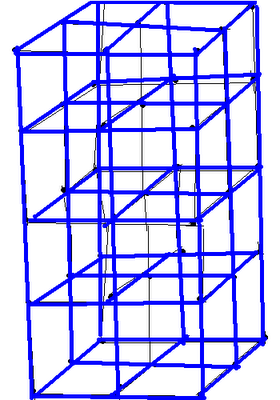
By eliminating all of the z-axis lines, aside from those on the edge of the board, you end up with some intersections with five liberties, most with four, and corners with three. Further elimination of some lines on the faces allow us to limit any location to having only four liberties. Using this system you should choose the optimal board dimensions to have the board make structural sense (unlike my example):
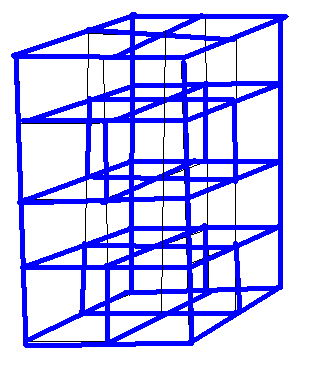
Actually, if you simply play only on the faces of the cube, you end up with a close approximation of a plain Go board, with no more than four liberties from any location. While that is a step "up" from a traditional Go board, it doesn't give me the real feel of three dimensions.
(A variant for this would be to play on three nested but completely separated cubes. This would be like playing three games of Go simultaneously on three different sized boards, where you can decide on which board to move each time it is your play. While a tad more confusing, it doesn't really add anything to the experience.
Another very strange variant would be to play several dozen games of Go simultaneously, where each plane represents a different game, and a single stone is placed simultaneously on three boards.)
I then went on-line to see what had been done with 3-D Go already. There is a three dimensional Go game on Sourceforge, but it simply uses the 5x5x5 cube shape.
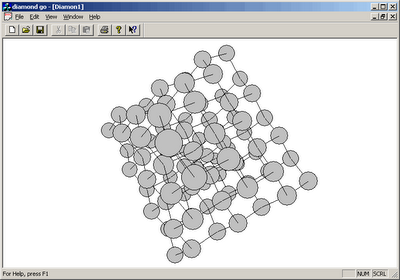
A more interesting approach is Diamond Go, which uses a strange crytalline latice structure in such a way that a true Go experience is recreated in three dimensions. Each location has four, three, or two liberties.
Ishihama Yoshiaki also examines several variations on three dimensional boards that produce playable experiences similar to the two dimentional version, including some really funky board shapes.
Funky.
Links:
Maksim points me to a report exploring games and health, including a game Glucoboy that helps you maintain the body's ideal blood sugar level for diabetics:
Speaking of games and the body, Columia University and the University of New Mexico have got DNA based computers playing and winning Tic Tac Toe.
Yehuda
Update: Bernie points to a Torus shaped Go board, no corners or sides.
Variations on Go: Including other rules, other boards, other pieces, and ways to include a third or fourth player.
Other variants
And even more variants at Sensei.
Before looking at these pages, my first thought was 3-D Go. I honestly don't know why.
The biggest problem was also obvious to me: a simple cubic board would have too many locations that each have six liberties, making capturing a veritable nightmare. I played around with the idea of using Tetrahedrons to solve this (d4's), but it didn't really work out.
I then thought about trying the cubic board, but simply eliminate some of the lines so that most of the locations still have only four liberties. Something like this:

By eliminating all of the z-axis lines, aside from those on the edge of the board, you end up with some intersections with five liberties, most with four, and corners with three. Further elimination of some lines on the faces allow us to limit any location to having only four liberties. Using this system you should choose the optimal board dimensions to have the board make structural sense (unlike my example):
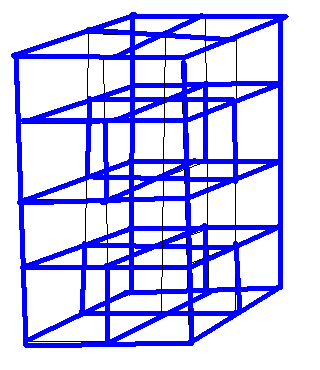
Actually, if you simply play only on the faces of the cube, you end up with a close approximation of a plain Go board, with no more than four liberties from any location. While that is a step "up" from a traditional Go board, it doesn't give me the real feel of three dimensions.
(A variant for this would be to play on three nested but completely separated cubes. This would be like playing three games of Go simultaneously on three different sized boards, where you can decide on which board to move each time it is your play. While a tad more confusing, it doesn't really add anything to the experience.
Another very strange variant would be to play several dozen games of Go simultaneously, where each plane represents a different game, and a single stone is placed simultaneously on three boards.)
I then went on-line to see what had been done with 3-D Go already. There is a three dimensional Go game on Sourceforge, but it simply uses the 5x5x5 cube shape.

A more interesting approach is Diamond Go, which uses a strange crytalline latice structure in such a way that a true Go experience is recreated in three dimensions. Each location has four, three, or two liberties.
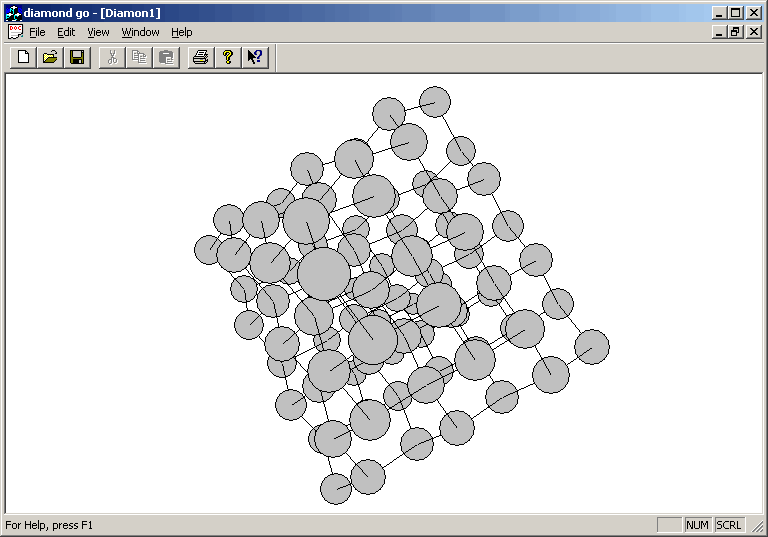
Ishihama Yoshiaki also examines several variations on three dimensional boards that produce playable experiences similar to the two dimentional version, including some really funky board shapes.

Funky.
Links:
Maksim points me to a report exploring games and health, including a game Glucoboy that helps you maintain the body's ideal blood sugar level for diabetics:
Glucoboy is a glucose meter that can be inserted into a Nintendo Gameboy. The product operates independent of the video game system but downloads video game programs that are contained within its circuitry into the Gameboy as a reward for maintaining good blood sugar control. With the patient being responsible for so much of proper diabetes management the Glucoboy carries an essential dual role, providing accurate medical diagnosis for the disease as well as an incentive delivery platform which serves as a key portal for obtaining patient-critical medical data; the foundation for fully automated, individualized, disease management program.There sure is a lot of new research going into how to marry games and health.
Speaking of games and the body, Columia University and the University of New Mexico have got DNA based computers playing and winning Tic Tac Toe.
Yehuda
Update: Bernie points to a Torus shaped Go board, no corners or sides.
Sunday, October 15, 2006
"One has a stronger hand when there's more people playing your same cards."
Links
Gosh, so many links, I don't know where to start.
Let's start with the title quote, which is some sound strategic card playing advice from our American president, George W. Bush. This quote, as well as many other well-known sayings of his, is also an exemplary example of fine grammar.
The above was quoted on a recent Daily Show, which also provided a reference to Kuma War Games, a site that specializes in bringing out games about real world conflicts with as little time lag as possible. In one instance, they were even able to bring out a game about a conflict while it was still happening, so you could shoot bloody murder on your screen while real people were also dying at the same time. What fun!
For other news on war games, here's a large site I managed to overlook until now, The Wargamer.
Speaking of overlooking, I missed this lovely article back in July, about obsessive board gamers (Euro gamers, actually) flunking out of school.
A Frederiscksburg, VA newspaper waxes nostalgic about board and card games.
A Fort Wayne newspaper informs us about the Bible version of Apples to Apples and a slew of really bad Jewish board games,
Here we have some Gothic themed paper board games (scroll down).
Wikipedia has a game themed version called eGamia. Most of the entries are about video games, but they have some entries about board games. The entries could use some fleshing out.
Meanwhile, some Scottish children are being taught to play Chess in nursery school at the age of three.
Books
The Greatest Games of All Time by Matthew Costello is a nice book and a great read, with stories about games from history. It's from 1991, so it's knowledge of video games ends with Nintendo and it's knowledge of board games ends with Sid Sackson. One whole chapter is devoted to Miniature Golf, which only after you think about it do you remember that, yes, it used to be a "craze" in America.
Most chapters also contain games that you can photocopy and play, including versions of classic games and some unique variants.
I asked Tom Vasel about his books with George Phillies (here and here). Tom says:
Gilad of Modiin will be hosting a games evening this Tuesday evening.
Nadine has sent me the files she used to create the Jewish themed version of Ra. If you wanted a copy, email me. The files are about 1MB altogether.
Yehuda
Gosh, so many links, I don't know where to start.
Let's start with the title quote, which is some sound strategic card playing advice from our American president, George W. Bush. This quote, as well as many other well-known sayings of his, is also an exemplary example of fine grammar.
The above was quoted on a recent Daily Show, which also provided a reference to Kuma War Games, a site that specializes in bringing out games about real world conflicts with as little time lag as possible. In one instance, they were even able to bring out a game about a conflict while it was still happening, so you could shoot bloody murder on your screen while real people were also dying at the same time. What fun!
For other news on war games, here's a large site I managed to overlook until now, The Wargamer.
Speaking of overlooking, I missed this lovely article back in July, about obsessive board gamers (Euro gamers, actually) flunking out of school.
A Frederiscksburg, VA newspaper waxes nostalgic about board and card games.
A Fort Wayne newspaper informs us about the Bible version of Apples to Apples and a slew of really bad Jewish board games,
Here we have some Gothic themed paper board games (scroll down).
Wikipedia has a game themed version called eGamia. Most of the entries are about video games, but they have some entries about board games. The entries could use some fleshing out.
Meanwhile, some Scottish children are being taught to play Chess in nursery school at the age of three.
Books
The Greatest Games of All Time
by Matthew Costello is a nice book and a great read, with stories about games from history. It's from 1991, so it's knowledge of video games ends with Nintendo and it's knowledge of board games ends with Sid Sackson. One whole chapter is devoted to Miniature Golf, which only after you think about it do you remember that, yes, it used to be a "craze" in America.Most chapters also contain games that you can photocopy and play, including versions of classic games and some unique variants.
I asked Tom Vasel about his books with George Phillies (here and here). Tom says:
One of the books contains about half of my interviews, the other contains 126 of my rules explanations from reviews. George comments in and around both books. Both books are aimed at video game designers, in an attempt to broaden their horizons by looking at designing in a different medium - board games.Local News
Gilad of Modiin will be hosting a games evening this Tuesday evening.
Nadine has sent me the files she used to create the Jewish themed version of Ra. If you wanted a copy, email me. The files are about 1MB altogether.
Yehuda
Thursday, October 12, 2006
Learn to Love Board Games Again:
100+ Ways to Rejuvenate the Games You Already Own
New Games ... For Free!
Do you have dusty games in the closet that you grew bored with years ago?Do your kids beg you to play with them, but you can't stand another round of roll-the-die/pick-a-card, move-your-piece, do-what-the-space-tells-you-to-do, and somebody wins a few hours later?
Do you want to add fun and excitement to your life without spending a dime?
In the last fifteen years, board game designers and dedicated board gamers around the world have learned a thing of two about what really makes board games fun for adults. The principles used in modern board game designs can be used to help you rejuvenate your old board games. You, too, can learn to love board games again.
It's time for you to break out the old board games. But I PROMISE you: you're not going to play them the way you remember playing them! This time, you're going to have fun with them. All it takes is a little preparation: no more than ten minutes for any game.
All you have to do is select a few new rules, and possibly write down some instructions on some index cards, for your old game to become fun again. It's like getting dozens of brand new games, better games ... for free!
Follow along with me; you're in for one hell of a ride.
The Problem With the Old Games
 The main problems with those old board games are:
- They're too long.
- You've already read all the cards. It's just the same game each time you play it, and the game never changes.
- There's an unfair advantage for the first or last player.
- There are no real decisions to make - it's mostly dice rolling, or doing what the card says.
- You can be eliminated early in the game - and that's the best outcome for some of those endlessly long games!
- Worse yet, you may have to keep playing for hours with no chance to win.
- There is no interaction between the players; there's nothing to do while others take their turns.
New Rules for Old Games
The following rules are designed to address all of the above problems. They are organized by topic.Disclaimer: I didn't make most of these rules up, myself! I am borrowing them from a whole bunch of really great games, including games by designers such as Klaus Teuber, Reiner Knizia, Alan Moon, Sid Sackson, Andreas Seyfarth, and so on. For more information on better games, as well as references and additional reading material, please see New Games at the end of this post.
Starting Player
In some games, the player who starts has a decided advantage over the other players. In other games it is the last player who has the advantage. Many games do nothing to address this problem, but solutions are not that difficult. Here are a few options:
- AuctionA simple auction can be used to determine first or last player. Players bid either money or points, depending on the game, and the high bidder pays the amount or loses points in order to gain the advantage of paying first or last. Alternatively, all seats could be up for auction. No matter what the advantage of first player, some price paid will equalize that advantage. For more information on auctions, see Auctions, below.
- Initial FavorsGoing first/last is an advantage, so why not offer other players an equal advantage? For instance, additional advantages could be starting with extra money, a few extra points, starting anywhere you want on the board, a bonus spare card to use when you want, the ability to re-roll one die roll during the game, or something similar. Create a set of cards with advantages, including "going first/last". Make one more than the number of players, and either deal them out before each game or let players pick them. If some get picked more frequently than others, you will know that you have to rebalance them properly.
- Advantage/DisadvantageIn some games, you can balance the starting positions by granting disadvantages to players earlier in the player order, or advantages to players later in the player order. For instance, the starting play may receive less money to start with, with progressively more money being given to each player in turn around the player order. The exact amount of money or points depends on the game. The best measure is to try some reasonable amount and see if all players still only want one position (first or last). Continue to adjust this amount until all positions are equally attractive. In games without money, sometimes points or some other advantage can be used to achieve the same result.
Special Powers
Most games have a decidedly short shelf life for one reason: monotony. Sure, the dice roll differently and the cards get picked in a different order. Wouldn't you love to have a game that is vastly different every time you play it?
There are several easy ways to have the game change each time you play, One way is to create special player powers.
Grab some index cards and write down a special rule-breaking power on each one. Some examples:
- The player gets to roll twice, choosing the best roll each time.
- The player can add or subtract 1 from his or her roll.
- The player starts forward of other players on the board by 5 spaces.
- The player can start from any position on the board - in games with tracks to the end, the player then needs to loop around and return to his or her starting position to win.
- The player gets an additional privilege, or double the privilege, when landing on certain squares.
- The player gets a free card whenever he or she lands on a square of a certain color.
- The player is allowed to choose between two questions, rather than only one.
- The player picks two cards and chooses one when picking a card.
- The player starts with an additional piece, additional money, or additional points.
- Whenever the player successfully performs an activity, such as selling a property, he or she gets an additional 10% bonus in cash.
- Once per round, a player can veto the use of any other player's special ability by losing a point or paying some money to the bank.
If you create only ten special power cards for a four player game, then you have created two hundred and ten games out of only one! With only another ten special power cards, you will never play the same game twice.
Before starting the game, distribute special power cards in one of the following ways:
- Randomly
- Player's choiceIf the same cards are picked over and over, this means that the card's powers are not yet balanced.
- AuctionSee Auctions, below.
Limited Ability Cards
This is the same as special power cards, but these cards are used only once and then discarded. Limited ability cards can be more powerful than special ability cards, because they are only used once. For example:
- Set the die to whatever number you want.
- Take an additional $100 from the bank.
- Move your marker to another square of the same color.
- Pick an additional action card.
Round Rotation
We all know how a game turn works: I go, and then you go, and then you go, and so on. Like clockwork. It's simple and it's fair, but it doesn't have to be this way.
A more interesting turn progression can add excitement to a boring game. Now you don't necessarily know if you will be going next after three other players go, or maybe earlier, or later.
How do you add intrigue to turn order, while still keeping it fair and easy?
- Rotating Starting CardThe first player gets a Starting Card. After each player gets a turn, the Starting Card is passed one player to the left. The new starting player then takes a turn, and so on. It's a funky ordering (1234234134124123), but it's simple and fair.
- AuctionAfter each player has a turn, put each place in the turn order up for auction. For more information, see Auctions, below.
- PurchaseGoing out of turn can be a card that can be purchased for a set amount, or an increasing amount each round.
- TradingTurn order can be something that is traded along with other items in the game. For instance, you can give away your next turn to another player for $200.
Round Order
On every player's turn, you do A and then B and then C, and then D. Ho hum. Let's see what we can do about that.
- RolesLet's say that each player's turn in a game consists of something like: 1) roll the dice and move your piece. 2) Pick and play cards. 3) Trade with other players. 4) Buy and sell properties. For a four player game, create four "role cards", one for each of these activities. Using the above Starting Card system, the first player chooses a role and then all players, in order, do the task on the role. Then the next player chooses one of the other roles and all players do that task. And so on, until all players have chosen roles. The roles are then returned to the center, and the Starting Card passes to the left, as usual.
Using this method, the savvy player can choose actions that, while everyone gets to do them, they timing in choosing them benefits the selector more than any other player.
For spice, add another role, such as "Take $100 from the bank" or some of the other limited ability cards described above. This way, not every action will necessarily be taken each round. The great game called Puerto Rico uses this system, and adds yet another feature: unchosen rolls get incentives placed on them, such as $50 each time they remain unchosen. On the next round, anyone choosing that roll gets the additional benefit of the money on the role. - PurchaseYou could separate the activities in a round into pieces, as we did above. Then, each player can do them in any order that he or she wants on their turn. Additionally, you can let a player do actions more than once, by having to pay some increasing amount for each time beyond the first. This amount should be sufficient to prevent players from simply winning in one turn!
- Action PointsSimilar to the above, each player can be given a set of points with which to buy parts of their turn each round. E.g. you get 5 points. Rolling the die and moving costs 2 points, picking a card costs 2 points, and getting $10 from the bank costs 1 point. Players can do whatever they can afford in points each round.
- NegotiationPlayers could be able to sell off parts of their turns to other players in exchange for fixed prices or a negotiated price. For instance, I could sell picking the card (before it is picked!) to another player for $10. Sorry, no refunds for bad cards!
- RandomizedYou could have players pick their round order from a stack of round order cards.
Board
The board comes with the game, but that doesn't mean that you have to stick with it to play the game. You can draw more paths on the board, cross some out, put two boards together to make a larger one, or cover over half of one to make the game shorter.
- A fantastic way to make games like Othello, Checkers, Chess, and so on more interesting is to play them on larger or smaller boards. Instead of 8x8, try 6x6, 10x10, or 12x12. Try 10x8 or 12x8. For Othello or Checkers, you simply need a few extra pieces.For Chess, you can add not only more of the same pieces, but you can also add new pieces that have different abilities, such as pieces that can move three spaces in any direction, swap places with any other piece on the board, be summoned to right next to any other piece, jump three spaces one way, and two any other, and so on.
- The best change you can make is to get rid of any squares that say "Do this!" which offer no decision making to the players, and instead replace them with decision making squares. This could be as simple as "Do this OR do this!", or it could be as complicated as "Before rolling the die, pay any amount of money; you add +1 to the die roll for each $100 that you paid." You can add all sorts of other decision squares: "Trade one of your houses with another player", "Pick a limited action card from the deck and auction it", or "Draw three cards, pick one to put in your hand, and put the rest on top of or underneath the deck in any order".
- For some games, you can create random boards. For instance, say a board has 100 spaces. Take 100 index cards and duplicate the spaces, one on each card. Then lay them down in a random order before each game starts. Each game will play differently.
- Another thing you can do with boards is make a board that changes during the game. For instance, get some construction paper in an assortment of colors and cut out squares equal in size and color to the game's spaces. Now add the following rule: whenever a pawn lands on a red square, it turns orange. From orange it turns yellow, then green, blue, purple, and back to red. Using this mechanic, the game may start off looking the same, but it won't stay that way for long.
- Here's another secret of better board games: game flow. Most games are the same activity, over and over, from the beginning until the end. A better games flows, where the beginning of the game is different from the middle of the game and the end game.It's not that hard to achieve game flow for many otherwise dull games. For instance, let's say that pawns landing on certain spaces at the beginning of the board gain 1 chip. Pawns landing on those spaces in the middle third of the board gain two chips, and pawns landing on those spaces in the final third of the board lose five chips. The winner is the one with the most chips when any pawn crosses the finish line.
You've now got a game with a defined narrative flow: small but important early gains, large gains in the middle, and then trying to hold on to your winnings before the end. Another good thing about this game is that anyone can win right up until the end. In most games, that guy way out in front is uncatchable. Here, he may be in front, but he may also suddenly lose all of his chips while the ones that are hanging back keep theirs.
Pieces
If you come away with nothing else from this post, I want you to come away with this one, the simplest and easiest change to make to any roll and move game: Play with more than one pawn.
By playing with two or more pawns, you take the simplest action - rolling the die - and change it into a decision making skill - which pawn do you want to move? It's that easy.
But let's not stop there.
Why should all of your tokens be the same? A Captain token works the same as any other token, but it has a different effect. For instance, if a Captain lands on a space, the rewards or penalties for that space can be doubled. Or if you have a game where you send another player back to the start by landing on his token, only a Captain token can send another Captain token back to the start. Any other token landing on a Captain token is instead sent back to the start itself!
You can give each player a Captain token as one of their starting tokens, or you can allow players to upgrade their tokens to Captain tokens at any time during the game, on their turn, or after landing on a certain colored space. Upgrading should be expensive, but not too expensive.
Of course, you don't have to stop at only pawns and Captains. You can give each player a veritable army of pieces, each with its own special rankings and abilities. For most games, however, three types is enough, or you risk the game becoming too complex.
If you play with multiple pawns, you can then have them interact in various ways, like little armies. For instance, two pawns together could make a square impassable. Or you could allow a player to move one pawn to a space adjoining another pawn instead of taking his or her regular turn. You could add rules for pawn positioning. For example, if all of your pawns are on a certain color, do something or gain something. Or if your paws surround an opponent's pawns, take something from them or eliminate their pawn. And so on.
Movement
Probably the biggest icon associated with board games is the ubiquitous die roll. You roll the die, you move your piece, you do what the space says (pick a card or answer a question). And probably the biggest cause of boredom associated with board games is this very mechanic.
We've been doing this for hundreds of years. Isn't it about time we bring our games up to the twenty-first century? And by that, I don't mean simulating a die roll using a computer!
- Draw DeckMake a batch of 36 cards, with each of the 36 possible dice roll combinations on them. Shuffle. You may optionally remove up to five cards at random. Each player then picks a card instead of rolling. When the deck is exhausted, reshuffle and repeat. While this method is not much better than dice rolling, it at least ensures a roughly fair distribution of rolls for each player.
Consider giving each player his or her own deck of die rolls. Each player is still picking randomly, but each player is going to be assured roughly the same total results over the course of the game. That means that the way a player plays is going to have more effect than the numbers that come up on the dice. - Card HoldingSimilarly, unless you're playing a game where the highest number is always better, give each player a hand of three cards, or a set of three die results to choose from on each turn. A player then picks back up to three cards at the end of his or her turn. This can also be used as a way of limiting turns that can be played out of order, if you are using that; you only pick back up to three when play passes to the next player.
- Draw vs drawA game designer named Bruno Faidutti wrote about the difference between drawing a card and then playing vs playing a card and then drawing. The former adds some more excitement to the game, at the expense of being slightly less strategic. A player may have to think longer on his or her turn if he or she is suddenly presented with a new option. The advantage of the latter is that you have every other player's turn in which to think what you will do next.
- NegotiationPlayers could be able to negotiate movement. As an example, let's say that there is a pool of 30 movement points available to all players for one complete set of rounds. Players can negotiate with each other how many movement points they get, through trading or requesting favors. If deals cannot be made, the points are distributed evenly among the players, perhaps with a penalty.
- Action pointsMovement is made for action points. As an example of how you can use action points for movement, you could give each player ten action points to use on each of his or her turns: one point moves your token one space, three buys you a card from the deck, five buys you $100, and ten points plus $1000 buys you an upgrade to a Captain token. Experiment. Be warned that action points can lead to apparent brain death in some indecisive players (what we call "analysis paralysis".)
- PurchaseYou could allow each space moved to cost a certain amount. For instance: Not moving at all gains you $10, moving one space is free, two spaces is $10, three is $30, four is $60, and so on.
- Push your luckUsing this variant, you still roll dice, but you can roll as many times as you want before moving your piece. You can stop whenever you want and move the total of all dice rolled. However, if you roll a 1, you lose your entire turn (or at least your entire movement) and cannot move at all.
Action Cards
This is just another word for limited activity cards. These may be familiar to you from Monopoly, where landing on a certain space may give you a Chance or Community card.
The difference between those cards and these cards is that Action cards offer you choices. Making the better choice then becomes a learning experience.
You can either replace the action cards that you already have in your game with new ones, or you can add new action cards to otherwise blank squares on the board.
If someone lands on the space, or buys the card, or whatever, you can either give the card to the player, offer the player a choice of one card from three, or turn up one card for each player in the game (or each player minus or plus one) and auction off the cards. See Auctions, below.
Using the "turn up one for each player" method, you can also have "bad" cards. Each player then has to join the auction in order not to get a card.
Players can "draft" the cards: Turn over twice as many cards as the number of players. The player whose turn it is takes the first card, the player on his left the second, and so on until reaching the player on his right. Then reverse the direction. Using this method (called Rochester draft), the current player gets the first and last card.
Example action cards:
- Choose one: take $100, move your pawn three spaces in any direction, or roll two dice on your next move.
- Pick an item out of play and auction it off. If you win the auction you pay the bank. If anyone else wins, they pay you.
- Draw three negative cards and hand them out to three different players any way you choose.
- Lay a bridge down anywhere on the board. This bridge connects to spaces on the track with a shortcut and can be used by any player who lands on one of the spaces.
Missions
Similar to action cards, missions are a staple in certain types of games, such as war games and train games.
Create missions on cards like you create action cards. Example missions: occupy the following three spaces on the board, have one of your pawns in each area, collect three cards of a certain type, land on an opponent's Captain piece, etc.
Each mission card gives a reward for completion, such as points towards winning, money, a special bonus item, or some such. You can have easier and harder mission cards with worse and better rewards.
Mission cards can be made available to the players in a number of ways:
- Flipped up at the beginning of the game. The first player to complete a mission takes the card.
- Two or three dealt randomly to each player at the start of the game. Mission cards can be kept open or closed. You may be dealt a new one every time you complete a mission.
- You could allow players to buy mission cards for a price, or after a certain event.
- Mission cards can be auctioned off at certain times during the game. See Auctions for more information.
Trivia
If you already basically know all of the cards in a trivia game, you can still play the game by adopting the mechanics of the game of Balderdash, itself adopted from the old game of Dictionary.
Each time you read a question, have each other player write what they think is the right answer OR any answer that they think might fool other players into thinking is the right answer on a piece of paper. You write the correct answer on a piece of paper. Collect and mix up the answers, and then read them aloud. Have each player pick which he or she thinks is the right answer.
Each player gets a "point" if they wrote the right answer, or a "point" if someone picks their answer if it was wrong. Play to a certain number of points.
For games where you've seen all the questions, you may find it suddenly hard to remember the right answer. Sure, if no one tries to confuse you, you can remember a certain obscure date. But if someone writes August 8 and the real answer is August 9, you may get confused. And many of the answers are likely to be hilariously wrong.
Purchase
In any simple game of roll and move, you can make the game more interesting by allowing players to purchase things that they generally get automatically. For instance, if a space says that you get a card, you can give each player money at the beginning of the game and assign point values to each card.
Players then have a limited amount of times during the game that they are allowed to get cards, and must choose when to get them. Alternatively, you can have a constant pool of flipped up cards, and allow a player to buy any face up card for it's price when they would normally get a card. This gives even more decision opportunities.
As mentioned elsewhere, you can also offer face up cards for auctioning or drafting.
You can flip up a number of cards and then negotiate with other players as to who gets what. You can set a time limit, so that if players don't agree within one or two minutes, no one gets any cards. Or you can give out the cards with a penalty if players can't agree.
You can also have one player divide a number of cards into piles, and then have another player choose which pile he or she gets and which one he or she leaves for the dividing player.
Conflict
If your game has conflicts, such as the ability to knock one player back by landing on his or her space, you can offer other choices to the players.
A player may be able to buy insurance from the bank; one insurance card is good for avoiding one setback. Actually, you can offer insurance in almost any game where something bad can happen to a player.
Alternately, you may be able to buy enhancing strength points. When conflict occurs, each player decides how many points to add to the conflict, and the higher value wins. You can have the attacking player decide first, and then the defending player, or you can have both sides choose secretly. You can also opt to allow uninvolved players to toss strength onto either side of the battle.
You may be able to negotiate truces with other players, where your pieces won't send his or hers back for a certain number of turns. You have to decide before the game starts whether these type of deals are enforceable!
Auctions
I've mentioned auctions many times in this post, because auctions are a great way of keeping all players involved at all times. What you may not know is that there are many types of auctions that you can use in your games. Try them each out until you find one that you like, or use a different type each time you play.
- Blind BiddingThis covers a whole genre of different types of auctions, but the essential idea is that every player at the table takes a certain amount of money, or writes down a certain number of points, and then all players reveal the bids at once.
- CircleThis is a traditional circle auction, each player in turn either upping the bid or passing.
Again, like blind bidding, you can decide that only the top bidder pays. A very nasty variant here is that the top two bidders both pay but only the top bidder gets anything.
In this version, you can give the first player to withdraw from the bidding either a bonus or a penalty. - FreeformA traditional freeform auction, where each player shouts at any time, and someone says "Going once, going twice, sold!"
- ChineseI don't know where the name comes from, but in this variant, each player secretly assigns any amount of money or points to any or as many items as they want. Each item is then revealed, and the person who paid the most for that item wins it. Or, each point or dollar spent on an item gives you an additional chance of winning the item, which is determined by drawing from a hat, but you may end up with nothing if you have bad luck.
- Combined biddingIn some cases it may make sense for players to be able to combine bids. For instance, if there is a group of items being auctioned, two or more players can combine their bids, splitting the results if they win.
- Auction tokensYou can give each player a set of auction tokens with which to bid, each token having a different value. If a bid is successful, the bidder loses the token. That leaves the other players better chances of winning future auctions.
- NegativeYou can have people bid on not acquiring a bad item. Or, you can set the price of an item, and lower it one step at a time until someone is willing to buy it.
- One per playerYou can have one item available for each player. Each player will get one item, the highest bidder picking the first item, and the lowest getting whatever is left over.
- FutureYou can have the results of one auction influence future auctions. For instance, the second highest bidder may be given a bonus to his bid for the next auction. Or the lowest bidder.
- Divide and ChooseWhile not exactly an auction, you can have one player divide items into separate piles, and then have the other players choose which piles that want. The divider gets the last unchosen pile.
After the bidding, there are many ways to determine what happens next:
- The top bidder pays the bid and all others keep theirs.
- The top two bidders lose their money, but only the top bidder gets anything.
- All players lose their money. If players were bidding on multiple items, the top bidder gets first choice, and so on.
- Same as above, but the bottom bidding player gets his or her money back. You can also let anyone who bids 0 get nothing but receive something small as a compensation.
- Or, lowest bid could get nothing at all.
- And so on.
Trading/Negotiation
Trading and negotiation are very much like auctions, only more than money or points are being exchanged for one or more items, and the parties are not required to accept the highest offer. Instead, multiple items, money, or points can be traded for multiple items, money or points. Basically, anything the traders can agree to within the bounds of the trading rules.
You will want to determine before the game starts what things can be traded and what cannot be traded. For instance, can houses be traded? Turns? Future promises of assistance? For future items, can players renege on their promises, or are they bound to keep them?
A good practice is to limit promises to only a single game round, which is much easier to remember. For players with sensitive temperaments, you may also want to exclude promises and behavior, and limit all trading to only physical items that can be transferred between player instantaneously.
Can non-involved players also take part, or is trading only between two participants? Can you trade only on your turn?
You will want to set time limits for any trading session, as the open nature of trading can tend to drag a game out.
Set Collection
You already know set collection from Monopoly, where you have to get a set of two or three properties from the same group. You can add this feature to most games.
For instance, you can keep track of how often a certain number is rolled or card is picked, and give a special bonus for the third or fourth time.
Normally cards are simply picked and then played. If you allow players to pick cards and hold them for later use, you can then give bonuses for playing multiple cards of the same type at once. For instance, if the card says "Collect $20", you can have two cards of that type played at once collect $50. Now a player has to decide whether to play the card now, because he or she needs the money now, or hold the card for a potential greater reward.
The same can apply to most any type of item in a game.
Game-End/Scoring
So many games are just too long. And I admit, adding new features like the ones above could potentially make them even longer.
Furthermore, most games are pretty one dimensional. You try to get to the end of the board. Or you try to get the most points. That doesn't leave many avenues for exploring different strategies.
Here are some ideas to help solve these problems. We'll start with how the game ends.
- You can end the game after a certain number of rounds. E.g. twenty times around the table, and that's it. Whoever has the most points or money at the end wins.
- You can add a card (or mark a card) as the game's end. At the beginning of the game, mix the deck and then separate it into two parts. Mix the game ending card into one half of the deck, and then place that half underneath the other half. Now the game will end somewhere near the bottom of the deck, but the exact time will be a surprise.
- You can have the game instantly end on some event, such as the third time a 12 is rolled on the dice, or as soon as someone lands on a green square from a blue square.
- I don't recommend limiting the game to a specific time (such as one hour) as that may encourage people to drag the game out on their turns if they are winning.
- First of all, you can add additional scoring mechanisms to the traditional one used in the game. For instance, you could say that holding a certain card at the end of the game is also worth ten points or ten dollars. Or having your pieces on certain squares.Or you could keep track of certain events during the game. For instance, every time you land on an opponent's piece is worth five points; on their Captain is worth ten points. At the end of the game, add these points to your total.
- You may have to collect various different things during the game, and your final score is whatever you have the least of. For instance, if you have 2 blue coins, 4 red coins, 5 green coins, and 7 yellow coins, your score is 2. That keeps you striving for balanced items as the game continues.
- Another interesting twist is the required game token. You can have any score you want, but you can't win the game at all unless you have also fulfilled some other condition, such as having acquired a certain type of card, moved your pieces onto a certain square, or gained one of each type of favor. It is best not to use something that relies too much on memory, unless you will be writing things down.
- You can also simply change the scoring altogether. Instead of scoring based on who reaches the end first, you can score based on what squares you landed on on the way, for instance: 1 point for each square of a different color, but each additional square of the same color is an additional 2, 3, 4, etc points. Or vice versa, giving bonus points for additional colors, and only one point no matter how many squares of one color that you land on.
Examples
Here are some examples to get you started:- Candy Land"Not another game of Candy Land," you may think to yourself, as your daughter pulls out the candy-coated box yet again. If you've played this game one too many times with your child, he or she is ready to take it up a step. It should be just a little challenging, but still not too hard for a young person.
Basic: First of all, each player gets two pawns, and must decide which pawn to move each turn. Secondly, each player has three cards face up in front of him or her. On his or her turn, a player decides which card to use, moves one of his or her pawns, and then draws another card. The game is now just a little more bearable.
Intermediate: After twenty games of that, you can add one more rule: a player can toss out two cards of the same color to move to the next square of any color, but they only draw back one card. So you can only do it twice during a game, and your hand loses flexibility. - ChessYou don't mind your grandson wanting to play Chess with you, but it's really not a challenge for you. How do you keep from being bored?
Basic: First you make the board 10x8. You get two additional pawns, and your grandson gets two pawns and two Footmen, each of whom can move either two spaces forward or three spaces sideways. If a footman reaches the other side of the board, it can promote to a Rook. Your grandson is still learning the basics of strategy and tactics, and now you have a new set of interesting problems to handle.
Intermediate:Your grandson gets a special power: he can move two pieces, one after another, so long as neither takes off your King. You also gain a special power: you win if you take off his King OR Queen. - Chutes and Ladders.Whoopee, another roll-and-move game with no decisions to make. Let's spice this one up.
Basic: Each player gets a special power: one person picks from the deck of special powers and gets: "Each time you land on a multiple of nine, you gain an additional die to roll on each of your following turns. You choose which die to use when moving." Another player's power is "If you land at the bottom of a slide, you may climb two levels and jump off on either side."
Intermediate: That's still a bit of a bore, so add this rule: you can move either forward of backwards on your turn. You get 5 points for landing on a square that is a multiple of five, and twenty points for ending the game by landing on the last square. The game is over in any case after exactly thirty turns by both players, unless someone ends it by landing on the last square. Add up your points at the end to see who wins.
Advanced: 1) Each player has three pawns, a Captain and two soldiers. 2) In the upper half of the board (51-100), a player can land on another player's piece. A pawn landing on a pawn gives 5 points, and knocks the attacked pawn straight down two levels. A pawn landing on a Captain, or a Captain landing on a pawn gives the Captain 5 points and knocks the pawn straight down 4 spaces. A Captain landing on a Captain gives 10 points and knocks the Captain straight down 2 levels. Follow whatever rules are involved on the space on which the knocked down piece lands. 3) Whenever a piece lands on a space, cover it with a white piece of paper. If a piece lands on a space with a white piece of paper, it gets a free move, and the white piece of paper becomes a black piece of paper. Skip spaces with black pieces of paper when counting for normal movement. If a piece gets knocked down and falls on a space with a black piece of paper, it continues falling another level. If this results on it falling off the end of the board, the pieces is eliminated from the game. In this variant, you don't have to have a turn limit, because the game will eventually end when the spaces are all covered with black paper. - Checkers (Draughts)This is an old standby, maybe a bit boring.
Basic:Start by trying the game on a 12x12 board, and two kings in your back row.
Intermediate: Each player has a secret mission to control two squares in the opponent's second row. You win the game in either the normal method or by accomplishing your secret mission. - Sorry!This pick-and-move game provides for few choices during the game, but is a great springboard for some deeper fun.
Basic: each player holds a hand of three cards. On the player's turn, he or she picks a card and then plays one.
Advanced: Auction off starting positions using points. Each player has four pieces: a spider, a goat, a swan, and a dog. The spider leaves a web marker on any space from which he moves. Any piece other than a spider that lands on a web marker is stuck; instead of taking your turn, you may remove a web marker from a piece by playing any card. The goat knocks a piece back whenever he overtakes any other piece, even if it doesn't land on your space. The swan cannot be blocked, and if you land on him, he bats you back ten spaces. The dog moves to any other one of your other pieces on the board if you play a five and choose to move him.
If you land on a colored square, a mission card is put up for auction (players bid the number of turns they are willing to give up for it). It is a simple round auction, where only the winner pays. The mission cards require the player to arrange their pieces into various pattern on the board. Completing a mission gives you a free move as well as four points. Each piece you get "home" gives you five points. The winner is the player with the most points when someone gets all of his or her pieces home, or by the end of the fortieth round, whichever comes first.
What's Next?
I hope you learn from this article that there's a lot more out there in board gaming than you may remember.Board games still have a lot of things going for them: they are social, they are intelligent, they require patience, they are cheap, they are portable, they don't need electricity, and they teach good skills. They can also be a whole lot of fun, if you're willing to make the leap I did into the modern world of board games.
Very few of the above ideas are wholly mine, most come from some great games and gamers around the world who are still creating board games. You probably haven't heard of them, because you thought people only play video games now. But there are more than ten million people who can prove you were wrong!
New Games
Some of the games whose mechanics I included above include: Puerto Rico by Andreas Seyfarth, Tigris and Euphrates, Ra, and Modern Art, by Dr Reiner Knizia, Tikal by Dr Wolfgang Kramer, Settlers of Catan by Klaus Teuber, Can't Stop by Sid Sackson, San Marco by Alan Moon and Aaron Weissblum, and many more.
These games are available at local hobby game stores around the world, or online at places such as Funagain Games or Time Well Spent.
You can find out more about these games, and many, many others, at Board Game Geek, the Internet's largest site for board game information.
Books
Great minds think alike. A wonderful book with similar ideas about renewing old board games is New Rules for Classic Games
by R. Wayne Schmittberger.Other great books include a series of books by America's godfather of game design, Sid Sackson
. Click to find his books A Gamut of Games, Beyond Solitaire, and many others.Enjoy,
Yehuda
Subscribe to:
Posts (Atom)