Showing posts with label Judaism. Show all posts

Friday, October 08, 2021

Holocaust Games

Not everyone shares my objection to Holocaust used as a subject in fictional films, but the concept of a Holocaust game draws near universal confusion and condemnation. This is simple enough to explain: most people understand "game" to mean "toy", "play", or "fun", something they don't think should be associated with the Holocaust. (Yet a film being "entertainment" doesn't bother them, go figure.)

To explain this more fully, consider the objective of a player in such a game. You don't want them to play a victim who dies or is tortured, because, even as an educational tool, that is too intense. You don't want them to play a victim who easily survives, because that is not the lesson of the Holocaust. That's just a revenge fantasy. You don't want them to play a Nazi, for hopefully obvious reasons; and anyway, most fictional portrayals of Nazis complete bury the point of how mundanely clean and rational they behaved. And playing as a gun-shooting liberator, such as an American or Russian, barely conveys anything real about the Holocaust.

That does not exhaust all options, thankfully. You can make question and answer games about the Holocaust; a game based solely on questions probably won't be too much fun (or worse, will be too much fun). You can make small, limited games that, through exploration, teach people about specific events of the Holocaust in passing, such as the deportation of a single town. This allows you to keep the game light enough while lightly educating and, perhaps, stimulating a desire to learn more (supplemental reading material, or links, should be bundled with the game, ideally).

Here are a few games that have tackled the Holocaust. I don't include major franchises that touch on the subject within broader WWII fighting games, such as Call of Duty and Wolfenstein. I don't include games where you take on the role of Nazis. I also don't include games that are designed but not yet published, such as Light in the Darkness.

  • Attentat 1942: This walkthrough game intersperses interviews, animation, footage, and stories by survivors with simple gameplay elements. For example, the survivor might describe how she had to hide paper before the Gestapo arrived, and then you are given the choice of where to hide the papers in the room. You job is to be a historical researcher and learn what happened to your grandfather.
  • Through the Darkest Times: This walkthrough of animated scenes depicts Berlin around the time that Hitler is voted into power until the end of WWII. It's narrative presents how his rise to power included the support of the population. You do various small tasks of resistance, although, of course, the end is the same.
  • My Memory of Us: A video game with a fantasy version of WWII, where two kids who are best friends are separated when an evil king (with robots) comes to power. They impose harsh restrictions on one of the kids (the girl) forcing them to wear certain clothing, mocking them, and creating dangerous situations. They only want to play together, and only by working together can the kids reveal their true power.  The game uses cute graphics against black and white dystopian steampunk backdrops of ghettos, garbage, and barbed wire. The story is narrated by Patrick Stewart.
  • The Journey: A children's based story app from the UK's National Holocaust Centre, about a boy who must navigate Nazi rule in the early 1930s until he gets to Kindertransport. Discover hidden objects and fulfill minor objectives.
  • Witness: Auschwitz: An interactive VR experience about the Holocaust, not actually a game as far as I can tell.
  • Rosenstrasse: A tabletop RPG about the only mass public protest by Germans during the Holocaust: non-Jewish women protested loudly and long enough about their Jewish husbands and successfully obtained the release of these 1,300 men.
    memoiAR, a CMU research team, created an augmented reality version of the game called We Choose Each Other.
  • Train: Brenda Romero's fascinating and controversial thought experiment, which is more of an interactive art piece that can be "played". You have to squish little yellow figures into trains until, at some point, a reveal is made to indicate that you are trying to send Jews to a death camp. At this point, the reactions of participants vary: some keep playing, some quit, some try to subvert the game's goals. While this game has been criticized for whitewashing the complicity of the perpetrators of the Holocaust (who knew what they were doing and volunteered to do it), I think the criticism misses the point about people blinding doing things until they receive a moral wake up call. It's a thought piece, in any case.
  • Charnel Houses of Europe: The Shoah: A supplement for White Wolf's Wrath of Oblivion/World of Darkness RPG. A prime example of what you should not do for a Holocaust game. The book gets some points for seriously describing some of the history and suffering of the Holocaust to people who might otherwise never learn about it. It loses all of these points by weaving in fantasy game elements, statistics for NPCs and campaign settings, and essentially (not intentionally, I'm sure) giving neo-Nazis a platform to roleplay the murder of Jews and other undesirables. Not well thought through.

Cardboard Genocide is a research paper from Poland with some other thoughts on the topic.

Thursday, August 16, 2018

My Memory of Us: A Polish Video Game About the Ghettos

My Memory of Us is a game developed by Juggler Games and soon to be published by IMGN.PRO, both of them Polish companies.


The game is set in a fantasy version of WWII, where two kids who are best friends are separated when an evil king (with robots) comes to power. They impose harsh restrictions on one of the kids (the girl) forcing them to wear certain clothing, mocking them, and creating dangerous situations. They only want to play together, and only by working together can the kids reveal their true power.

The game uses cute graphics against black and white dystopian steampunk backdrops of ghettos, garbage, and barbed wire. The story is narrated by Patrick Stewart.


I'm happy that they are not directly using Holocaust imagery, since this tends to end up in the hands of Nazis who enjoy watching Jews lose the game (like they enjoy watching Holocaust movies and rooting for the bad guys).

I don't know exactly how the story plays out. It might be an apologetic for Poland: the main characters are obviously the bad German regime and the two kids, Polish and Jewish, who work together and are both victims. Or it might not. You could gloss over that and simply enjoy the game. Apparently, the game was inspired by the real lives of some of the developers.

HT: Engadget via Boing Boing

Saturday, August 27, 2016

Poem: Headstrong

O golden robed Moses, divinity-defier, is that you levitating in a wavering nimbus under an absent moon?
Where do your open soled sandals of glory fly tonight?
Come black-bearded shepherd, passionate prophet of awesome consequences,
Come perambulate among the remnants of your descendants in their stateless state, a dead line drawn from your flame-haloed bushtop to decades of dispute.

Come tap your magic staff on children tussling in the dirt you were denied, earthen and iron idols in their hands, hunting for virtual gods. Their leathered footsteps have trod every centimeter of this land.

We built your broken tablets into silicon halls, shopping malls, and supermarkets. Come walk the aisles of our exile, where artificial orange heads push cartons of crembos, occlusions of cantaloupes, cheese loaves and labane for Friday night beach blankets. Your stiff-necked people heed scribbled signs about 10 items or less as surely as they heed your engravements about 10 commandments.

We built your pitched basket of tar and reeds into roads that would amaze you, but we drove out the white haired goats and dripping honey dates. Come argue with our reckless chariot drivers who peel sunfruit by the yard, mustaches spitting stolen olive pits and politics. We plastered those gossiping spies carrying grapes and bemoaning the inhabitants onto every brochure as our national symbol for welcome.

If you are wondering what happened to your omnipresent ever-protective clouds of smoke and fire, they are still belching as the sun burns red-orange over Haifa bay.

Did the leaders you so carefully picked to minister to the hundreds, the fifties, and the tens sell their favors for hundreds, fifties, and tens?

Come swing your compelling compass needle to the backgammon players, sunflower seeded sabras and saviors, baby angels learning all night instead of living all day. Here the Arabs dance as Jews, the Jews dance as Christians, and the atheists patrol the watchtowers.

Here knives stab without hands (apparently), bullets spring miraculously from bodies (allegedly), Midianite spears pierce the wombs and genitals of righteous zealots, and hatred is the cream in our morning coffee.

How quickly can we rush to birth to offset our rush to death? Bodies struck down and buried in the sand don't stay buried here for long.

(I take your hand and pat a jagged stone wall, wet with blood and papers and thorny brush falling to a discordant dissolution. Your sister's tambourine was knocked out of her hand by a folding chair.)

Dear introvert, shy shepherd, wolf-tamer, what do your circumcised lips utter so softly in your trembling lisp? Is this the vision of the borders of Israel that the Almighty showed you as He cupped you in His palm and raised you over the majestic mountains of Gilead?

Copyright 2016 Yehuda (Jonathan) Berlinger

Monday, August 17, 2015

Vacation Day 12-18: Drinking Cappuccino in a Cafe in Rome

City

Rome is a city, and not an especially beautiful one. Why this should surprise me is, in itself, surprising. What Rome has is occasional nice building architecture from the last several hundred years, public fountains, a scattering of embedded ancient palatial buildings and ruins, and a river.

The attractions of Rome are primarily architectural - which, to the untrained eye, are no different than any of the other European cities I have visited so far (Budapest, London, Amsterdam; Dublin is a bit more modern) - historical, and iconic. I already know that I have very little interest in things that are architectural, historical and iconic, yet I keep letting others convince me that I will enjoy city X because it is "beautiful". But by "beautiful" they invariably mean architectural, historic, and iconic. I don't. It's not.

I am happy the moment I get out of a city and into the woods, the seashores, the mountains, and the small villages. The only reason I need big cities is art museums, cultural performances, easy access to cheap and/or kosher food, and a Jewish community.

So, how was my trip to Rome? It was okay. But I spent too much time in Rome.

Culture Shock

Italy was less enjoyable to us than New England, because we were more stressed. In the US I can wing everything. I can speak the language, I know how things work, and I can find things to eat anywhere. Going to Italy was like going back to the Middle Ages - not that Rome isn't a modern city, just that I couldn't get anything to operate, so we ended up living without modern day necessities. Like air conditioning. Places that accept credit cards. And SIM cards.

Life in the Dark Ages

I honestly don't know how people lived before there were smartphones, or at least cellphones. I have a vague recollection that I grew up without them. What did my mother do when we got lost on camping trips? It's bad enough to get lost on a trip in the US where you speak the language. Tal got separated from us in Rome for an hour or so, and we had no way to call her, and no one to help us. It was scary. Why didn't we have SIM cards, you ask? Because I couldn't figure out how to get them.

I researched online how to do this, and I found four companies with stores in which I could get the cards, but there were no stores of those kind at the airport or near our BnB before shabbat. On Sunday I found one of the stores, but it was closed, because everything is closed on Sunday. I found another one on Tuesday - with three days left to the vacation - but I couldn't understand what the guy wanted from me or how to do it, even though he was speaking to me in English. He said something about paying 15 EUR for the card and then 12 EUR for 300 minutes and a 1GB of internet, but I had to go to a different store to top up the minutes for 10 or 15 EUR. Did that mean I had to pay 15 + 10/15 EUR? 27 + 10/15 EUR? 27 EUR? I have no idea. He explained again and again and I never understood.

Cash Only

In any case, I couldn't buy the SIM card because, aside from major stores like supermarkets, clothing chains, and high end restaurants, everyone only takes cash. I had, by then, run out of cash. Places that take credit cards require you to have your PIN number, something I didn't need in any other country. By sheer accident, I happened to have one of the PIN numbers stashed on me and it happened to be for the one of the cards I had with me. Without that happy accident, I don't know what I would have done.

And Everything Else

Many other things work differently, which is to be expected, but there are no signs in English to help you out and I didn't have internet access to help me out. In a grocery store, you are expected to print out bar codes to stick onto every batch of fruits and vegetables before you go to the counter. I pissed off a grocery clerk on my first shopping expedition; he had to go back to the vegetable section in several trips to get stickers. To get onto a bus or subway you need tickets which you have to buy from candy or tobacco stores; you can't buy them on the bus. The tickets don't helpfully tell you whether they are used or not, so if you have a bunch in your pocket you have to try them all to figure out which ones don't work.

Every street has a pizzeria. I think the word pizzeria just means "restaurant" or "cafeteria", since some of them didn't actually serve pizza. There is a pizzeria in the Vatican. Every other store serves gelato. The elevators sometimes have both outside and inside doors that have to be closed manually for the elevator to work. The elevator won't work if the door wasn't closed properly on some other floor.

Rome has trees, but they are freaky trees with upside down bowls of green on top of the branches. There is free water (aqua) all over Rome, and most kiosk stores and pizzerias will fill up your bottle for free. But better restaurants won't give you free water. They will charge you for bottled water and for each piece of bread they put on your table. That's so obnoxious that I refused to eat in such restaurants, except once to have kosher pizza, and where I refused the water they offered us.

A popular Italian breakfast appears to be pastries, bread, minimal vegetables, and hard boiled eggs. And coffee. Lots of coffee.

Friday: Hungry

Our Alitalia flight was only 45 minutes late, instead of an hour late like the last two segments. This left us to scrounge for kosher food just as the kosher mini-mart and kosher bakery closed, which they do early on Friday. I was hoping that we could pick up prepared foods like lasagna and so on, but they best we could manage was lox, cheese, humus, bread, and some pasta we got from the bakery (Flour, which was also the pizza restaurant I mentioned above). Thankfully I brought some salami from the US and we bought some vegetables and fruit. Our shabbat meals were simple.

Our BnB La Casa di Eva was kosher, which meant that they give us a simple kosher breakfast and information about the local synagogues. I thought that I had arranged for us to stay in the historic Jewish ghetto area of Rome, which could be nice to walk around on shabbat afternoon. I was mistaken; we were actually in the other, newer Jewish area of Balogna which is boring (lots of photocopy stores and campus bookstores).

We had hoped to have meals arranged by chabad in Rome, but they were unable to find us anyone. Instead we sort of ate together (in the same dining room, provided by the BnB) with some fellow travelers: two girls traveling from Israel who befriended my kids, and a couple from the US on their one year honeymoon. As the usual Jewish coincidence goes, in the Italian synagogue (Beit El) we ran into a couple (who I don't know very well) from my synagogue in Israel. They were also there on a holiday, staying at a different BnB.

Saturday: Hot

We had some Italian breakfast, some kiddush after shul, and otherwise spent a long day staying in the BnB. The a/c was pretty much not working, though the BnB was planning to fix it during the renovations starting on Sunday. In the afternoon I got one of the girls to join Tal and me in Ticket to Ride; the girl won. Late in the evening, the couple and the girls and Tal went out to the Jewish ghetto for gelato.

Sunday: Ghetto

The BnB was closing for a few weeks for renovations (seems an odd time of the year to do that) so we had to move to another kosher BnB, Dem Guesthouse. They have four locations, and ours was only a few blocks away. The a/c worked a bit better. They don't have much in the way of breakfast, and it was often hard to get hold of them without a cellphone, but otherwise okay.

Later we took a bus to the Jewish ghetto by the river.

The ghetto was the result of a long string of insufferably nasty popes and other Roman leaders and it resulted in a long period of suffering for Jews. The area now has rows of kosher restaurants, the great synagogue, and otherwise not much to offer other than its continuum with downtown Rome. Saarya took a tour of the synagogue while Tal and I walked around, bought some souvenirs, had some coffee, and poked around Piazza Navona.

Monday: Sore Feet

Monday was spent on an all-day tour organized by Real Rome Tours. The morning was from the Colosseum to the Pantheon (the latter of which is a functioning church, so we didn't go into it) and the afternoon was the Vatican (the palace, we didn't go into St Peter's Basilica). We considered not going into the Sistine Chapel, but in the end I decided that it wasn't really a functioning church, even though the Pope gives a sermon in it a few times a year.

Our tour group was 13 people, nearly all of whom, by chance, were Jewish. Our guide was Roman Catholic, quite good but with some unusual ideas.

The Colosseum is really the Flavian Amphitheater, called the Colosseum due to a now destroyed large statue of Nero that used to stand near it.

The Colosseum was built with money robbed from the Jewish temple, using Jewish slaves, and was used to kill hundreds of thousands of Jews. As a result, I felt like I was touring Auschwitz. Saarya said the comparison is not apt, since the Holocaust was specifically antisemitic and the Colosseum was merely a result of a world without any specific regard for life. It was still hard for me, especially since, although the guide didn't hide any of the horrific things that happened, he still sounded (to me) like a Roman proud of his heritage.

Christians were never killed in the Colosseum, but that didn't stop popes from declaring it to be the sacred ground of Christian martyrs and placing crosses onto it. Nowadays, it is being restored by an athletic shoe company, and I'm sure it will someday be named for the shoe company.

The Vatican tour is insane. It's a castle with hundreds of rooms. Outside are hundreds of statues and similar art objects. Inside each room are dozens to thousands of paintings, statues, floors, walls, and ceiling tiles, murals and tapestries, maps, and objects curated from around the world. Most of it is old or new testament based, but a large number of objects are pagan.

Michaelangelo was a card. He was a sculptor who only reluctantly agreed to paint the ceiling and other items in the Sistine Chapel. Since he was pissed off, he added a lot of naked people, two men  kissing in heaven, and the faces of the people who commissioned him or complained in hell. He wasn't allowed to sign his work, so he added himself in the paintings. When someone complained about the naked people, he added the guy into a painting as a lord in hell with a snake biting his penis.

All tours are funneled into a specific path through the rooms; you get to see a few dozen rooms, but with only three hours or so to see them, we literally did not stop walking. Imagine going to a museum and trying to see the art without ever stopping walking. It's insane. Thousands of beautiful pieces of art flew by me as we walked and walked with only one direction possible and thousands of other people packed around us (and it was not a particularly busy day). If you're going to tour the Vatican and you really want to see the art, plan on spending a few days.

The only moment of rest was in the very tightly controlled Sistine Chapel where you are not supposed to talk or take pictures. They tried to get me to remove my baseball cap, but one of the guards let me keep it on after I turned it around. We were supposed to have a moment to rest here, but Tal was really feeling ill so we ended up leaving after only 15 seconds or so.

Then we got separated from Tal on the way out of the building and it took an hour or so to find her. The police and the Vatican security guards wouldn't help us or look for her, nor would they let me look in the building near the entrance. They said they would only help us if she was a small girl; they wouldn't help us find an adult. Thanks.

Naked, Naked, Everywhere

Walking around Rome - and the Vatican - you can see many, many statues of naked men, with or without penises. Those without are because of popes who decided that the display of genitalia is offensive and so they had many of them broken off. There are almost no statues of women, naked or otherwise, and even the ones that are semi-naked are covered on the bottom half. I guess this is due to historically considering women to be holy and pure. (Women were also placed higher up in the Colosseum to limit their ogling of the men, although the section for the nuns (vestal virgins) was a little lower.) It's an odd contrast to today's media where women end up naked more often than men.

Tuesday: On the Edge

On Tuesday Tal stayed home. I picked up a rental car and figured out that the blue lines are for parking and how the the parking meters worked. Saarya and I drove to a small town hanging on the edge of a cliff in the middle of a forest called Calcata. It is beautiful, and presently populated with artists. We also took a small walk along a nature preserve near the river you can see when looking down from the town. We had pizza in the evening.

Wednesday: Swimming

We left our place in the morning to an AirBnB place in Tragliatella, a suburb north of Rome, out in the boonies. It was a villa with a swimming pool that was delightful, although the place also didn't have working a/c and one of the bathroom doors was missing (luckily there were two bathrooms).

Thursday: There and Back Again

We drove a bit further north to see some small towns around a lake Lago di Bracciano. We saw Anguillara Sabaziam which had an accessible place for swimming. Bracciano had some shopping and a castle Castello Orsini-Odescalchi, which we didn't go into. We headed back to civilization by spending an afternoon at the mall Parco Leonardo near the airport. Saarya and I bowled; each game was 1.50 EUR.

As usual, our Alitalia flight took off late, this time an hour and a quarter, bringing us back to Israel at 3 am.

Pictures on Facebook.

Tuesday, August 04, 2015

Vacation Day 8: Snores, Stores (Shaw's), Shores, and Scores

We woke up in our beautiful small house in a garden near a small pond on one of the islands on Maine's south coast. For some reason we all slept late. We didn't do much today, which was my plan, but I'm having trouble trying to convince the kids that doing nothing is a good plan; they prefer to do something.

We shored up on goods at the nearest Shaw's, which did not, in fact, have kosher meat, except for Hebrew National salami [1] and, surprisingly, some kosher cheddar cheese. Saarya noticed an entire aisle filled with nothing but beer. He also now believes that humus is the U.S. national dip, since he keeps seeing it everywhere (sometimes spelled HooMoos). Shaw's has several dozen varieties, including some infused with artichokes or avocados, and one that claims to have 40 spices.

In the afternoon we took a 45 minute drive to Reid State Park. Since there is an entry fee, it would have made more sense to go tomorrow and spend more time, but we're not always sensible. We found a beautiful spot to BBQ on the rocky/sandy shore with water streaming around us. The weather continues to be perfect, even a little chilly.

Yehuda

[1] I am aware that many religious Jews consider Hebrew National products to be not kosher. Some of these people may not know that their manufacturing was reduced to a single site and their kashrut was upgraded to triangle-K in 2000. Their parent company ConAgra was the subject of a lawsuit regarding their kashrut status a few years ago, in that it did not meet the "highest quality of kashrut standards", which was dismissed by the court who refused to rule on kashrut standards. Like all butchers, they may sometimes engage in questionable cleanliness and ethical practices, but I can't see that they are different then other kosher butchers (other than that they certify non-glatt meat, while other American kashrut agencies only certify glatt meat), and the tirade against them has always seemed to me to be more political than factual.

Wednesday, January 21, 2015

Review: The Hidden of Things by Yael Unterman

The short of it: The Hidden of Things is a warm, funny book with mostly insightful stories that will be enjoyed in particular by Jewish English-Speaking Thirtysomething Emigrant Religious Singles (hereinafter JESTERS) who make up the book's characters, but will also be enjoyed by people who like stories about dating, relationships, and the quest for meaning, and don't mind an occasional clunky bit of prose.

Disclaimers: Yael has been an acquaintance of mine for many years.

Book summary: The Hidden of Things is a series of loosely-connected stories about JESTERS dating, mostly in and around Jerusalem. The stories are set primarily between 1999 and 2002, with a few later stories coming every few years after until the publication date (2014) and one story set in the future (2029). The stories occasionally foray over to England and the US, but they are mostly set in the small areas of Jerusalem in which JESTERS tend to concentrate.

The protagonists are all JESTERS: nearly all female with the occasional male thrown into the mix. They are all on the hunt for a) a mate and b) a meaningful connection to God, the latter of which instantiates as a self-righteous abstinence of physical contact with the other gender and a desire to be more self-sacrificing. The stories describe hilarious or sad dates, internal conflicts with religion and selfishness, religious conundrums so fine as to be bewildering (you may find yourself thinking "first world problems!"), and the casual anti-Arab, pro-Israel, anti-secular, anti-French, and other provincial sentiments that are common to many (but not all) in the JESTER population.

The core group of women have stories that intersect over meals, at apartments, at the zoo, and on an artificial minimalistic theater stage. One story is a series of blog post entries by Emma, the snarkiest of these women and character with whom the writer most clearly identifies. One story is written like a play. One is mostly a dream sequence. One, being written in the future, dabbles in an exaggerated version of today's religious restrictions as it may instantiate with pervasive computing. Mostly, the stories are laments about loneliness, life choices, or reflections during a torah lecture. Many of them touch on the anxieties of living in Israel, away from family and during the Intifada.

Reactions: Yael chose to write what she knows, and it is obvious in many stories that the people and scenes come from her own experience or the experiences of people close to her. She has a keen eye for the absurd. The stories are often funny on paper, but they are even funnier if you have a chance to hear Yael read them aloud.

Her characters have multiple dimensions, to the limited extent that their world provides: they are all machmir Orthodox Jews, bordering on Haredi: worrying about insects that might be hidden in a fresh date or over the slightest amount of skin that might show or the slightest contact they might make with the opposite sex. Their lives are consumed by a search for a mate, the danger of terrorism, and their fear that they are not holy enough. They attend lectures by perfect, male Rabbis, about whom they speak with reverence and who lecture about general principles about how to be good. These lectures are always exactly what the protagonists need to hear when they hear them (these sequences are used as bridges of transformation within the characters).

The book is strong when describing women and their relationships with men. These stories are keen and sensitive, and everyone has their hangups and foibles. The use of interwoven characters that occasionally come together in conversation is excellent; it raises even the lesser stories to a sum greater than the parts.

The book is weak when it ventures out of this territory. The male characters think like types: like how women want or believe males think; I found them one dimensional and unrelatable. Her "feminist" passages are polemics ranting against straw men of her own devising. The two long stories about people becoming ultra-religious - a woman singer born to humanist parents who moves to Israel, and a man who leaves a sheltered Haredi world but ultimately returns - are unconvincing fairy tales; even if they are/were based on true stories, the stories contain little of interest beyond sermons on the emptiness of modern culture and the joy of withdrawing from it (the man leaves his ghetto because he discovers that he is walled off from the world, but he ultimately returns to it). The last story, a science fiction story, was frightfully badly written; bad science fiction, and a bad story.

In my opinion, a good editor should have cut out or down some of the latter stories, cut or massaged a few other sequences, and asked for more of what she does best. The overlapping characters work better than I think even Yael realizes, it seems; more of this would have been welcome. As it stands, if you can forgive the weaker parts (mostly the last few stories), you can really enjoy the bulk of the book: some really great stories and sad/funny characters offering a slice of early twenty-first century expat singles life in Jerusalem.

Friday, October 03, 2014

Gmar Hatima Tova

I wish everyone who will be fasting this Yom Kippur a healthy and meaningful fast.

The search for the right life partner continues, despite having met already some incredible, wonderful women. I recently had an epiphany about something I did wrong in my last marriage; I apologized for it and was forgiven.

The "I'm writing a book" line is sounding a little tired; I really am, still, but it sometimes takes me a month (or four) to get back to it while I do other things. I've started other projects and other books, done industry surveys, lectured on gamification and will be lecturing on API design.

My bucket list mainly includes what I still want to give to the world. What books do I still have to write, games do I still have to design, lives do I still have to save, change do I still have to effect? I also want to travel, learn guitar, and so on, but that's less important. Time is fleeting. I've got work to do. I think I may need your help.

No other person can be responsible for my happiness. But I'm more focused, more effective, and admittedly happier working together with a partner and with good friends.

God bless,
Jon

Tuesday, June 17, 2014

Shabbat in Berkeley, Back in Israel

Gamification conference post still to come. Here's the rest of my trip:

I spent shabbat in Berkeley around the synagogue Congregation Beth Israel. The area was pleasant and suburban. The shul does not arrange places for visitors to sleep (there are many every week), but they arrange meals. The couple Ruchama and Avraham Burrell took me for Friday night meal. They invite any stray travelers for shabbat meals, as they have been hosting people for over twenty years now and they consider it a life mission of sorts. Contact me for details.

Another couple hosted me for shabbat lunch. At both meals I ran into souls who had gone through, or were in the process of going through, difficult times: who had MS, who had been (in the past) homeless in San Francisco, who were estranged from their families, whose mother had recently died but who had no support network for grieving and no connection to a Jewish community (this was her first time in a synagogue). They were offered community, support, and meals.

At shul, they said psalms multiple times for the three boys who went missing and appear to have been kidnapped by Hamas.

BART took me to the airport on Sunday morning and the trip home was uneventful, which was surprising for me. Even the TSA agents who patted me down were more relaxed than the ones in Philadelphia.

Saturday, June 07, 2014

Day 1: Sunset District San Francisco

Sunset District in San Francisco is beautiful. I was expecting "urban"; it looks like England small-town urban, not big city urban.

This morning, with little jet lag except for a head buzz, I left my AirBnB apt on 31st and Lawton and walked to the Safeway on Noriega to buy groceries. Despite rumors to the contrary, the supermarket has everything kosher I could possibly need, except meat. It is possible to find thousands of kosher products in pretty much any supermarket across America and Canada without any difficulty. The only problems will be meat and wine (this supermarket actually had kosher wine, as well as some Hebrew National hot dogs).

Dropped off the groceries and walked down Lawton to the beach. All of the houses are pastel and pretty. The streets are clean. The air is foggy and chilly. Birds chattering, little in the way of traffic, and everyone drives very slowly. At least half of the population appears to be Asian (Korean or Chinese, I'm guessing). On the streets with stores (Irving, Noriega), store after store has signs in both English and Chinese, with hundreds of Asian-style restaurants and Asian food markets.

Sunset District, Lawton St looking from 31st Ave

Street names are etched into the sidewalk. Street signs have house number ranges on them.
 

The beach was nearly entirely deserted with the odd jogger or two. It's clean and expansive.

Off the end of Lawton is the Pacific Ocean

One of my only fellow life forms on the beach


There were red rose singles dropped on the beach every thirty feet or so. Was this due to something happy or something gone awry?

I walked north and crossed over to Golden Gate Park, also very lovely in the corner that I saw.

Entrance to Golden Gate Park

In the park


I tried to get a SIM card in a Verizon store, but they don't sell SIM cards, only phones with plans. While waiting in line I struck up a conversation with a mom and teen who were buying a new iPhone 5S to replace their two year old iPhone 4S; the only way to renew their plan is to buy a new phone, apparently. I was already considering whether to spend money to replace my own tired one, and was looking at picking up a Samsung Galaxy S3 from Amazon. When I asked, they said that I could just have their old one for whatever I felt, since they would probably toss it out otherwise.

Sad. It's weird how these phones cost a huge bundle if you buy them unlocked but since they are given out for free with service plans they become valueless.  Even programs that encourage you donate old cell phones often just recycle or safely dispose of the materials in them (which is better than having them dumped in a landfill, I suppose).

I picked up a SIM from T-Mobile.

I also checked out the synagogue I will be visiting this shabbat. They are setting me up for dinner and having a communal lunch, as well as hosting a rabbi-in-residence.

Shabbat shalom.

Friday, September 13, 2013

Reflection

It's at times like this ... when I've just sold one apt and bought another, when I've just sold one car and bought another, when I've just had minor surgery (corrected a deviated septum) and it's made me fatigued the whole week, when I've just started a dizzying new relationship, when I've been told by one person that I'm the most religious person they typically hang out with and by another that I'm the least religious person that they typically hang out with, when I've just had several discussions analyzing the choices I have made with my religion and whether they are the right ones, and when I want to do what's right, do God's will, be a better person for myself, and be a better person for the rest of the world, that I need to take some time for reflection. And look at this: here comes Yom Kippur. Yehuda

Monday, July 29, 2013

Irena Sendler: a Holocaust Hero

The following is a guest post by the Lowell Milken Center:

Throughout the years numerous accounts have surfaced regarding the actions of Righteous Gentiles who saved Jews during the Holocaust. The Irena Sendler story, although one of the most amazing tales to emerge from the era, was almost buried in the ash heap of history until a group of amateur historians -- high school girls from Uniontown Kansas -- uncovered the events and publicized the story.

When the Nazis invaded Poland in 1939 Irena Sendler was a 29-year-old social worker. She was employed by the Welfare Department of the Warsaw municipality and she took care of the poor and dispossessed Jews in the city after the Germans occupied Warsaw. Historians estimate that Sendler was able to assist over 500 Jews locate hiding places during those early years of the war. The Zagota underground, of which Sendler was a member, helped the Jews survive in hiding which included paying for the Jews' upkeep and medical care.

When the Nazis established the Warsaw ghetto and interned over 400,000 people in the small area Irena Sendler secured identification papers that indicated that she was a nurse who specialized in infectious diseases. Using these documents she entered the ghetto to bring in food and medicines.

Sendler quickly ascertained that the needs in the ghetto far exceeded anything that she could have imagined. She realized that, while the supplies that she brought into the ghetto might result in a small easing of circumstances for a few people, she would be able to better impact more lives if she were to smuggle people out of the ghetto. Sendler began to smuggle children out of the ghetto, at first smuggling out street orphans but, over time, approaching families in the ghetto with the suggestion that they allow her to take their children out of the ghetto into hiding.

In an interview that was conducted with Sendler over 50 years after the war Sendler described the agony of those days. "I talked the mothers out of their children" Sendler said as she described the long-ago events. "Those scenes over whether to give a child away were heart-rending. Sometimes, they wouldn't give me the child. Their first question was, 'What guarantee is there that the child will live?' I said, 'None. I don't even know if I will get out of the ghetto alive today."

Sendler and her underground compatriots employed a number of schemes that allowed her to smuggle the children to safety. Young children were often sedated and hidden in toolboxes and luggage, under tram seats and even under piles of garbage in garbage cards. Older children could be walked through the sewers that criss-crossed beneath the city and through which the children could be brought to the "safe" part of Warsaw.

Once a child had been removed from the ghetto it was vital to immediately find him a secure hiding place. Sendler and her underground comrades forged documents for the children and brought them to orphanages, convents and to homes of sympathetic Polish families who were prepared to accept the risk of hiding a Jewish child. As a social worker Sendler had contacts with many institutions and she exploited those contacts to secure hiding places for the children including at the Rodzina Marii (Family of Mary) Orphanage in Warsaw and in convents in Chomotow, Lublin and Turkowice. Sendler listed the names and coded addresses of the children on tissue paper and placed these pieces of paper into glass jars which she buried in her neighbor's yard, hoping to reunite the children with the Jewish community after the war.

After the ghetto was destroyed Zagota appointed Sendler, whose underground name was Jolanta, as the director of the Department for the Care of Jewish Children. Historians estimate that Sendler, together with Zagota, saved over 2500 Jewish children.

On October 20 1943 the Nazis arrested Sendler and brought her to the infamous Pawiak prison where they tortured her. Sendler did not reveal any information about the children's whereabouts. She was sentenced to death but Zagota members managed to bribe a guard and she was released to live out the remainder of the war in hiding.

In 1999 a group of rural Kansas high school students heard a rumor about Sendler's wartime activities and began to investigate the historical episode. Their research culminated in the creation of the Lowell Milken Center along with a wide-ranging project about Sendler's activities, Life in a Jar, which has now developed into a book, a website and a staged performance.

Thursday, December 06, 2012

Preorder My New Hanukkah Game Now!

My (old) new game Candle Quest is up on Kickstarter. You can go there right now to pre-order the world's first and only decent game with a Hanukkah theme ... heck, with any Jewish theme. Go there. Right Now. I'll wait.

You should know, however:
  • This game is a new version of The Menorah Game, of which my previous published game It's Alive! was a re-theme. This new edition returns the game to its original theme, but with all new graphics and professional publication (the original game never went beyond prototype stage).
  • The game includes new simplified rules for younger players.
  • The game will not actually be available for a few months. You won't be getting it this Hanukkah. Kickstarter is being used to contribute to make publishing the game possible and as a PRE-order. We need the money NOW to print and ship the game. Your backing gets you all kinds of goodies, and for just $25 you also get the game itself, shipped free in the continental US.
  • This game will be printed in a limited run, so backing the project on Kickstarter is your best chance of securing a copy of the game.
  • As of right now we are seeing a large expense in getting individual games shipped internationally, and that includes Israel. Hopefully we'll have a solution for that sometime soon.


Everything you need to know about the game, the project, the rewards for backing, etc, is on the Kickstarter page. A brief summary:

Candle Quest is a lightly-themed set collection and resource management game that features an assortment of dancing, waving and sad candle characters. It is a fast-moving family board game for 2 to 5 players ages 5 and up and takes 30-45 minutes to play.
In Candle Quest, you and your fellow players each need to find 8 different colored candles to light your Menorah. Some candles you can buy. For others, you can’t afford to pay full price; you may have to sell or bargain for them. Be on the lookout for the highly-valued magical dancing candles, but watch out in case one of your candles burns out! Will you be the first to collect your candles and light your Menorah?
Backers of the Kickstarter campaign who pledge at least $25 will receive a copy of the game when it is printed. All backers will receive additional benefits such as signed games or artwork, or digital downloads. Like most small publishing efforts, this game will be produced in a limited release, so it if you want a copy, grab it now.
The game will appeal to experienced gamers looking for a quick strategy game as well as parents and teachers interested in an original game that relates to the Jewish holiday of Hanukkah.  There is a complete lack of original entertaining games with Jewish themes beyond a few simple roll-and-move or trivia games for children. Candle Quest breaks new ground as the first and only designer game for Hanukkah intended to be entertaining for adults but playable by all members of the family.
Some gamers liked the horror theme of It's Alive! However, there were many others who liked the game but wanted a more family-friendly alternative. We hope that this new theme will serve the purpose. While it's about candles for your Menorah, there is no actual Jewish content in the game, so it should be enjoyable for anyone.

Sunday, July 29, 2012

Fast is Slow

Last year, a few days before Tisha Baav, I arrived in Raanana. On Tisha Baav I went to the Carlebach shul for the first time and, as I sat down, I volunteered to the gabbai and Rabbi that I could read a chapter of Eicha if they needed. They smiled and assured me that they had planned the reading well in advance, so thanks but no thanks.

And then one of the readers didn't show up and they frantically signaled to me from across the darkened room. I was asked to read chapter 2 with zero preparation time.

My previous Eicha reading experience had been chapters 3, 4, and 5, so chapter 2 was a new experience for me. I know the trope (and I think I sing them well) but I stumble a little over the Hebrew when reading for the first time. So I read very slowly, which is all the better for Eicha anyway.

Last night I did the same thing: I volunteered to read, was told that they have it all covered, and then again one of the readers didn't show up.

This time the missing person was the reader for chapter 1, the remaining chapter that I had not previously read. So I fumbled and sung my way through it, and hopefully didn't ruin anyone's enjoyment of the evening.

Another example of my roller coaster philosophy: I don't know what I'm doing, it looks scary, I volunteer.

Sunday, July 01, 2012

Updated Elevator Technology

I had an eventful weekend.

- Wed night I went to an engagement party.

- Thursday I had a day off, since my company moved buildings (one over to the left).

- Thursday morning: chores, haircut, pick up three pairs of pants I had patched up. When I paid the bill, I pointed out to the store that they misspelled their service as "Swing Services" in English, instead of "Sewing Services" on their card. The owner was shocked. "I just ordered 40,000 more cards today!"

- Thursday noon I attended the funeral of a lovely 52 year old man who died after a long illness. The funeral was at the cemetery outside of Beit Shemesh. The chevra kadisha performed some odd kabbalistic (and undoubtedly idolatrous) ritual of holding hands and walking around the body some number of times chanting verses and waving their hands to ward off spirits (I'm guessing Lilith). Less and less like Judaism and more and more like idol worship. Please don't let anyone do that over my body when I'm dead.

- I spent the rest of Thursday working on my book at a restaurant in Beit Shemesh. I've started an Excel sheet to track all of the articles and books I've now read as research for the book. Lots and lots about the "magic circle".

- Thursday evening I had a date in Beit Shemesh. I liked her, but I received a termination notice from her on Sat night. Oh well.

- About 10 km out on my way to Jerusalem from Beit Shemesh, my car lost its ability to regulate temperature; i.e. it went from cold to severely overheated in a matter of a km. I had to slowly return (drive, wait, drive, wait, ...) to Beit Shemesh. Fan problem? Radiator? Temperature gauge? Oil?

- After dozens of calls, I finally found a friend to put me up for the night in Beit Shemesh.

- The car had a blocked radiator; I don't know what repairs were actually required, but what I ended up with was a new radiator, temperature gauge, some hoses, fluids, etc costing1,845 NIS. Bleah.

- I missed two engagements I had scheduled for Friday morning in Jerusalem (a game designer who wanted to consult with me about publishing, and another date).

- Shabbat with mom and my shul.

- Shiva visit Sat night

- Sunday morning I arrived at my new building on the left. I'm fairly sure that the technology defining the elevator interface (buttons) has remained relatively unchanged for 100 years or so. This elevator's designer decided that "Up" and "Down" wasn't interesting enough. Instead, the controls are a number pad - no instructions as to what to do with it. Apparently you key in the floor to which you want to go to, whereupon the pad informs you by which of four elevators to wait. There is no indication as what floor the elevator is currently, so no progressive feedback as to how long you will be waiting for it to arrive. The elevators have no floor buttons in them. Once you're inside one, you have no opportunity to change your floor number. The only controls are "keep open", "close", and "emergency".

Update: apparently this is called a "destination control system".

Yehuda

Friday, April 27, 2012

Homies

It's tempting to leave the "lesbian" post up as the last post a little while longer, but I have to keep my hand in, after all.

My country is 64. I went to a bar mitzvah at the hall in Mitzpeh Yericho, a yishuv on the edge of a cliff overlooking the steep rolling hills and valleys that lead down to the Dead Sea. The view is bare but beautiful. With friends around, good food, health, a beautiful land, and the freedom to be Jewish, I felt lucky with the time I live in. It's not always perfect, but it's better more often than it's worse when I think about it.


I did a lot of dancing at the bar mitzvah, which reminded me how much I love to dance and how much I miss it. I need to crank up my music at home and dance more.
I am spending shabbat with my old community in Talpiot (Jerusalem), after spending Independence Day (yesterday) with them hiking, bbqing, and at the bat mitzvah. I do love them, and I feel so much at home with them; I don't have that feeling in Raanana yet.
Obgames: I played 1.5 games of Scrabble on the hike/BBQ. I played both Troyes and El Capitain last shabbat when Nadine was around. I've also learned to play Vikings, Hanging Garden, Thunderstone, and Luca online at yucata.de . Vikings is a good mid-weight filler when played with the basic tiles. The expansion tiles might make it better. Hanging Gardens is pretty flat for me without much in the way of strategy. Luna is fiercely difficult to understand from the rulebook; we're in round 5 out of 6 and I'm starting to understand some of it. Thunderstone took me a few games but I feel like I have the hang of it now. It's a fun game, as good as Dominion. The monster queue is problematic in some respects; otherwise no complaints.

Maybe I'll give them longer reviews in the future.

Sunday, December 25, 2011

38 Years of Bridge With These Guys

I stopped in for a quick dinner at my brother's house, attended also by my other brother's family and my mother (and my son).

I've been playing Bridge with my brothers and mother for 38 years now. It's surprising how poor I am at the game (well, mediocre, actually) after all this time, especially since the skills I learned from Bridge help me to do fairly well at most other games. Still, it's nice that we're still playing together after 38 years.

As far as holidays goes, Hanukkah is a pretty nice one' hope you're having a nice one if you celebrate it. Merry Christmas to the rest of you.

Some Hanukkah vids:


Sunday, November 20, 2011

Day 18: Shabbat in Dallas

Shabbat

Shabbat was with my friend David. He made a vegetarian meal for us (pizza, with a tofu one for me). Friday night we also went to a "tish" reception for a visiting rabbi. Many of the other synagogue members were away for another member's wedding (or something), so it was a low-key reception.

At the tish the ewish geography was thick. I think there comes a point in Jewish geography when it's just a way of turning the conversation back to yourself. "I went to Cornell and ..." "(interrupting) Oh! I have a cousin who went to Cornell!"

Lunch and several shiurim at the synagogue, and I still felt sick, so I slept for nearly the rest of shabbat. We packed up and raced back to BGG.con with the expectation that I was supposed to finish up the scoring and present the award for Spare Squares.

Back at the Con

Like my arrival on Tuesday, everything was already done by the time I got back. Participation in the game was good (over 50 submissions). Most of the entries were in track A, which had 12 perfect scores. The rest were in the other tracks, each of which had a single winner. Owing to wanting to get through the awards ceremony as quickly as possible, Aldie simply announced the winners. I didn't get to tell a joke I had prepared for the announcements.

Still, I shook hands with the winners and heard some good things about the game, which appeared (despite the color problem) to have gone fairly well.

After this, I finally got in touch with the remaining people who were selling me used games.

Nadine and I played a game of Agricola with Jim Ginn and Chris Brooks. Jim played some amazing food production cards, but didn't follow through with the rest of the goods (animals, farm spaces, etc). Nadine didn't seem to move anywhere, except for her clay house. Chris did well with animals and house, etc, but I managed to squeak a 2 point victory over him in the end.

It was a good game, especially the company. Chris and Jim are just two of the nicest people I know.

We left early to go back to the hotel room, eat some kosher frozen dinners, repack for tomorrow, and sleep.

Tuesday, November 15, 2011

Day 13: Kosher, Spanish, and Chinese Style

I feel like I slept through much of the day, a result of my jet lag and continuing sickness (slowly getting better, I think). As a result, most of what I recall are some images or driving around and food.

Me in Bill and Shirley's backyard

Kosher in Kansas City

The Hen House supermarket in Leawood has the most extensive kosher bakery I've ever seen in America, larger and more diverse even than several kosher bakeries I know in Brooklyn. It encompasses the entire supermarket bakery, and includes breads, cakes, donuts, pies, and everything else I expect to not be able to eat at a regular supermarket; all kosher. Very impressive.

The super also sports a kosher meat and deli counter with some prepared foods (similar to the one in Tom Thumb in Dallas), and the more ubiquitous three columns of frozen kosher products; there may have been shelves of non-frozen items as well, but I didn't look for it.

Spanish Architecture

We took a drive down Ward Parkway, a very wide and prestigious KC street that sports more elaborate mansions as you get closer to the plaza at the end of it.

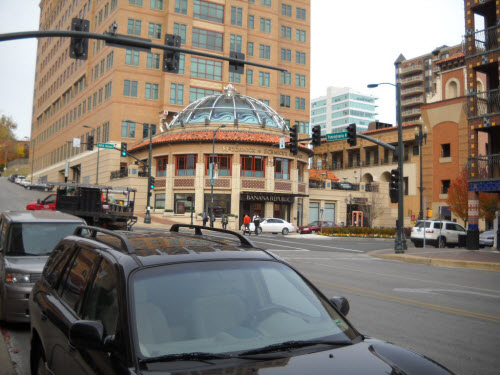
The plaza is Country Club Plaza, a clean midtown shopping district dating back almost a century, but still looking pretty modern. The architecture contains Spanish influences with colored squares and diamonds. I didn't photograph the whole place or the most interesting places, just around the area where we sat down to eat.

Kansas City also apparently has a lot of fountains.


Everything on interest in KC is closed on Mondays, so the only other thing we could do was stop outside the WWI memorial and look out over downtown. We also checked out the science gift shop in Union Station (I almost bought a Star Wars Mad Libs for its high geek factor).

Looking up at the WWI memorial column


Looking over downtown KC; Union Station is in front

I went home to rest, and woke up to some more of Shirley's incredible cooking, a fusion of American and Chinese styles (but mostly Chinese). Yum.

Sunday, November 13, 2011

Day 11: It's a Small Jewish World


Coincidental meetings are common enough in Jewish circles that experiencing one, while it may get a surprised look and a laugh, is to be expected now and again.

So I was surprised, but not stunned, that Friday night dinner at the rabbi included two members of my synagogue from Jerusalem, friends from only a block away from where I lived. I wrote it off as coincidence. It's to be expected that a religious Jew passing through Ireland will have dinner at the rabbi's house, and it's merely coincidental that, if they are Israeli, I happened to know them.

But I was stunned when the same things happened the next day, with a different person at a different host's house. This time a very good friend of my (ex)step-daughter, and someone who had been in my house in Jerusalem on several occasions.

Like last shabbat, both meals by the warm and welcoming Jewish community members of Dublin were delicious.

Game Night

I headed out to central Dublin to meet some BGGers for a game night. It wasn't the brightest idea, as it meant a long trek in the cold while I'm sick. However, the people I met were lovely, and so was the evening.


Eoin on the right
Just don't expect me to remember their names, as I couldn't pronounce them. I gave Eoin (pronounced Owin) a copy of It's Alive as a gift; but then I decided to take a taxi back instead of a bus, and I was shy some cash, so he gave me some, so it ended up being kind of a sale.

They had never heard of my game, so we played that first. I'm not a fan of playing it five players, but the basic game worked out pretty well. The advantage of the basic game for five players is that both the high and low cards are worth something; since it's a while between each of your turns, this matters more. They played fairly slowly, but we still finished in 45 minutes. I think they all enjoyed it.

We then played Carcassonne, or one of its many variants. All I really need to know is what scores when, and how much, and if it scores incomplete at the end. I got some of this information - I didn't catch the half score for incomplete cities and roads, for instance - but it didn't matter because I couldn't draw the tiles I needed. Ever. I had three cities waiting to be capped, two from near the beginning of the game, and they never got capped because I couldn't draw a capping tile.

While frustrating, the game is still fun to play as you can mess up other players or just make pretty pictures.

Tomorrow: the airport.

Sunday, November 06, 2011

Day 4: The Disappearing Jews

The religious Jewish community of Dublin is committing suicide. Don't expect to find an Orthodox synagogue in Dublin ten years from now.

I spent shabbat with a few of the families who are left (but not for long). I can tell you what they told me.

Ten years ago the shul was packed for Yom Kippur, which means that over 600 people were in attendance. This last Yom Kippur they had 186 people.

The "Hebrew elementary school" is 45% Jewish; the Hebrew high school has 10 Jews in it, out of 200 students. And they don't learn much in the way of Jewish content, other than historical. No torah, no halacha, etc. For that you have to go to school in London or Manchester.

There are 40 or so elementary school children from the synagogue's families; there are ten or so teenagers. Where did they all go? They go to London or Manchester, or to Israel, or they leave Judaism. In ten years, less than a handful of families have moved in. In contrast, the death rate remains steady (say fifteen a year, so 150 over ten years) and young adults are making aliyah, leaving Judaism, or moving elsewhere. Of the several families I talked to, all but one told me that they were already planning to move out, and they named the month they were moving (so the plans were concrete).

This is the kind of thing Rachel and I heard about in the smaller communities in middle America; the kids all move to the bigger cities. In Dublin's case, the bigger cities are apparently in England.

The families were welcoming and generous to me as a guest in the community. The rabbi and rebbetzen had me over for dinner, along with several other guests. The rabbi had also arranged a place for me for lunch, and that family, too, were nice. All the food was scrumptious. I (re)learned to play Canasta with my lunch hostess (if you don't know, it's a rummy variant and that's about it; like all card games, it's better as a partnership game).

Sat night I went to another bar. The music was ok - covers of popular dance and rock songs - and I did a little club dancing. Not as nice as Thursday. Oh well. One girl turned down my request to dance, but another one (out with her mom on her mom's 60th birthday) danced with me for one song.

O'Connell Street, central Dublin, at night

First pub

Knightsbridge pub

The band

A giggle of girls wearing flashing bunny ears

Danced one dance with me