Showing posts with label its alive. Show all posts

Saturday, April 06, 2019

Frankenstein: A New Version of It's Alive from Invedars

Hey guys. News about the game formerly known as It's Alive.

After the first prototypes, two editions of It's Alive from Reiver Games, and two versions of Hanukkah themed versions called Candle Quest by Victory Point Games and on The Game Crafter (still available), the game has been picked up by Invedars, returning to its original Frankenstein theme.

The new version is called Frankenstein and it looks amazing. New artwork, and a figurine and a new events expansion for Kickstarter backers.


The project is up on Kickstarter and reached its goal in only 24 hours. It is now many times above its goal.

They have already sent prototypes to reviewers for new reviews, for example:


Follow Invedars and progress about the game on Facebook.

Sunday, July 28, 2013

Shabbat Gaming / New Rule For It's Alive

I spent shabbat with my good friends David and Yael. Shira, their nine year old daughter, was also home. David is a semi-regular at the Jerusalem game group.

We started the evening with Shira telling me that she wants to play a great game with me that she has called It's Alive; she went goggly-eyed when I told her I had created it. We played the basic game after dinner with a new rule change:

The following new rule is an official variant for the game of It's Alive, and will be the standard rule in any new editions. On your turn, you can - instead of buying, selling, or auctioning the top card of the deck - buy a card from someone else's graveyard directly to your board. It costs the buy value + the sell value of the card. You can pay this cost using any combination of cards and/or coins. I.e.:


Card valueCost from grave
23
34
46
57
69
710
812
913
1015

This replaces the entire double step procedure of first paying to bring the card to the center of the table and then buying, selling, or auctioning the card.

In the basic games, this means that cheap cards are nearly always bought from graveyards, and expensive ones more frequently. In the advanced game I suspect that duplicate cards will be auctioned more frequently and expensive cards fetched from graveyards more frequently.

We played the basic game and Shira won.

After this, David and I drafted Magic cards before bed. The next day we played with our decks. I had to play three colors and I was feeling pretty vulnerable with my deck because it had nothing against fliers except for a Serrated Arrows. I lost the first game quickly because I didn't draw more than two lands. But I won the next two games with one of those level up white guys who gives all of your other creatures +1/+1 . David didn't get many fliers out, and the one that he got out I killed with the arrows. So I basically won because I had the big white guy; when I drafted it, it was choice between him and an equipment that you could use to tap an equipped creature for any color mana.

We drafted again and played again, and this time I lost two games, both with large buildups, and once again I had nothing to take out his fliers.

On shabbat morning before lunch, Shira taught me Thirteen, a game that we played with a whole mess of cards from various decks, though I suspect that it should be played with two standard decks of playing cards. Shuffle both decks, including the jokers. Each player gets thirteen random cards face down in ordered slots, numbered one to thirteen. The first player picks a card and places this card face up in the slot corresponding to the card value (A is one, K is thirteen), then reveals the card that was face down in that slot. He goes again using the newly revealed card. This continues until he reveals a card that corresponds to a slot that is already revealed. He then discards the unusable (for him) card. In case you didn't notice this part of the game is exactly like the solitaire game Clock.

The second player takes the discard if he needs it and proceeds the same way. Otherwise, he draws from the top of the deck and proceeds the same way. Play continues this way until one person has finished his board. He sets aside the last revealed card to use in place of a draw on any later turn that he desires. He shuffles all of his cards in with the deck and the discard pile, deals out twelve cards (one less than the previous round) and continues. If he draws or reveals a King, he can't play it obviously.

This continues until a player has only one card left and then completes his board, whereupon he wins. Jokers can used for any card, and if you draw a card that goes into a slot with a face up joker, you can replace it and reuse the joker somewhere else.

There are two choices in the game. 1) when to use a card you set aside from a previous round. 2) where to place a Joker, the significance of which depends - very slightly - on what cards your opponent has already revealed. These choices are not significant.

Shira won, with some jokers to spare.

Later in the day we all played Cities and Knights of Catan. Shira needed some help understanding the cards and occasionally deciding where to place roads and settlements. She won this, too.

Sunday, December 02, 2012

Innovation

Abe, Sara, and I played Carl Chudyk's second major multi-purposed cards game Innovation (the first is Glory to Rome, whose black box Kickstarter edition I am still waiting to receive; the first appears to have gotten lost in the mail). Innovation is published by Asmadi Games.

Like GtR, Innovation features cards that not only have several purposes (the same could be said for San Juan or Race for the Galaxy), but are crowded with text and icons across several sides and the center. During play, none, one, or some parts of the iconography or text are relevant at a time; the others have no function at all. While clever and resourceful, and while this naturally enables useful decision making mechanics, the design is threatening or confusing to some types of players. If you're not able to process five different meanings on seven different cards at a time while always remembering exactly which is in effect at any given time, or you're always forgetting what's in effect or asking what "will happen if I do this", this may not be the game for you.

For those that like this type of thing, Innovation is far more chaotic that GtR, which was pretty chaotic. It is possible that my opinion about the chaos will change as I learn the cards. But in my first game, and with only three players, whenever my turn came back around nearly every players' boards had entirely changed. This made any kind of long term-planning nigh impossible, and so we played nearly every round simply grasping for the most points or progress that we could achieve each round.

Now this was not entirely the case; Abraham used the same card Democracy several rounds in a row because no one could find a light bulb to leech off of his card's usage. And I planned and executed a series of splay actions over three rounds that netted me the special achievement for splaying all of my cards. These were more exception than the rule.

Here is the gist of the rules: There are four actions. Each player has in front of him five card piles, one in each color. Each card has a series of icons, a number indicating 1) the deck from which the card was drawn, 2) it's point value if stashed as treasure, and c) the deck from which you may draw cards if it in on top of one of your piles. Each turn, you get to play two actions (the same or different, in any order). The actions are:

- Draw a card.

You draw from the deck matching the highest number on top of one of your piles. If that deck is empty, draw from the lowest number deck that is higher than that number. So if the highest valued number of top of your five piles is 6, and there are no cards in the 6 deck, draw from the 7 deck (if it is empty, from the 8 deck and so on).

- Play a card.

Play a card of any number on top of the pile in front of you of that card's color. It is now the top card of that pile.

- Activate a top card of one of your piles

The cards do lots of things. Each has one or more activated abilities, executed in order from top to bottom. Each ability is preceded by a miniature icon. There are two main types of abilities:

a) Force other players to do something. In this case, all other players who have LESS of the indicated icon than you do must perform the action. So, if the icon is a tower, and between all of your top cards you have 5 tower icons, all other players with fewer than 5 tower icons must do the action.

b) Do something. In this case, all other players who have THE SAME OR MORE of the indicated icon than you do ALSO perform the action.. They do it first, and then you do it. After you finish all the abilities, if ability of this type (b) was performed by any other player, you get a free "draw a card" action.

This explains the icons on the card. You are constantly watching not only the potential abilities on every other players' cards as well as your own, but also the icon count to see which ones, either positive or negative, will affect you.

Each player has up to five possible choices for card activation, one for each pile in front of them.

- Claim an achievement.

Some of the abilities let you take cards - from hands, piles, or decks - and stash them under your player mat as "points". There are 9 achievement cards numbered 1/5, 2/10, 3/15, ... 9/45 (these are actually regular cards from the deck being used for this special purpose instead of their regular purpose). To claim an achievement, you must use this action and have a) a top card in your pile equal to or greater than the achievement you want and b) have the required number of points (5 times the card level). Achievements cannot be stolen or lost.

That's the bulk of the game. You take two actions (each from the above choices of draw, play, activate 1, activate 2, activate 3, activate 4, activate 5, or claim) and play passes to the next player. On another player's turn, you might play an activity if another player activates it and you have the right icons. Many actions, unfortunately, cover over or remove the top cards from the piles of other players or from yours, so the available top cards - and thus player choices and powers - changes after nearly every action.

There are some other rules: five special achievements that are taken without actions if you fulfill their conditions, and card "splaying", which means uncovering the icons of cards beneath your top card in a pile, which basically adds some or all of the icons in these cards to your board.

We didn't get to finish the game by the end of about three hours, though we had a baby, first game learning, some interruption for cake, and a somewhat slower player. I took an early lead and we were fearful that this might lead to a runaway leader problem - I already had more points and better cards on the table. Thankfully, this was not the case, as first Sarah and then Abe caught up in points and achievements. We were neck and neck when we had to wrap up. It didn't look like anyone was going to win with the five achievements required (though still possible, I grant). The other way the game ends is when someone needs a card numbered 11, which doesn't exist.

Abe and I both wish to play again. Alas he is leaving for Houston. Bye bye, Abe.

---

Last night I had a family over for the first time, with some kids. Tal taught the kids how to play It's Alive, which they appeared to enjoy. One of the kids won. I then taught both kids and parents how to play For Sale, which they also enjoyed. I played together with the 8 year old and we won in a close game: 56 to 54, 54, 52, and 38.

Last shabbat I played some Gin Rummy and Oh Hell with my daughter, something I hadn't done in a while.

Tuesday, November 15, 2011

It's Alive iOS v1.1 Available

An updated version of the iOS version of It's Alive is now available for download. Improvements include local leader boards, random start player, bug fixes, and additional features. Still at a fantastic price.

Go download it and leave a rating.

Thursday, October 20, 2011

It's Alive! for iOS!

It's Alive! is coming to iOS (in time for Halloween, I hope).


The game was ported by Jeremy Maher, who has created several other apps for iOS, including Simon Graham and the Extraordinary Timepiece. Jeremy has been a pleasure to work with; I've really had to do almost nothing.

Says Jeremy:

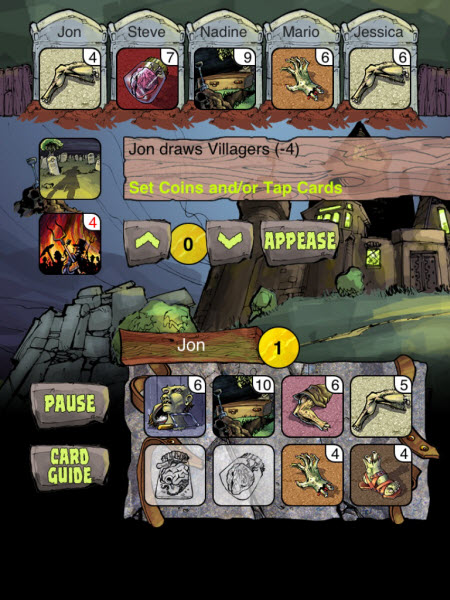
Pretty much all of the features of the original are included. Two to five players (any combination of human and computer) can play on one device. Networked (online) multiplayer will not be part of the initial release. Each computer player has a name, and there are subtle differences in play style. All the basics are there - buy, sell, auction, coffins, villagers - with an option for either Basic or Advanced rules.
Games can be paused, saved, and resumed at any time.

There is some animation, as well as sound effects and an orchestral score. Volume for music and effects can be adjusted independently. There is also an in-game manual, which shows the original rules, edited and re-written as appropriate.

Here's a screenshot:


As soon as it's on the app store, go buy it!

Sunday, July 10, 2011

Anyone Else Want to Produce My Game?

Reiver Games aka Jackson Pope has finally sold off the remaining stock of the second edition of my game It's Alive! and released the rights back to me.

So, any other publishers interested in producing it? It's still a game that I enjoy playing, and I'm a pretty fierce critic of games, you know. I'm especially interested in retrying it with a religious theme (Menorah, Santa, etc) which would immediately make it one of the few decent religious games on the market.

I still have a few copies of the second edition, as well as a few of the prototypes from the original Menorah version.

Sunday, June 27, 2010

Shabbat Gaming

At Nadine's in the afternoon, I played PitchCar x 2, It's Alive, and Puerto Rico (other games played, in which I didn't participate, included Casino and Scrabble).

PitchCar

We played two games, using two different track layouts. I came in second in the first game; I was ahead nearly a lap at one point, but I crashed a few more times than one of my opps did, and he was just able to overcome me in the final stretch. I came in first in the second game.

My success is rather odd, as I don't typically win this game, but I played rather slow and steady, and that seemed to work.

It's Alive

We played a five player game (not my favorite) and Nadine taught it to two of the players. As usual in a five player game, there was a lot of auctioning and pieces went for face value. I pulled at least three of the Villagers and a few too many low cost cards, which hurt my income and progress. Nevertheless, I played with my new "keep my coins at exactly half of my board value" strategy, and I came in second with 45. The winner finished was the one who finished, and he had a score of 57. So it's not a perfect strategy.

Puerto Rico

Rachel, Nadine, and I played this. Even though we played on Nadine's set, and she only has the base set and official expansion, we proxied most of my usual custom buildings. I was third player.

Rachel on my left took the first trade good, coffee, so I took coffee, too. Nadine took tobacco soon after. I had a fairly early Factory, and access to a tobacco plantation, so I simply took tobacco soon after, giving me a full Factory. Nadine had the other early Factory. Rachel was the only one who had Harbor.

I ended with an equitable amount of shipping points, three of the big buildings, and an embarrassingly high score of 69 to their 49 and 52.

Sunday, May 16, 2010

My Publisher is Shutting Down

Jack started his company Reiver Games on the basis of my game It's Alive. He sold out a first edition of the game, and then 2/3 of the second edition. He also published two other games. But he wasn't able to make enough money to keep cash flow and to keep it going. On the verge of publishing his fourth game, he decided instead to fold up shop. He blogged, and continues to blog, the whole sordid affair here.

I think he is now in discussion regarding selling the remaining stock and/or the company IP, including name, publishing rights to the games, etc. So I'm not sure yet what's happening with my game rights. If no one buys the rights, they could revert back to me. Otherwise, they would go to the buyer.

A shame. Jack's cool.

In other news, maybe I'll get to publish The Menorah Game, again.

Wednesday, March 24, 2010

Two-Player Age of Empires III

It's been about five years since my step-son last played a game with me. He is into computer games (and was into Warhammer). He never liked Euros (except Settlers when he was little), CCGs, or anything that didn't involve visceral killing and complex war strategies.

Upon recommendations, I picked up Age of Empires III on my last visit to the US. While I understood that it is a Euro, I also hoped it might tempt my step-son, who had played the computer game, and who had, at least, looked curiously at some of my other recent Euros that sported pictures of generals and armies (though typically had no combat). So I was thrilled that he was willing to try it.

AoE3 (at least, for two players) is not really a war game, less of one than either Antike or what I remember of Wallenstein (played once about four years ago). But the combat is in there, and we did use it; actually I used it first and more viciously than he did. I'm a big fan of "remove one for one" combat in comparison to dice rolling; my step-son prefers the dice rolling.

Actually, AoE3 is a game of worker-placement, resource-management, and area control. The object is to earn the most victory points, which you get from a) buildings (ala Puerto Rico and Caylus), b) areas discovered, c) your end-of-the-game income (excepting any bonuses from buildings), and d) three times during the game from areas controlled.

Each round you have five guys to allocate between a) turn order, b) moving to the areas, c) adding guys to your contingent ready to discover an area/discovering an area, d) buying a building, e) getting an additional special guy to use next round, f) taking an income source, or g) declaring your intention to battle.

The income sources are various commodities, which you can also get from discovering one of the areas on the board, as well as one "wild" commodity. Three of any commodity gives you $1 income, three of a kind gives $3, and four of a kind gives $6. Money is good for buying buildings, declaring a total war on another player (rare), or (useful only in a game with multiple players) one space that lets you buy a special guy for use on the next round.

The special guys are worth double value, or give you income once, or can be used to shoot the other player's guys in an area during a battle.

Each area has an initially-secret strength you have to overcome during discovery (essentially, how many Indians you have to slaughter :-( ). When you run out of areas, you can still discover areas off the board for more victory points, but you don't actually move guys to them. Control of an area is worth 6 points, second place is 2 points; this is counted three times during the game.

In our game, we both scored about equal for this over the three scorings.

At the end of the game, you also score your income levels. I scored a bit higher for that. You also score your discovered territories. Again I scored a bit higher for that.

Lastly you score your buildings. The big point-scoring buildings only appear in the last two round of the game, so it is essential to be first or second to claim these in one of these rounds. My step-son miscalculated the importance of these, and his buildings only amounted to some 17 points total, while mine totaled some 35 or 40. Earlier buildings give you bonus cash, bonus guys each round, bonus income, etc...

Oh yes, combat. If you declared combat, you can pick one player in one region and have each of your soldiers in that region remove one of the other player's guys. If you pay $10, you may instead declare total war against a player and have this occur in every region of the board. I killed a few of his guys first, and then he loaded the board up with more soldiers. The object, of course, is to be the one with the most in an area during scoring turns.

The game is a scant 8 turns long. The entire game took us about 45 minutes on our first play, which was impressive, maybe even a little too short. We could both tell that the game becomes richer and more competitive with multiple players, so probably 4 or 5 players is ideal.

I quite enjoyed it, and my step-son thought it was a good game, though he would have liked more dice and more combat. I'm looking forward to trying it out with the game group.

---

This week has been overwhelming: I'm essentially working two jobs (I missed a lot of work in the US), keeping up my blogging, fixing a whole lot of things, dealing with various money issues, and cleaning for Pesach while the wife is away (coming on Friday). And I started the week with a bad stomach virus of some kind.

I had to cancel both game night this week and games day I usually host over Pesach. Luckily, one of my gamers is hosting a smaller version of games day at her house, which I will try to attend after work next week.

A video review of It's Alive.

Saturday, October 24, 2009

Weekend Gaming

Friday night

It's Alive

Two of my 18 year old guests stayed to play after dinner. One had previous experience with The Settlers of Catan, while the other had no real game experience.

I brought out It's Alive and set it up without letting them see the box cover (and thus the designer's name). We played the basic game, which I won. I asked them how they liked it, and they both liked it and wanted to play again. Sweet.

As we were setting up to play the advanced game, I let them know who the designer was. I won the advanced game 58 to 48 to 43.

R-Eco

They liked the theme and the game. Thankfully, I didn't win this one, too. The score was 13 to 7 (me) to 5.

Saturday

The Talpiot neighborhood gaming scene is growing. I hosted a lunch of some of the local gaming fellowship: Bill and Shirley, Abraham and Sarah, Eitan and Emily, Nadine, and Adam. With company like this, I expect game night will continue even while I'm away in November.

El Grande

Eitan, Emily, and Sarah had not played El Grande, and Abraham had played only once. I told them that it was a required staple game. Nadine has a history of kicking butt in the game, and I told the other players that they could consider their score a "win" if they score at least 2/3 of Nadine's score.

Three hours later shabbat was over and they had finished round 6, whereupon they all quit. Nadine had something like 72 points, and her closest competitor was Emily at 47. So no.

Modern Art

Adam loves this game and wants to play it whenever he's over. We hemmed and hawed about it, but eventually I said let's do it, since I hadn't played it in a while, anyway.

The rest of us aren't fans of Modern Art. There are several problems with the game. The auction prices are too high for "once around" auctions. For a pair of paintings worth 100, anything player A bids, other than 99, is going to be outbid by player B and player C. The "name the price" auctions always favor the player to the left of the person setting the price, which, if your left-hand opponent tends to play, sucks for you. The double auction cards are always game breakers if one person gets too many of them; we fix this by dealing them out evenly to all players.

Other things that look like problems may not be. It appears that you should never win your own auctions (below half the value of the item); however, letting the person who is winning gain 49 to your gain of 51 may not be worth it. It might be better to gain only 35 and have your opponent gain nothing. Also, it's always best to be the one winning the auctions, so long as you gain 1 (obviously you want more, if possible). But the evaluation of prices adds a bit of complexity into the auctions, so you can't always know exactly where that gain of 1 is. And turn order matters a great deal; what's worth one thing to your LHO is worth something entirely different to your RHO, since your LHO is about to play the next painting, so gets to affect the valuations more directly.

So it's a tad more interesting than it seems. But I still don't like the auction price variance for once around auctions, and I don't like "name your price" auctions.

Adam won, but not by much. He had 567, Shirley 552, me 537, and Bill 480-something.

Pillars of the Earth

I taught this to both Bill and Shirley.

This game doesn't have a tremendous amount of luck, but the luck sometimes goes screwy and kills me. This time it didn't, thankfully, and I simply lost due to my own shortfall and Shirley's good play.

The game hinged on the last round. None of us had any money, so none of us could utilize the pay for VP cards. However, the craftsman who converted metal and wood to 6 was available on the board to a master builder. None of us had any metal. There were two locations to get metal: the usual taxes location, and one of the personalities. And places to get wood included the location that takes a cube from the market, and the personality who gives a stone and a wood. (I don't think anyone had a Woodworker, so none of us could buy the wood.)

When my master builder came up first, I paid my last 7 to take the taxes location in order to secure one of the metals. Really dumb; I should have secured the craftsman itself. Of course, if I did, both of the metals might have been taken by the other players, but at least none of them would have gotten the craftsman. Shirley took the craftsman and then both personalities without much difficulty. I sold the metal at the market and could buy 1 other good, but was one coin shy of buying an additional good.

Shirley won by one point, 54 to 53. Bill had around 45.

Saturday, January 03, 2009

I've Got 10 Copies of "It's Alive" in Israel to Sell

For those of you in Israel that want to buy my game but have been put off by the shipping costs, I have 10 brand-spanking new copies of the second edition in my hands to sell for the ridiculously low price of 90 NIS each (that's less than with the UK shipping rate). Email me if you want.

First come first served. If all 10 sell out, I might get more at the end of February.

I also picked up a copy of Reiver Games' other game, Carpe Astra, which I hope to get to the table sometime soon.

Yehuda

Saturday, November 22, 2008

Daughters and Their Friends

The eldest came home from the army dog sick. The army wouldn't give her anti-biotics, so we're ensuring that she gets some tonight, before she goes back to the army tomorrow.

She still arranged to have a group of her friends over for the third meal; a lovelier and stronger group of young women you have never met in your life.

The youngest had two friends over for shabbat. She has written 18 complete songs, including lyrics and music, and one of the two friends is a guitar player who is learning to play them. I hear they may even get some studio time at some point. They sang us one of the songs before shabbat started, and it's pretty good. I've been encouraging her to continue her voice lessons and put stuff up on Youtube. She will eventually. Right now, she sometimes busks on the midrachov.

She taught her friends how to play It's Alive. When I first saw them playing, I thought that the friends were going to turn out to be non-gamers, but in the end they liked it enough to play four games.

Friday, October 31, 2008

Games in Transit

I auctioned off a slew of games and game books, and in the end got rid of nearly all of them. Could be because some of them went for as low as $0.01.

Rachel should be landing in Chicago soon with six packages to mail, and they will go out tomorrow (if post offices are open on Halloween) or Monday. She'll be returning with seven new games I ordered and shipped to a friend.

A number of them I sold or gave away in Israel. My games closet looks only packed, rather than overstuffed as it usually does.

I'm a big fan of recycling games. What we don't play, I'm happy to trade or sell, in order to get new games. And I'm happy to buy used. I'd be curious to know the first time someone sells/buys a used copy of It's Alive.

Speaking of It's Alive, Reiver Games took 840 copies of the game to Essen and only returned with 4 copies. Yes. He got rid of 836 copies of the game in three days. He sold 158 to passersby, sold 36 to shops, gave away 11 review copies, used 1 copy for demoing, and the remaining 630 copies went to distributors.

Nice work for three days.

Monday, September 15, 2008

Hungarian Gamers Taught me Agricola

I played with Scott (originally from England), Miki (from Nikolaus), and Akos (pronounced Akoosh) on the second Saturday afternoon at my apt in Budapest. All three were lovely, fun players, and nice socially, a perfect combination of serious play while keeping the atmosphere moving and fun. If this is what the Hungarian gaming scene represents, I want more of it.

Their game group meets biweekly and attracts 20 or so participants.

Scott brought me a quite unexpected gift: a Hungarian board game called Atilla vagy Aetius? which is not on the Geek, is in Hungarian, and has no English translation. I'm waiting for Scott to send me a translation so that I can give it a try.

We played It's Alive, Agricola, and one round of the Mu (and More) games.

It's Alive

I introduced them to my game. I think it went over pretty well, although they didn't ask for a second game.

We did the occasional buying and dumping of cards, but they were all very into auctions. A great number of the cards were auctioned off for their face value, sometimes higher. I eventually picked up on this and did some auctioning of my own. Money kept going around, but I only managed to get a little of it.

Miki ended the game by completing his board, But Scott had a vast reserve of cash (he couldn't count his last two coins), and he won the game by two points. Akus and I were further behind.

Agricola

This was my first play of the pretender to the BGG throne for most desired game. Luckily they had an English copy; much of the game is language independent, but the cards are intensively language dependent, and they are integral to the game.

Rules

The goal is to earn the most points by the end of the 14th round. Each round players place workers on available actions. One new action, and all previous actions, are available each round. Each action can hold one worker, and so can be used only once per round. Each player has two workers, unless they acquire more during the game.

When you place your worker, you get the benefit of the action: one or more resources, tiles, cards or activities. Resources such as wheat or stone allow you to feed your workers or do activities. Tiles, such as plowed fields, allow you to do other activities. Cards give you benefits when you perform actions or take resources, but cost resources to utilize. Activities net you resources, workers, or tiles, but cost resources or tiles to utilize.

After turns 4, 7, 9, 11, 13, and 14 you lose three points for each worker you can't feed (food gets used up). At the end of the game you lose a point for every resource or tile type that you don't have, or unused space on your board. You gain 1-4 points each for each resource and tile type you possess, and for having played certain cards.

Since the limit is 4 points for each type of resource and tile type, there is no sense ending with more of any resource or tile type than is necessary. A minimum of one of each type is recommended, since the first not only eliminates the -1 point but gains you 1 point; any subsequent one gains you only 1 point, at most.

That's the nutshell, and if you see Caylus in the above, there's a good reason for that. The worker placement, and thus the heart of the game is Caylus.

There is one very important additional mechanic: the cards. While a few cards are available to all players like Puerto Rico buildings, most of the 200 or so cards are not. Each player is dealt 14 cards at the beginning of the game, and those are available only to them. These private cards function a bit like alien powers in Cosmic Encounter. They not only give you special abilities (if you play them) that others don't have access to, they also shape the strategies and tactics you will use during the game. Since there are so many cards, and so few used each game, and so many different combinations that may be available to you, each game you play will be somewhat different. Very nice.

Reactions

I enjoyed the game, as I expected, but the real question is: is it better than Puerto Rico? My short answer is: I don't think so.

I've only played one game, so it's rather too early to tell. My first game took around 3 hours; that is too long for Caylus, a game I liked the first time I played it, but fairly quickly grew to dislike. I'm fairly sure that I won't grow to dislike Agricola quite so fast, and I fairly hope that I will grow to like it even more. It's too soon to tell.

There were a number of things I liked about the game: I liked the personal cards, and I liked the tight choices you had to make. The game appeared to be nicely balanced, with many many possible routes to take. As such, it looked hard to really screw someone by taking what they needed most; that's actually not necessarily a good thing.

There were a number of things I didn't like about the game, but, being that this was my first play, it may be that I'm mistaken about them: Because of the -1 points for every single type of resource and tile, and the general low scores of the game, you simply need to have at least one of nearly everything, and most of your game board covered. That makes a whole lot of decisions in the game moot, since you may spend the last few rounds taking all the things you didn't take at the beginning or middle of the game, which makes for dull play.

The second is that all of those options look pretty similar to me. I spent a number of rounds looking at the available options and saying "2 points if I do this, 2 points if I do that, and 2 points if I do this other thing. Hmmmm..." This might be my inexperience, however.

I'm already thinking of reworking the scoring in the game, but I will prudently hold of until I've played a few more games and read some articles on the Geek.

Our Game

In our game, I came in last, but only by a few points, so I felt ok about that. Final scores were something like 34 to 33 to 31 to 28. I concentrated on stone buildings, cards with points, and gaining new workers as soon as possible (which is just not that easy). I pretty much ignored all farming. Meanwhile, others were farming or fencing a lot of land, which gave them points in those areas. It was close, as you see, so I'm not entirely sure that my strategy wasn't a workable one.

Mu

We had little time left, so I learned one of the games from Mu and More, and we played one hand. I did spectacularly poorly again. The game was a fairly simple trick taking game, fun enough but nothing extraordinary at first glance. Lack of partnerships was a big factor.

Yehuda

Sunday, July 27, 2008

Thursday, June 12, 2008

It's Alive to be Re-printed

My first board game, It's Alive, is going back to the printers for a second edition.

Not much will change in this edition. The artwork will be tweaked, and some commonly requested rules changes will be changed.

You can pre-order a copy at 30% off at the publisher, or pester your local or online game store to pre-order copies.

Yehuda

Sunday, June 01, 2008

It's Alive! Up For New Award

Tom Vasel was kind enough to include It's Alive in the nominations for one category in the new Dice Tower Awards. I'm up for Best New Designer.

I doubt that I have much chance, as most of the people on the committee won't have played the game. Still, it's nice to be noticed.

Yehuda

Monday, May 19, 2008

It's Alive! Is Now Officially Sold Out

My first game, It's Alive!, is now officially sold out. It was a small print run - only 300 - but they were beautifully made, hand cut, and assembled. Thanks to everyone who bought a copy, to the playtesters, and to Jack of Border Reivers for printing the game. Sorry to those of you who still wanted a copy; maybe ask Jack to do a reprint.

In other news, I see that the proposed next location of the Board Game Studies colloquium is Jerusalem! Woo hoo. That would be cool. If only the contact email address they give on their site actually worked.

In other news, Chris Farrell has restarted with a new game blog. This is bad news, because now my site won't be in the running anymore for best board game blog on the Internet. (Needless to say, get thee hence).

Yehuda