Showing posts with label go. Show all posts

Saturday, March 31, 2007

1 Out of 7 Cashiers / Weekend Gaming

Surprises can be found around any corner.

3-3-1

7 times I go shopping,
  • 3 times I receive the right change,
  • 3 times I receive too much change, and
  • 1 time I receive too little change.
7 times I receive too much change, when I try to correct it,
  • 3 times they correct it without comment,
  • 3 times they argue with me, thinking I'm trying to tell them I received too little, and
  • 1 time they thank me for my honesty.
7 times I receive too little change, when I try to correct it,
  • 3 times they correct it without comment,
  • 3 times they argue with me, thinking I'm trying to rob them,
  • 1 time they apologize.
7 times I receive the correct change,
  • 3 times they do so without comment,
  • 3 times they try to hurry me along by scanning in the next person's items before I've packed my own, and
  • 1 time they say "Thank you," or "Your welcome."
That 1 person in 7 usually gets my business again.

Games

I ended up playing more than I expected.

I played two games of Yinsh with the daughter before lunch. I won the first game fairly easily, but the second one was very close.

My friend then surprised me in the afternoon by agreeing to a game of Chess. And I thought he didn't play games altogether.

I actually gained a very slight advantage at the beginning but then made a mistake which threw the balance his way. A series of exchanges later I resigned. He turned out to be a reasonably good player, or, at least, better than me.

I then played a few introductory games of Go with the daughter again, six in all. On a 9x9 board, I started her with a 2 stone advantage that eventually went up to 5 stones. She still couldn't win. I think I'm not a good introductory Go game teacher.

Anyway, I discovered something playing the game: a corner of the board with four empty spaces in a square, surrounded by five stones as the two other sides a square, can't be saved, even though two eyes could fit into it.

Yehuda

Thursday, February 22, 2007

Session Report Up, in which I diss Stephenson's Rocket

The latest Jerusalem Strategy Gaming Club session report is up here. Games played include: Chrononauts, Power Grid, Zertz, Cosmic Encounter, Stephenson's Rocket, Grave Robbers From Outer Space, Bridge.

The report is up, although some parts are still incomplete.

We held first plays of Chrononauts and Stephenson's Rocket. I was unimpressed by the latter, although I'm willing to try again. I also discovered a problem with Zertz not covered in the rules. Turns out it was covered in the rules.

Game News

ITNews talks generally about a new algorithm to help computers improve at Go.

OnMilwaukee discovers Apples to Apples and calls it "a game of strategy". Indiana's Ball State News Daily also discovers Apples to Apples, as well as iMAgiNiff.

The Orlando Sentinel discusses cheating. "We live in a society in which obtaining a goal or an end becomes more important than how you go about obtaining it."

Yehuda

Saturday, February 10, 2007

Didn't We Agree That It Was Next Week?

Have you ever extensively prepared for dinner guests only to be informed at the last minute that you had gotten the week wrong?

If anyone in Jerusalem is hungry tomorrow night (or the next or the next), stop by for some food.

Tichu

Instead, Friday night dinner was just myself, Rachel, Saarya, and Tal. Since it was a winter evening, which meant an early dinner, we also finished early. I tentatively proposed to Rachel that we all play Tichu. She usually only plays Puerto Rico, which Saarya and Tal don't play, but she has occasionally played Bridge.

To my surprise, she agreed to try it, seeing as it was quick, she was in a good mood, and it would include all present in a mutual activity. Saarya had played once before, and Tal had played President and was certainly capable of playing this.

I only asked Rachel to play one hand to see if she liked it. After one hand, which was mainly working out the rules and kinks, she asked to play again. After that one, she said that she was finally getting it. We ended up playing four hands in total.

Tal liked it, and Rachel did, too. Not crazily, but enough that, at the end of game night if there is not enough time for Puerto Rico, she may be willing to be roped into a hand or two of this.

On the flip side, I think I've pretty much "got" the game at this point. While I foresee that I will continue to enjoy it, as I still do Hearts and so on, I don't know how much more "game" there is for me to learn about this game.

There's still no partnership card game like Bridge.

Zertz

The next day before lunch I tried Tal out on Zertz. She took to Yinsh, didn't take to Dvonn, and, like me, was not particularly intrigued by Gipf.

After two games, both of which I won fairly easily, she's not too keen on playing it again, and I'm still interested in learning more. My victories were, in both cases, more a result of her not seeing what I was planning than in any deep play that would ensure me a victory. I need to play some better players to see how deep the game really goes.

Game News

A year and a half ago bradley's almanac covered this game in a blog post, but for some reason it only showed up in RSS today. The game is What Shall I Be?, the exciting game of careers for girls, and it's quite instructive. There was a boy's version, too.

An article in Reuters about Go on the Internet. I'm not sure why that's new news.

And lastly, I want to share with you this advertisement from our local Jerusalem Anglo mailing list:
For Sale - Ideal for anarchist or revolutionary

Bedframe and several matresses for sale.

The frame is metal in good condition unfortunately,
but the paint has peeled off and there are some
encouraging signs of rust. There is a choice of three
mattresses, a spring mattress which sags in the middle
and two foam mattresses with somewhat torn covers.

This bed is ideal for an anarchist or revolutionary or
any anti-establishment sorts. A couple of nights of
sleeping in this bed will ensure a completely
different outlook on life, leading to greater world
peace.

I am willing to sell for a nominal fee, or will barter
for any books written by Marx or Engels, or anything
published by the Free Democratic Republic of North
Korea.

Thank you.
Yehuda

Tuesday, January 16, 2007

Lost Cities with Tal

I played Lost Cities with Tal last night (aged 13 girl, not a power-gamer), and she liked it.

I won the first game easily, but she won the next two. While I still don't see any real depth to the game, I am not utterly convinced about this, and will try it again until I'm sure there is nothing there.

I like the way that just about every card comes into play and gets cycled through the discard piles, but the player who draws the 9's and 10's is simply going to win, all other things being equal.

Gone Gaming's Board Game Internet Awards are a wee delayed, owing to travel, sickness, and a host of other excuses.

I'm working on poetizing the Canadian copyright, now that they're proposing to ruin it.

I'm also working on an article about globalization, one about de-evolution, and a few cards games.

Endgame radio points to yet another series on the evolution of video games, with a brief stop at board games.

Someone in India is planning "a contemporary film catering to today’s hi-tech teenagers titled 'Monopoly-The Game of Money'." Source.

Lots of press about "Deal or No Deal" being a big seller over the Christmas season.

The game Go is growing in popularity even in America, partly as a result of the anime Hikaru No Go, reports Syracuse.com.

Now that I have self-confidence in my blogging, I am less concerned about my steady drop in Technorati's rankings ... but still, I could use some link love. So do link once in a while. Or comment on my posts. Or subscribe to my feed. If you already do, then thank you.

Even better, buy a few things from Amazon or FunAgain through me. Heck, buy through anyone; it's better that someone get a commission then no one.

Yehuda

Sunday, January 14, 2007

Just spilled tea on the power outlet

And blew the circuit breaker for my computer and three other people in my office. Oops. A waste of some good Earl Gray.

Meanwhile, my new installation of Word 2003 keeps on crashing ...

Go might be heading for the XBox.

Kohls and Target have dropped a bunch of drinking board games from their shelves, such as "Drinko".

I don't think I mentioned the Ethics Challenge board game, created for Lockheed Martin, but also available in a Dilbert themed version. Used in real companies in groups of up to 40 people.

Yehuda

Sunday, November 12, 2006

Review: Hikaru No Go

Summary: An intelligent and emotionally gripping anime series about the ghost of an ancient Go player who visits, befriends, and trains a contemporary Japanese boy in the art of Go. 75 episodes and a holiday special (all are currently available on YouTube).

Hikaru No Go on IMDB.

Overview

Shindou Hikaru is a small boy who knows nothing about the game of Go. The game is taken seriously and played professionally by players across Japan, China, Korea, and the rest of the world. Several newspapers follow tournaments and professionals. The game has its own jargon, history, famous plays and players, and schools.

Shindou lacks both grace and seriousness, but one day he falls in with a ghost of an ancient Go player, Sai, who was once wrongly accused of cheating while playing for the emperor, and now on his second visitation and still trying to play "the divine move". He begs Shindou to play, and together they learn about the modern world of Go. Shindou meets another boy his age, Touya Akira, an exceptional player in his own right, as well as many, many other players both young and old.

Shidou's interest in the game begins while letting Sai play, and he eventually embarks on the road to professional Go after discovering his own incredible talent. Meanwhile, Shindou's shifting attention to his own Go play means less time for Sai to play; how will Sai ever achieve his goal of playing "the divine move"? Sai and Shindou both learn about respect, continuity, life, loss, meaning, friendship, and above all, the incredible game of Go.

Cartoon

My exposure to anime has thus far been limited to Akira, Princess Mononoke, Kiki's Delivery Service, and the series Serial Experiments: Lain. All fantastic, by the way. I learned a lot about the form from watching this series, both the good and the bad.

The good: The themes and plots of this anime series are adult, even though the protagonists are primarily children. I have never seen Western cartoons come even close to covering the deep lessons that are covered here. The plots also don't follow the usual "I'm happy, here's an encounter, I'm angry, I overcome, I'm happy" format that so plagues the cartoon format I am used to.

Instead, Shindou, while finding incredible potential within himself, starts and ends the series in pursuit of his dreams; one player in a long link of the Go tradition. In fact, that is the ultimate message of the series. There are no wholly evil or good people, no enemies or perfect friends. There are well over fifty characters with well developed histories, faults, assets, and personalities.

The animators draw the same characters in different ways to reflect the character's moods. Sai changes between a regal thousand year-old man of ancient wisdom, looking tall and sharply defined, to a childlike figure begging to play Go or sharing a joke looking short, noseless, and with big round eyes and mouth. It's a very funny transition to make, and sometimes I burst out laughing, such as when a round, noseless Sai leads Shindou in his stretching exercises.

Several hundred games of Go are played over the course of the series, and they are all real games. Not only are they real games, but the very specific nature of each game: a teaching game, a particularly well-executed move, and sometimes moves even more subtle than that, are all demonstrated in great detail. It is a treasure for Go lovers to see.

The bad: As far as actual animation goes, anime is really pathetic. While the background drawings are sometimes beautifully illustrated, a large amount of time the film technique is to pan slowly over completely static pictures of people who are absolutely frozen.

Seeing all 75 episodes in a row, you also have to endure a number of scenes that pretty much repeat from show to show; this woudn't have been as noticeable when the show was first broadcast, probably. I had the same issue when I saw Serial Experiments: Lain.

Shidou can be really obnoxious, sometimes, and he's the main character. And with so many other characters appearing, you sometimes wish the story would get back to what you want to see, rather than have to endure another side tangent. But for the most part they are all fascinating, so it's not much of a problem.

Other

Overall, it is a great experience, and liable to surprise many people who wouldn't believe that there can be a tense, gripping, and meaningful show based about a kid playing a board game.

I especially enjoyed the few details about Japan which I picked up while watching the show. The etiquette of how to play and some of the Japanese words that are repeated ("Good luck", "I resign", "Thank you for the game"). The vast number of places where everyone takes off their shoes. The existence of "NcDonalds" fast food alongside the ramen and sushi bars. And the vastly varying hair styles and colors of the children.

As a final note, while Shidou treats the girls around him with contempt, especially the one girl who continues to like him even while he does so, generally speaking the women on the show are accorded a good amount of respect. Although the women don't seem to be able to complete with the top professional Go players.

Yehuda

Thursday, October 26, 2006

When to Not Give Up

One of the major lessons of Go is when to give up. Playing in an area in which you have no hope of acquiring is not merely futile, it is counterproductive, because a) you lose more points in lost stones and b) each play represents a lost opportunity to play elsewhere.

In other words, the lessons Go teaches us about giving up come with several caveats:

1) That we are absolutely sure that what we've given up on is totally lost
2) That trying anyway is counterproductive, or even more harmful
3) That the energy spent on a lost cause is robbing us of resources better spent elsewhere that will actually do us good

Item number one is the hardest one to wrap your head around. All of the inspirational thinking in our world teaches us exactly the opposite. The game isn't over until it's over. You never know what you can do until you try. Great geniuses can accomplish what others consider impossible.

The funny part is that they're right. The game isn't over until it's over - that's because you have nothing better to do with your time anyway, so playing it out and hoping for a million to one chance doesn't represent any lost opportunity. You never know what you can accomplish until you try - because the evaluation about what is absolutely lost is often premature. Accomplishing the impossible - because some people don't seem to follow the rules.

I find these latter people to be the most annoying, actually. I have a friend who took various illicit drugs in high school and college while maintaining a straight A average and doing all sorts of extra curricular activities. He slept around without causing any major social problems or contracting any diseases. He smokes one cigarette a year and has never gotten addicted to anything.

So sue me. I still don't condone cigarettes, drugs, and promiscuous sex just because some few weirdos can beat the odds. Naturally, this person thinks it was a great experience and doesn't think fooling around with these things is as bad as others make it out to be.

Another seemingly blessed person is Scott Adams, creator of Dilbert, who claims to be the first person to ever recover from a debilitating speech problem, from which no one else has ever recovered, by sheer force of will. In previous posts he talks about all of the other odds he has overcome, despite everyone around him telling him that he can't do it. He always does.

Is he an inspirational story for the rest of us? Or a freak, whose inspiration will lead others into attempting, and then failing, the impossible?

Although I would like to condemn him to being a freak because I don't like his bloated ego, all of his persistence stories never actually violated any of the three above rules: either what he tried to accomplish wasn't really impossible, or his attempts didn't make things worse, anyway, or his efforts didn't represent a waste that could have been better used elsewhere. He tried various techniques to regain his voice, because why not? And he succeeded.

One other point needs to be made regarding giving up: often people fail at things simply due to lack of persistence. 99% of people won't accomplish X because they get discouraged by the fact that 99% of people won't accomplish it. The 1% who succeed are sometimes the 1% who are willing to continue after the attempt becomes less popular and then find themselves with more space on the playing field. The 99% self-selected themselves to failure.

As to when to really recognize that something is not worth the effort because it is an absolutely lost cause: either you really know it to be true from experience, or you are happy to direct your efforts elsewhere, regardless of whether it's true or not.

Games

I tried Lexicon again with my daughter and reconfirmed my belief that word based card games are simply too easy, as it is very easy to meld words from a handful of letters.

I also taught Go to a non-gamer friend. She bemoaned her lack of understanding what she was doing throughout the game. I told her that that was normal. We will see if she asks to play again.

I am working my way through the Go based anime series Hikaru No Go via the magic of YouTube.

Links

Baby Blues is becoming a favorite of mine for board game related linking. In the latest, Hammie explores the nature of cooperative games.

The Huffington Post posts a nice article about a parent finally cluing in to the positive aspects of video gaming. (via Raph)

Sinister Dexter asks about museums of gaming and gets a batch of wonderful replies. Check out the link to see a dozen links to museums or museum displays on gaming around the world.

Yehuda

Wednesday, October 18, 2006

Three Dimensional Go

Although I said in my last post that Go is probably the one game that really needs no variants, naturally there exist variants for the game:

Variations on Go: Including other rules, other boards, other pieces, and ways to include a third or fourth player.

Other variants

And even more variants at Sensei.

Before looking at these pages, my first thought was 3-D Go. I honestly don't know why.

The biggest problem was also obvious to me: a simple cubic board would have too many locations that each have six liberties, making capturing a veritable nightmare. I played around with the idea of using Tetrahedrons to solve this (d4's), but it didn't really work out.

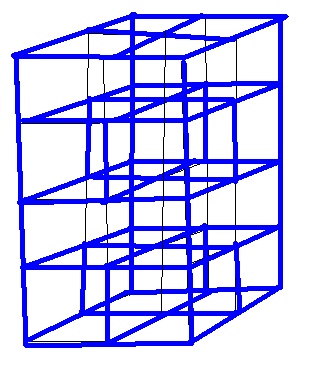
I then thought about trying the cubic board, but simply eliminate some of the lines so that most of the locations still have only four liberties. Something like this:

By eliminating all of the z-axis lines, aside from those on the edge of the board, you end up with some intersections with five liberties, most with four, and corners with three. Further elimination of some lines on the faces allow us to limit any location to having only four liberties. Using this system you should choose the optimal board dimensions to have the board make structural sense (unlike my example):

Actually, if you simply play only on the faces of the cube, you end up with a close approximation of a plain Go board, with no more than four liberties from any location. While that is a step "up" from a traditional Go board, it doesn't give me the real feel of three dimensions.

(A variant for this would be to play on three nested but completely separated cubes. This would be like playing three games of Go simultaneously on three different sized boards, where you can decide on which board to move each time it is your play. While a tad more confusing, it doesn't really add anything to the experience.

Another very strange variant would be to play several dozen games of Go simultaneously, where each plane represents a different game, and a single stone is placed simultaneously on three boards.)

I then went on-line to see what had been done with 3-D Go already. There is a three dimensional Go game on Sourceforge, but it simply uses the 5x5x5 cube shape.


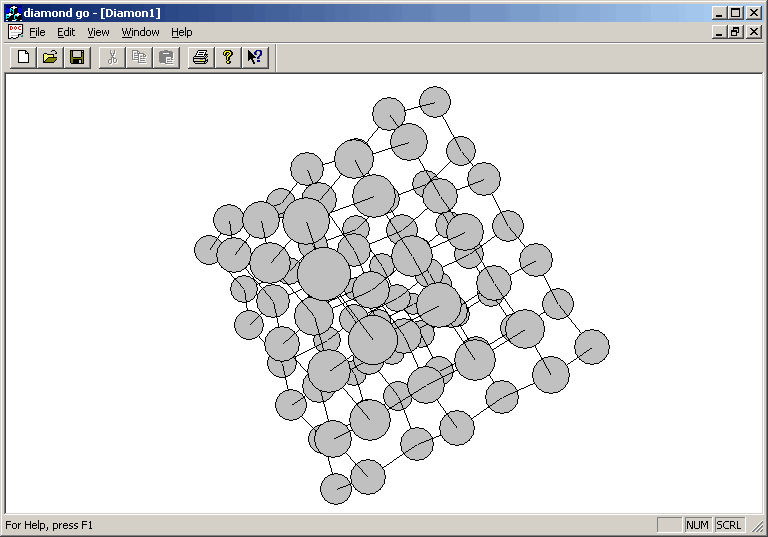
A more interesting approach is Diamond Go, which uses a strange crytalline latice structure in such a way that a true Go experience is recreated in three dimensions. Each location has four, three, or two liberties.

Ishihama Yoshiaki also examines several variations on three dimensional boards that produce playable experiences similar to the two dimentional version, including some really funky board shapes.


Funky.

Links:
Maksim points me to a report exploring games and health, including a game Glucoboy that helps you maintain the body's ideal blood sugar level for diabetics:
Glucoboy is a glucose meter that can be inserted into a Nintendo Gameboy. The product operates independent of the video game system but downloads video game programs that are contained within its circuitry into the Gameboy as a reward for maintaining good blood sugar control. With the patient being responsible for so much of proper diabetes management the Glucoboy carries an essential dual role, providing accurate medical diagnosis for the disease as well as an incentive delivery platform which serves as a key portal for obtaining patient-critical medical data; the foundation for fully automated, individualized, disease management program.
There sure is a lot of new research going into how to marry games and health.

Speaking of games and the body, Columia University and the University of New Mexico have got DNA based computers playing and winning Tic Tac Toe.

Yehuda

Update: Bernie points to a Torus shaped Go board, no corners or sides.

Tuesday, October 17, 2006

Coffee, Go, and Pente [1]

What I could see of the sky was black polygons, edges fading into the yellow-pink glare of streetlights. These same lights poured gold into the Jerusalem stone on the sides of every building. I walked into The Coffee Bean, Tal in tow.

Since Rachel was going to be home late, and since Tal had a voice lesson, I asked her to meet me downtown so that we could go to the Go club together. Tal is not enthusiastic about Go; mostly because she's not very good at it. I hoped that she would be inspired to play, anyway, assuming she didn't have too much homework.

The Jerusalem Go club had been changing locations every few months. This was the second meeting in its new location, a coffee house on the corner of Jaffa road and Heleni Hamalka Street. It was a beautiful location.

However, it was also expensive, with coffees ranging from 15 to 25 NIS ($3.50 - $6.00). Rather steep. Nevertheless, I bought a vanilla coffee for myself and a "hot vanilla" for Tal. It was good; I'll grant them that.

We could see the Go players from the outside as we passed through security. An old friend/acquaintance Josh was instructing a group of others, running through a complete game that had been played recently at a tournament. This was well beyond my level. It's not that I didn't understand what he was saying; it's that I was so far from playing at that level, yet, that the techniques he was discussing simply didn't apply to me.

Altogether, there were around twelve club participants this evening, including myself and Tal, and not including two people who came only to watch. Others, including the waiting staff, gave occasional curious glances. To my surprise, one of the participants was Adam, a regular from my own club.

While Josh continued his teaching in preparation for several games to start [2], Adam and I played on an 11x11 grid. Adam and I knew that he was the stronger player, so I played first and Adam declined the bonus points for second.

When I play Chess, I don't mind losing, but I mind playing well and then forgetting somewhere in the middle of the game that my queen is under attack. Losing that way doesn't give me any lessons learned (other than to always watch for stupid oversights) nor satisfaction if it happens to my opponent. So when I play Go, I don't mind losing, but I want to take back a move if I do something that was obviously stupid. Adam, and Go players in general, wasn't used to that, but he let me.

I did it twice during the game, both times rolling back about three moves. So I don't mind saying that he won, because I took back my moves. After I took back those moves, I concentrated more carefully. The end result was my winning by about 18 points. Next game I hopefully won't make the same stupid mistakes, as I now know what to look for.

The 11x11 board is still largely tactical, as opposed to grandly strategic, but it's still more strategic than the 9x9 board. I was definitely getting into the spirit of the game. I began to look at each pattern and count the liberties, carefully considering different plays that I could do to extend my liberties by more than one, and carefully looking to see what plays my opponent could make to trap me against a wall or another one of his foundations.

I'm always amazed at the game. It's just so beautiful. Although there exist variations other than changing the board size, Go is probably the one game that really doesn't need any variations.

While I played, Josh managed to convince Tal to play a game of "elimination Go", where the winner is the first person to take one of the other player's pieces. Tal declined to play with any handicap, and lost, but she played well.

After my game with Adam, I figured we should split and play with other people. Adam played with someone and I challenged Josh to some Pente. This is a great tactic to use when playing with a Go player who can wipe the floor with you. I am a reasonable Pente player, and Josh had barely played. I won two games off of him, and he immensely enjoyed the games.

While I played Pente, Adam played Go with Tal, and Tal again declined a handicap. This time they played a regular game, and with Adam giving a few nudges here and there, Tal played to an impressive loss of only 15 to 8 (Japanese scoring). That's pretty impressive; it's about what I would expect to score against him.

I played two more games of Pente with someone else at the club (Eli) who had never played before, again winning both. And then Tal and I had to leave.

OK, so I really should have played another game of Go, but I'm not yet an expert at Pente, and it really is an enjoyable game, too. My respect for it goes up a bit each time I play, actually.

High on a great evening, and looking forward to game night tomorrow night, Tal and I left to catch the bus home.

Yehuda

[1] I wanted to use the heading "Coffee, Pente, and Go (Oh my!)", but Tal nixed it.

[2] Josh generally gives his opponents about a six stone advantage.

Monday, October 02, 2006

Sticks and Stones: The Mechanic of Sudden Death

Sticks

Way back in the days when kids had wholesome freckles, wore overalls, and carried slingshots made from a forked stick and a rubber band, the starting team in a street game was decided by throwing a stick up into the air.

One player threw the stick and caught it somewhere in the middle with his hand. He gripped the stick with fist. The designated player from the other team then grabbed the stick with his fist right above where the first one was holding it. The first player placed his other hand on top of the second player's fist, and so on until the last person who was able to grab the stick won the right to go first for his team.

The winner was predetermined from the time the stick was caught. All you really had to do was measure the size of the extended part of the stick and divide it by the size of a fist. That's how many fists were going to fit onto the stick, and that's all you really needed to know. Of course, that way is both slower, and less fun.

Today, we can see this mechanic repeated in various forms in numerous games. Go is a perfect example.

In Go, you may find yourself in a position where you can add a stone to your own group which extends the liberties of the group by one. Your opponent can then reduce your liberties by one by placing his own stone. You can then place another stone, again extending the liberties by one. If this pattern continues toward a blank wall, the conclusion is foregone; you are going to lose your group. However, if the pattern is extending to another one of your groups, the extending group may be saved if both groups can be solidified. A wise opponent will work to ensure that these two groups can never meet.

Another game that uses this mechanic is Gipf. There are, of course, others, such as Through the Desert, Othello, and so on.

Stones

I played my first game of Gipf on Sunday with Tal, and I was pleasantly surprised. For some reason, I was expecting the game to be rather like Pente, and therefore a pedestrian sort of abstract game. It also looked a little like Abalone, a wholly mediocre sort of abstract game. However, it turns out to be quite interesting, at least on first play.

In Gipf, you slide stones from off the board into the hexagonal area, stopping at any empty space. You may also land on an occupied space, pushing all stones in a line the same direction for no more than one space. You may not push any stones off the board in this way.

When you have four in a row, you remove these stones and any others in a contiguous line with them off the board. Your stones return to your store, while your opponent's stones are removed from the game. You lose the game when you must place a stone and have none left in your own store.

Like the two other games in the Gipf series that I have played (Yinsh and Dvonn), the game has simple rules yet creates a wonderfully complex game space.

Here are some things you have to think about, all of which I discovered after only one play.

- Having more pieces on the board gives one more control, but also leaves one closer to sudden death, which occurs if you have no stones left to play.

- If you are running low on stones, you can, if possible, remove your own stones from the board simply in order to have more to play.

- It is possible to create double threats, and just as possible to have the board shift in an unexpected direction before you can complete either of them.

- What one person undoes, another person can redo, up until a certain point.

It is this last point that creates the "stick" mechanic that I noted at the start of this post. One person can push one of your stones out of place, whereupon you can push it right back into place. They can push it right back out of place, and so on, until the line cannot be pushed because to do so would require a piece to be pushed off the board. That tit-for-tat ends in sudden death. The last person to move suddenly wins that battle.

Since this can all be calculated from a given position, you need to have a good reason to start this line of action if the end result isn't going to end up in your favor. Very nice.

I have only two negative things to say about the game from my first impression. The first is that, unlike Dvonn and Yinsh, the rich appear to get richer. That is, it looks hard to come back from a losing position, unlike the other two games.

The second is that the box is inexplicably larger than the boxes of the other two games and therefore doesn't stack properly on my shelf.

And by the way, I won the game against Tal, who essentially stopped trying to win about halfway through the game. We then played Oh Hell, and I won at that, too, although it was only apparent during the last three rounds of the game.

Meanwhile, I finished reading the excellent "Greatest Games of All Time" and I'm working on "A Theory of Fun". I'll report on both of them later.

Yehuda

Wednesday, September 20, 2006

Pallankuzhi, by any other name ...

There's an article in the Hindu about the game Pallankuzhi, a game popular in Southern India.

Apparently the game was the subject of some research at a "three-day festival of games at La Tour de-Pielz near Lausanne". Three day festival of games? News to me. Anyone? Update: Info on the Mancala conference is here. And here are some links to a lot of academic papers on Mancala games (scroll down).

Pallankuzhi is one of a group of similar games that includes Mancala and Oware. It is probably the most ancient game that still exists and is actually "good". Obviously, Go is another candidate.

Interestingly enough, another recent article in the Hindu suggested the link between the two games Pallankuzhi and Warri as a possible means of enhancing an India/Antigua alliance, akin to the "Ping Pong Diplomacy" that enhanced U.S. and Chinese relations in the 1970s.

Speaking of Go, Wired is back on the subject of AI and games, this time taking on Go (thanks, Mischa).

I've been having some back burner chat with Dominic from North Star Games. They produce the games Wits and Wagers and Cluzzle, both well received by my fellow gamers. Dominic is sending me copies of each game to evaluate.

They suffered some collateral damage owing to their relationship with the former Eagle Games and are trying to get back to profitability, so check them out.

Yehuda

Thursday, August 10, 2006

Anime Series Based on the Board Game Go

I know I'm posting a lot, but I can't help it. I promise I'll slow down soon.

ChiyoDad points out an entire anime series based around the board game Go. Wild.

Yehuda

Friday, August 04, 2006

Quickie

Hello, goodbye.

Good people in times of strees:
"One day [last week]," said Motti Avraham, owner of the Mor Minimarket near the southern entrance to the city [Kiriyat Shmonah], "two elderly men walked into my store. I could tell they were from Jerusalem by their accents. One of them asked me if I sold on credit. I said I did. Then he asked me whether some of my clients were poor. I said they were.

"He told me to take out my list of people who owed and mark those who were poor. After I did that, he turned to the other man and said, 'Take it out.' The other man took out a wad of crisp NIS 200 bills. He then began to give me NIS 300 for each of the people I had ticked off and told me to deduct the money from their debt.

"I asked them who they were. They replied, 'What difference does that make?' Then I asked them to at least give me their phone numbers so that their beneficiaries could thank them. They replied that the greatest mitzvah is when the donor does not know whom he has given to."
Mainstream article about humans still reigning supreme at Go versus computers.

Yehuda

Saturday, July 15, 2006

Weekend Gaming

Most people just glance over these Weekend Gaming posts, so I can say anything I want and no one will know.

Books

Let's start with what I've been reading - actually re-reading. I always need to re-read once in a while anything by William Gibson, and Tam Lin by Pamela Dean.


Gibson is the writer we use to prove to the rest of the world that science fiction can first and foremost be good fiction. And Tam Lin is just something lovely and literate that strikes something in me. Soothing.

El Grande

For lunch on shabbat we hosted Nadine and Adam from the game group, Zeke who used to come to the game group occasionally, and some other nice folk.

After lunch we played the classic El Grande, which Nadine has wanted to play again for some time. Zeke didn't mind playing it either, and Adam had never played.

I started out not worrying about intermittent scoring, which left me behind a bit in points but better in position. So at the first scoring, I pulled out in front by about ten points. The others caught up some and then I pulled ahead more by the end of the second scoring round, about fifteen points.

It ended with another catch up and pull ahead, with me ending at about 106 to 93, 91, and 88 (roughly). Still pretty close, actually, although I feel I played pretty tightly, and area control games are my thing.

Go

Nadine then left to go to the shiur with Rachel, after which Adam and I would meet them to play Puerto Rico. Adam asked to play Go, which I was thrilled to oblige.

I had thought I was already advanced enough to graduate from the 9x9 board to the 11x11 board, but apparently I'm not. We started off giving Adam a two stone advantage and the game ended very closely. For a new player, he is quite strong. Some forced battles in the corner, and I lost with 36 points to his 45.

In the second game he only received the first move advantage, and aside from one wrong move on my part, I played a slightly better game. Of course, the one wrong move - not securing a double eye for a territory that I needed, but felt that I could just get later - was a fatal mistake. I noticed it immediately, and would have asked fro my move back, but I wanted to see what would happen. I watched for fifteen moves as he forced my moves in some other area of the board until he finally looked back at that location and then took the spot that I should have. So I lost again. Very nicely done on Adam's part.

Go is a great game.

Puerto Rico

We met up with Nadine and Rachel for Puerto Rico, still the best game in the world despite a wee problem of imbalance when a new player plays. Adam made some mistakes - perfectly reasonable ones for a new player - which resulted in Rachel being able to capitalize on them for some huge bonuses. I struggled along, but without much hope.

The strangest move was when I, with a Harbor, took Captain, which was practically begging for Adam to monopolize a coffee boat (he had a monopoly in coffee). I did this just to prevent Rachel from having continuous access to free boats in order to stop her from shipping her four corns every round. But Adam wouldn't bite, since he wanted to trade the coffee.

For a change, we tried to play with minimal advice given, which was nice.

Link

A forum site for tabletop sports games. Not that I've ever played any, or likely ever will.

Yehuda

Thursday, July 13, 2006

Gaming Narrative and Go in Israel

Gaming Narrative section

Attack of Opportunity talks about the lack of narrative in online RPGs, and his suggestions sound suspiciously to me like turning RPG games into Eurogames. Lucky for him there is a new book called Game Writing: Narrative Skill for Videogames. And while we're on the subject, The Play Ethic talks about emotional narrative in video games.


Israeli Go section

The Jerusalem Go club now meets twice a month in a new location.
Place: Bein Aza Le'Berlin is a choumous place on Shlomtzion Street, 100m down the street from "Daila". The address is : Shlomtzion 12, corner of Ben Sira.

Time: 18:30 first and third MONDAY of the month. Next Mon, 17 July, and then August 7 and 21. If they get enough response they will consider weekly.
And speaking of Go, the following ad appeared in Janglo today:
Learn to play GO and be a winner! Fun, GO boards and green tea are guaranteed!!

Private GO lessons in English, Russian and Hebrew, to all ages in Merkaz HaIr (one-to-one), Ramot (groups) or in your place.

One-to-one lessons cost 80 s.h. and 3-5 participant group session cost 50 s.h. per student. 7+ participants lessons cost 30 s.h. per student.

Call Sensay David at 052 569-4559 (English) or e-mail at chassida@yahoo.com to set up your FREE introductory lesson.


Personal Section

I took a day off from work today to do a number of things: try to get a network set up in my house (which didn't work), discuss retirement and insurance with an agent, go to the dentist, and visit my parents.

Tonight was game night, and the session report will be up tomorrow, hopefully, including first impressions of New England.

Someone offered to trade me Santiago for Goa, which I was happy to accept, seeing as I never really warmed to Goa, and I am passionate about Santiago. To exchange, I had to get Goa back from the Tel Aviv group, and while we were doing that, the TA group got back from me Amun-Re for which they had also received a trade offer for.

That hurts, as Amun-Re was a standby in our group. We may just have to buy it. While I was sending games back to the TA group, I sent along three other games we had borrowed from them but never play: Evo, Oasis, and Attika.

Someone is translating my first Ethics in Gaming article into Latvian, for inclusion on a website.

USA Today complains about the new Ultimate Board Game Collection, in that the games aren't any fun without real opponents. I could have told them that. The point of silly board games is companionship, since the games themselves aren't worth anything.

I also have to add that I'm impressed at how well Binyamin from my game group is doing with his game teaching in Beit El. He is running classes for kids of many ages every day of the week. In school, after school, and full games days. And he is getting great attendance, and the kids love it. An entire generation of kids are being turned on by his efforts. Kol Hakavod, Benny.

Yehuda

Monday, July 03, 2006

Some Israeli and Jerusalem Gaming News

1. A new Chess club is opening in Jerusalem. Their website is here. Their first meeting is today at at 15.45 in the Matnas on Emek Refa'im 12 in the German Colony.

2. A Scrabble tournament in Tel Aviv:
Just over two weeks to go before the Tel Aviv Scrabble Club hosts its
first ever open Scrabble tournament. The tournament will take place on Wednesday, July 19th.

Players in the event will play in different divisions (according to level of play) one division consists almost exclusively of beginners and the experts among you will feel right at home in the expert division.

For further details.

The number of places in limited so please register as soon as you know whether you can come. If you have any questions, don't hesitate to email or phone at 077-8844013 (h) / 09-7781976 (w).
3. The annual Diplomacy Convention DipCon2006 is being planned. For further details contact Sharon Prober.

4. Go meets on the first Tuesday of every month (tomorrow night) in Jerusalem from 19.30+ Cafe Rimon, middle of Lunz Street, a pedestrian link between Ben-Yehuda and Yaffo. (City Centre). Contact person: Uli (Sam) Freed, 054-4925747.

5. ICON 2006, the Israeli sci-fi and roleplaying convention is already scheduled for the entire week of Hol Hamoed Sukkot, 9 - 13 October. As usual, the JSGC will be having a games day on one of those days.

Yehuda

Friday, May 12, 2006

Two Narrative Books about Go

The Master of Go, by Yasunari Kawabata.

This book tells the true story, more or less, about the final game of the reputed "Master of Go" and his challenger, 7 dan Otake. The game took place over eight months in 1938, and the author is a reporter who covered the match, as well as a Go player in his own right. The book uses a classic Japanese story form, starting at the end and then moving back and eventually returning to the starting point.

This is a nice little book that gives the feel of not only the game and its tense play and cultural significance, but also a bit about the family life of the players and the clashing worlds between the old style of Go player and the new one.

One illustration of this clash is described in the introduction of the "sealed play". In the old days, a player would simply make a play when he needed to. If a scheduled break occurred, the players would simply break and return to the game later.

This allowed unscrupulous players to time their moves so that the break would occur when it was their turn to play, allowing them to consider the board during the break without having to use up time on their time clock. In order to forestall this type of activity, the sealed play was introduced. The last play before a break is sealed in an envelope and only placed on the board at the beginning of the next session, thus preventing this type of dishonorable manipulation.

The Master had never played with this rule. The book represents it as one of many needless inelegances that the Master feels as having undermined the spirit of the game. So it seems, almost, as if this game is fated to be his last not only because he is getting old and soon going to die, but because his world has already faded.

And still, the Japanese players have much more in common with each other than they have with the rest of the world. The reporter meets an American enthusiast on a train who plays some games with him. He reports:

He had the forms down well enough, but he had a way of playing thoughtlessly, without really putting himself into the game. Losing did not seem to bother him in the least. He went happily through game after game, as if to say that it was silly to take a mere game seriously ... One always found a competitive urge in a Japanese, however inept he might be at the game. One never encountered a stance as uncertain as this. The spirit of Go was missing.

In contrast to this attitude of Go being a silly game, the master almost resigns when his opponent makes a move that seems almost insulting:

The Master had put the match together as a work of art. It was as if the work, likened to a painting, were smeared black at the moment of highest tension ... Everything is lost when suddenly a false note is struck, or one party in a duet suddenly launches forth on an eccentric flight of his own.

It is quite nice, but somewhat slight. It is not expansive enough to be a masterpiece, but it is a diverting read. You also have to know the basic rules of Go to understand the game play.

The Girl Who Played Go by Shan Sa.

This book of fiction is also based in the 1930's. However, here the game of Go is used entirely as an allegorical device around a more expansive narrative, a backdrop to the Japanese invasion of China.

A young Manchurian girl struggles through her daily life in a small village, including her self-image, friendships, boys and sex, her passions, and her family. Meanwhile, she passes her free time playing Go against a mysterious stranger. This stranger is a Japanese soldier/spy, who is undergoing his own trials and transformations.

This book is lovely and powerful. The armies on both sides are brutal, and the war take its toll on both human lives and human spirit. The book manages to capture both the intimate and personal strivings of the individual as well as the grand struggle of the nations.

Very beautiful, and recommended, although of less interest from a gamer's perspective. You don't need to know anything about the game to enjoy the novel.

Yehuda

Technorati tags: , , ,

Tuesday, May 09, 2006

Go in Israel

Since I'm on the topic of Go, here's a little more about Go, as well as Go in Israel:

Go is considered one of the four arts of the Chinese scholar, which also includes the musical instrument Gǔqín (an ancient instrument, similar to a mandolin), calligraphy, and painting. If you saw the recent movie Hero, a very beautiful film, you would have seen all of these in use.

John Nash is alleged to have invented the game of Hex as a response to the game of Go.

Sensei lists a series of Go proverbs. Sensei is a pretty large place to get you started on Go terms and strategy. There are many others, as well.

In Israel, there is a national Go club called "Go Mind". Its putative link is here, but its real link appears to be here. Click on the English icon on the top left for more info, although the information in English is incomplete.

If you are in Jerusalem, the contact info is:

Jerusalem Go Club
Meetings: Every First Tuesday of the month, from 19.30+ Cafe Rimon, middle of Lunz Street, a pedestrian link between Ben-Yehuda and Yaffo. (City Centre).
Contact person: Uli (Sam) Freed, 054-4925747

Helena King of "The Educational Centre for Games in Israel", whom I mentioned once before, just held a Go meeting in Tel Aviv. She writes:

The Go Tournament on Yom HaAtzmaut in our centre was a great success. 49 young people from the ages of 8 to 18 took part in the tournament and got points of international standing. There was also a sadna for those who are still learning. Needless to say there were parents, grandparents, brothers and sisters. They came from as far away as Beer Sheva and Haifa. The atmosphere was relaxed and happy and the participants look forward to the next tournament which will be on Lag B'Omer.(Not in our place.)

Helen's email is boardgames.ecgi at gmail.

Meanwhile, I'm still up for a game of Go any week at our game club.

Yehuda

Technorati tags: , , ,

Monday, May 08, 2006

Are Games Art? Part 2

This continues the discussion of games being, potentially at least, art. The first part of the discussion can be found here here.

But first, a little digression about ...

The non-definition definition

One of the three criteria I cited as required for something to be art was that it tackled an important theme, or a deep meaning. Not necessarily deliberately, but at least in the experience of the viewer or participant.

Chris Farrell in the comments posited that any issue is sufficiently meaningful, not only 'deep' issues, such as love, hope, faith, etc. It's true that I did not define what makes an issue "deep". And deliberately so.

That is because I would first like to find consensus about the framework before discussing the specifics. In my opinion, what is meaningful changes from society to society, and generation to generation. When someone argues that any issue is sufficiently meaningful, it argues that no meaning is required at all. It is not enough to say that expressing "something" is sufficient. This non-definition drops out of the equation, altogether.

I suspect, although I could be wrong, that when someone retreats to the "any meaning" argument, it is out of a sense of defeat. It is impossible to agree with all people at all times as to what is meaningful. Therefore, rather than argue that the concept of meaning still exists but is subjective, we tend to argue that the concept of meaning doesn't exist at all because it is subjective. I don't agree with that.

As an example, the concept of morality exists. Many diverse segments of the world population can agree or not agree on specific ideas as being moral or immoral. The consensus will never be 100%. Instead, we can say that unprovoked killing of a civilian with religious beliefs different from yours is considered immoral by 92% of the population. Killing an unwanted fetus may be considered immoral by only 60%, or 40%. As the questions become more specific, the numbers may change. What stage in pregnancy? What is the health of the mother? And so on.

Just because we can't agree 100% that a specific act is moral or immoral, doesn't eliminate the idea that all of us can agree on the idea that it is better to act morally rather than immorally. OK, all of us may not agree even about that, but frankly, that is where I draw my first line; I'm simply not talking to the people on the other side of that line. Those of us on this side of the line, which even includes suicide bombers most likely, may point at acts diametrically opposed to each other and call them moral, but we at least have one initial common framework for discussion.

In the same vein, although we may disagree about what is meaningful, I think that many of us would agree that we would like art to include the concept of meaning in it, rather than simply wave our hands and say that since we can't convince people what is meaningful, that art doesn't have to be.

No dialog can ever really succeed without an initial common framework. That is why I choose to draw it for art, perhaps more restrictively than others might. My minimum first line is that art must tackle one of the classic ideas, a deep meaning. The line is wide and gray, but the line does exist.

In a similar conversation on Alfred's blog, Alfred and I talked a bit at cross purposes. Alfred doesn't define art, since as a historian he is more concerned about what society chooses to identify as art. That may be, but I was discussing frameworks, not anthropology. Here are my comments from that discussion:

As I mentioned in my previous article, when anything can be X, then nothing is X. In order for there to be art, there must be non-art. Otherwise, you have simply discarded all definition. I don't give up that easily.

I know that the definition of "meaningful" is subjective. However, I deliberately did not give a definition of "meaningful" in that paragraph. I am fully aware that, following my definition, one item can be considered art by one person and not art by another, or art at one time, and not art in another.

My definition does not suffer as a result of this discrepancy. It is perfectly acceptable for people to debate specific items from now until doomsday, so long as they have a definition upon which to debate. If they have no definition, then there is nothing to discuss at all.

By discussing whether something is or isn't art, you discuss the value and meaning of an item. Without that to discuss, then you accept all items, even those without value or meaning.

My definition does not pin down a specific item and call it art. It only holds up an objective for items to be considered against.

Also missing from my definition is "what is meaningful"? Hope? Faith? Sadness? Shame? These can also be discussed. But whatever you choose to place, or not to place, within the definition of meaningful, so long as it doesn't include everything or nothing, it is still fits within this workable definition for art.

A definition that includes within art "anything called art" on the other hand means precisely nothing. Actually, it is much worse than nothing, because it equates equal value of meaning to meaningless. [Note that this is fine for a historian studying a culture, just not for a philosopher studying art.]

One person can't dictate to another what is meaningful or not, but unless we hold that something can have meaning, we lose a vital concept of civilization. Just because we don't agree on a specific item as valuable, doesn't mean that we can't agree that valuable is better than valueless, and that it should be our goal.

I believe that people can be educated to make moral choices about behavior, even when other people say that all morality is relative. And I think that people can make critical distinctions about art, despite when other people say that everything is art.


So much for that. Of course, there can be reasonable objection that if nothing specific can be identified as meaningful, than meaningful really doesn't exist. I would prefer to not address that for the moment.

One more word: I notice that I left a hole here that would let slip in childish games that are facile attempts to instill morals or teach ideas, such as an eco-themed Monopoly style game. Let me state that I wouldn't consider these to be of any artistic merit, owing firstly to them being highly unoriginal, and secondly to their messages being shallow, at best. Didactic teachings, even about meaningful subjects, are generally neither meaningful nor artistic, in my opinion.

Games

On to specific games. Since we are now entering a discussion that deals with specific games, and in which we will be talking about whether specific issues are, or are not, meaningful according to my definition, I expect my first tentative choices to be wholly unsatisfying to many people. That is fair and fine; arguing about meaning and whether an item is or isn't art is as good a use of one's time as anything else.

In my previous article, I suggested that Go should be considered art. Chris added that some other games, such as Settlers of Catan, Modern Art, and Lord of the Rings could be considered art.

It should be noted in the following that there is no connection between my rating or enjoyment of a game and what I consider its inherent artistic value. However, it is likely that a very poor game is likely to have little in the way of artistic merit.

Go

Go is an elegant, yet extremely complex abstract game. When you are first learning to play Go, you learn many of the simple concepts of Go tactics, such as ladders, liberties, connections, threats, and so on. However, as your depth of the game increases (and mine is not all that deep, by the way), you begin to see not only general patterns about the game, but the patterns in the game as they reflect ideas of the world.

It is a bit hard to explain, since the lessons are not so much difference from ideas touched on briefly during other games. In Go, however, they are not just ideas that you briefly experience, but ideas to which you gain insight. The art of a single stone placement can ripple to all corners of the board. The simplicity of an individual becomes not only a part of a whole, but more than a whole. Balance of power, wavelike movement within seemingly immovable pieces, and the perseverance of will can all be experienced. After mastering Go, one looks at life itself differently.

For most other games, a play simply nets more points or less points. In Go, there are honorable and dishonorable plays, violent and respectful plays. All of this is experienced as a result of the dialog between the authors of the game and the players and onlookers.

I suspect that it has a lot to do with the lack of random elements, other than your opponent's mind, as well as the sufficiently large board that allows for several different phases of the game to occur.

Other abstracts

There are other complex abstracts, such as Chinese and traditional chess, Shogi, and so on. I would say that many of these have elements of art in them, although to a less successful degree that Go does.

Simple abstracts, such as Othello or Checkers do not seem to reveal any deep meanings as they are being played, at least to me. Therefore, I wouldn't consider them art.

Eurogames

Let's start with Settlers of Catan. Basic important principles must be used in Settlers of Catan , like many other games, such as: trading promiscuously is beneficial, early investment results in increased profits, lying low can help you avoid becoming a target, changing paths can be profitable if one avenue to success dries up, and not to lose sight of the ultimate goal.

Furthermore, we can also note a reasonable simplicity and elegance in the design, marred perhaps by the development cards which are not so elegant.

Perhaps the strongest argument is the integration of all players at all points during the game, while many previous games followed a strict turn structure.

What seems to be lacking here is that while you may need to bring important ideas into the game, and while you may even learn some basic concepts of tactics as a result of the game, nevertheless I don't feel that the game really touches upon an elemental human theme. Perseverance, yes, but no more so than any other game. Patterns, yes, but nothing that would awaken a sense of awe or inspiration, or cause you to look at the world differently.

This is where my insistence on deeper meaning exacts a harsh cutoff. I can't really think of any Eurogames that would qualify as art under my definition.

Others

Instantiations of roleplaying games would need to deal specifically with moral, artistic, or philosophical issues. However, the roleplaying game is more akin to a pack of paints. Probably most systems can be used to produce specific campaigns or sessions that are works of art. There are exceptions, of course.

I don't know much about war games, but I think that I know enough to disqualify ASL, as it appears to be heavily technical and not very deep for all of its massive, massive breadth. I would look more for games where a specific engagement would directly inspire deeper feelings in the players. Perhaps missions of mercy, rescue, or terror, engagements that teach about judgment and consequence beyond the descriptions in the rulebooks, or highly stylized journeys through new and interesting territory and worlds.

There you go. That's as subjective as it gets. Not much in the way of art in games at this point. Maybe next time I'll try to describe how games can be designed with more art in them.

Yehuda

Techorati tags: , , , , , ,

Sunday, April 16, 2006

Hike, Town, and Gaming

Hike

Mistakes were made

Friday, the first day of Hol Hamoed, is the second day of Passover, and the first day that is half mundane/half holiday. That means that, while food restrictions of Passover are still in effect, other proscriptions are not. And, since it was a Friday, and we were going to Beit Shemesh for shabbat and did not need to prepare meals for shabbat, it was good day for hiking.

For the competent, that is.

My first trouble was the fact that it was a really hot day. Nowhere near summer heat, but hot. At least it wasn't raining, like it would be the next day.

My next problem was that Rachel wasn't available to come, so it would be just me, Saarya, and Tal. In order to boost the companionship, I invited some friends who had two young kids to join us. Their kids are only 2 and 3 years old, something which should have bothered me when considering whether to invite them on a hike. However, the kids were not too much problem, as the parents were willing to carry them most of the time, and they didn't whine overly much (a bit, but not too much)

The biggest problem was my ability to follow directions. A tour-guide friend of mine gave me directions to the hike, which included "drive to the end of the dirt road, and then get out, cross under the train tracks, and begin hiking the black trail".

Unfortunately, my ability to understand "the end of the dirt road" did not include the logic that the dirt road ends at the big sign that said "only 4x4s beyond this point". Me and my little sedan, followed by my friends and their little sedan, looked around at this point, didn't see the bridge under the train tracks, and decided to keep on going down the dirt road, slowly.

For an hour.

Until I realized that there is a reason why only 4x4s should go beyond this point. I then had to make a painful and nervous turnaround without falling off the road into the polluted stream, and drive for another hour slowly back to the sign.

That effectively killed a lot of our hiking time, not to mention probably all of my tires. They're not deflated yet, but I expect them to have lost half their lives, at least.

With a little bit of looking around, we now found the bridge and the black trail. Now, my instructions were to walk up the black trail, rest at the top, and then go down the blue trail until you hit the green trail, and then down the green trail until you end up back at the start of the black trail. This is because the black trail is more populated by other hikers, while the blue/green trails are nicer, slightly longer, and less populated.

Naturally, we started up the green trail, intending to come back down the black trail. Actually, that was not so bad; it really was a lovely trail, shaded, great flowers at this time of year, and great views. However, owing to having started so late, we were still on the blue trail after an hour and we had no idea of how long it would continue before we got to the top and could return on the black trail. And we were running out of water.

It was already getting close to shabbat, and both Saarya and I knew that we could descend the way we came and get to Beit Shemesh in time for shabbat, whereas we had no idea, other than instructions and hope, that if we continued that we would make it back in time. After all, we may have been going completely the wrong direction, for all I knew.

The other family decided to continue, while we returned the way we came. A little frustrated for having backtracked twice in one day. We heard later that they got back to their car about half an hour after we did, which would still have worked, but would have been cutting it close. In any case, the prudent course was the best choice.

These types of minor disasters happen to me all too often. The only time they are worse is when Rachel comes. Rachel's Battle Cry of Hiking is "Let's get lost!". She's only happy when we no longer know where we are and are scrambling around the side of a garbage dump next to an eight meter drop into a barren pit, or crossing a live firing range (both true events).

Back to nature

Israel has extensive marked trails and nature preserves, when they are not being burned down by our enemies or careless hikers. Leave any city and you will see numerous brown signs and little paths pointing you to the start of trails, overlooks, historic sites or ruins (by the bucketful), and so on.

You can actually get all the way from the tippy top of Israel to the bottom of Eilat on a series of connected hiking trails. The nicest ones also have water during the winter and spring (watch out for flash floods in rains).

The biggest problem for me is that most of them feel dry. You don't get that sort of wet, fungus, lichen, ferns, green misty sense that you do hiking around new England. Instead, unless it has literally just rained, the trees and air always feel dry and rough. There are usually thistles and some cacti on the train.

What we do have, in March and still in April, are beautiful wildflowers, especially blood-red poppies, as well as various white and purple things. Books are available on the subject, if you are interested. Sorry, I didn't bring my camera on the hike.

Town

Nofei Aviv

Nofie Aviv is a community within Beit Shemesh. It is basically an Anglo enclave, although some native Israelis or others also live there. Picture a banana shape of about 200 houses around the base of a hill. The residents are almost all very well off. Houses sell for $400,000.

Off of the convex side of the houses, you get fields going up another hill to the Beit Jamal monastery (makes lovely ceramics). On the convex side, and a little higher up the hill, are the "tromim", which are stucco apartment buildings with very poor people, including many immigrants from Ethiopia. The Ethiopians are Jews who were rescued from the warfare and poverty in their country, but haven't quite been integrated into society, yet, either due to cultural, political, or economic reasons.

Continue past the tromim, and you get the rest of Beit Shemesh, in its various forms, about 40,000 people. Nofei Aviv is one of the wealthiest spots, strangely situated right next to one of the poorest spots.

The attitude of Nofei Aviv is the conflicting attitude of the wealthy but religious. They complain about their neighbors trashing their park and playground, breaking in and stealing their bicycles and cars, and generally looking threatening. On the other hand, they donate tons and tons of clothes, food, household items, and so on, run education programs, both religious and economic, and hire them when possible at modest wages.

The shul and its colors

One place where this stands out most is in shul. The shul is a generally modest but large building right up against the tromim apartments. The entrance to the shul is even facing these apartments. The shul may have cost $800,000, but this is mostly due to its size and air conditioning units; it is pretty understated and not flashy. The exception to this is a humongous ostentatious chandelier which someone donated recently and hung in the main sanctuary; it might be kind of pretty in the oval office, but looks totally ridiculous in the shul. Most people in Nofei Aviv feel the same way and are angry about it, but it was, after all, donated.

But what's interesting is that some of the Ethiopians from the tromim come to shul. It started with one or two families, and is now about eight or ten families. And every single one of these black-skinned people sits in the back corner of the shul in a little group.

There is no discriminatory policy in this shul, as far as I know. Each of these people gets called up to make blessing on the torah like any other person would in the shul. They get honored with holding the torah, or opening the ark. No one, to my knowledge, has ever so much as given them a dirty glance that would make them uncomfortable if they chose to sit more scattered around the shul. People say hello to them and shake their hands after shul like they do to everyone else they see after shul, although they don't speak English or much Hebrew.

I asked someone about this, and he said that the truth is that many sub-cultures sit together in shul. The French speakers all sit together, too. It's just that this isn't noticeable because you can't tell a French speaker just by looking at him or her, as you can an Ethiopian. When an American or British black visits, as they do on occasion, they sit anywhere in shul without any problems or particular notice (well, everyone notices a black in a room full of whites, but no more particular notice than that). I guess it is just the fact that they are all in the back corner that makes it seem weird.

But enough about all that.

Gaming

In Dallas I stayed with my friends the Elkins who are on sabbatical for a year. In Beit Shemesh, we stayed in their house which is still occupied by their 19 year old son and 18 year old daughter. We would have stayed with my parents, but they are in Haifa for Passover and had rented out their house.

In the Elkins house I get to play Billiards, another one of my little passions. I am passingly competent in many things, and Billiards demonstrates this very well. Although out of practice, since I never play unless I visit the Elkins, I am still capable of breaking, sinking balls, positioning shots, and so on. Not with any real professional competency, nor with great consistency, but pretty good. I managed to win five games before losing one.

We are not likely to get a Billiards table in our house any time soon, not only because they are grossly expensive, but because the act of playing Billiards somehow seems even more indolent to my wife than playing board games.

Friday night we ate at the Ehrmans. They are a good match for us, in many ways. The father is a torah learner like my wife, and a passionate Jew, singing songs and so on during the meal. He also used to run an online computer game company called "2am" and has many years of game experience.

They have some good games in their house, like Settlers, Carcassonne, San Marco, Junta, and so on, and they play a lot of Bridge (not too well, I gathered).

Last time I was there I taught the kids (seven of them, plus friends) how to play Spit. This time I was nicer to my hosts and avoided a game with screaming, and taught them how to play Oh Hell. I seem to be on an Oh Hell kick, even though the game is fairly random, and I don't really like the rule about the dealer having to not bid a sum that would add up to the number of cards.

We started with 5 players, but lost one after two rounds, and finished with 4 players. I won by a large margin. All the while, one of the players was complaining about how the game was "all luck". I was trying to explain how there is "luck" and "all luck", but without much success. The fact that I won 40+ to single digits all around should have been enough to convince her, but apparently it wasn't.

The next day at lunch we went to another family, one that I have mentioned before. They have visited us for shabbat a few times. The parents don't play anything; well, David, the father, is willing to play the game: going around in a circle, each person says a number and the person who said the highest number wins.

Luckily, the son Shlomi plays, and he was keen to play Go with me again, as was I with him. Last time we played, I thought that I would be better than him, but it turned out that he was even or slightly better than me. This time we played eight games, taking turns going first, and each time the person who went first won. That is about as even as you can get. We played on a 9x9 board. I invited Shlomi to Games Day which was on the following day.

Back at the Elkins house in late afternoon I taught and played some more Oh Hell and Billiards.

I also played some Settlers of Catan, and completely failed to teach an 18 year old girl how to play. She was the type that would just look at you and smile, and cringe and complain that she can't understand a word that you are talking about. She begged to be released from the game before it began, and I realized that it would have been pointless to try to encourage her to play any further.

Instead, I played three player, stealing the Longest Road from Saarya, who stole it back to win the game. I can't remember the last time I beat Saarya at any game, and he's only 14 years old. My son.

Yehuda

Technorati tags: , , , , ,