Power Grid: Factory Manager is the latest game from Friedman Friess, a green-haired, goofy, and goofy-looking guy who creates really good board games. Most of his games have two "F"s in their German name, and most of his box covers have a substantial amount of green in them, like his hair.
FM is in the same "world" as Power Grid, his most successful game, although its mechanics have little to do with PG. The artwork and detailing are the same, and there is a plant market with lower valued plants available before higher valued ones. But that's where the similarity ends. No route connections, no buying fuel, no running out the fuel supply, and no auto-balancing mechanism for "last place".
Instead, you have a factory with 14 spaces for machines, 9 workers, and money. Each machine adds or reduces to the energy your factory requires to run, adds or reduces the workers your factory requires to run, or adds to the amount you produce or the amount you can store. Two spaces are allocated to certain types of machines, leaving 12 for your general machines, robots, and storage equipment. And 2 of those 10 spaces cost money to build (like Bohnanza, once you build them, they stick around and you don't have to pay for them again).
Your income at the end of each round is the lesser of your production and storage values x 10, minus your energy cost x the price of energy, which rises sporadically over the game's five turns. It starts at an insignificant 1, but could reach 8 by turn five, in theory.
You have available to you each turn the number of workers that are not busy operating your machines. You bid with these workers for turn order: lower turn order means first crack at plants, but less monetary reduction of the plants' costs. Then, in turn order, you drop as many plants from the supply stacks into the market as you have workers (less the ones you used to bid), and each other player does the same, with the last player able to optionally add a few more plants if he or she wants (not in a two-player game).
Then, in turn order, you buy whatever plants you can afford from the market, but no more than one plant per space you have available in your factory, and no more than the number of workers you didn't use for bidding. If you have no space left in your factory, you can clear away a location at the cost of another worker. First player does all of his buying before second player, and so on, and so - barring lack of money - buys all the good plants. Last player generally gets crap to choose from, and pays much less for it.
After all this, you get all of your workers back, reassign as many as you need to run your plants, leaving you with however many are left. You can also buy up to two additional workers at 7 bucks each, which can be used as regular workers for all things. They go away in the next round at this same point, though you can then buy them again.
Any items in the market go back on top of the supply stacks. This means that crap buildings that even the last player didn't want get put back onto the stack and are the first ones out of the gate again on the next round. Power Grid had a mechanism of getting rid of these wastes of space, but Factory Manager leaves these in, apparently deliberately. I'm not sure why. I think PG's idea was better. I found this annoying in FM, but perhaps it's not such a problem in a four or five player game. I will have to see.
You then collect income. The game is limited to five rounds, which is somewhat surprising for this type of game, but seems to be about right. The winner is the one with the most money.
In our game, I had the most money at the end of turn four, and couldn't do anything useful in turn five, so I did nothing and saved my money. Nadine did tons of stuff in turn five, shooting ahead in every area, but costing her a lot of money. As a result, even though income is doubled in turn five, I was still far ahead at the end.
It's a lot of juggling numbers. Add this and that and that, subtract this and that and that, factor in the money and workers required. Unlike PG, it didn't provide much tension as a two-player game, but that may be because we didn't know to block each other for turn order enough. Going first in the turn order is a huge advantage, but only if you have enough workers to do something with it. I suspect that multi-player is where the game shines.
Showing posts with label power grid. Show all posts
Showing posts with label power grid. Show all posts
Saturday, January 16, 2010


Thursday, November 12, 2009
I Can't Give You Water Because We Sell Water
Or, Adventures in Cincinnati
Half-Priced Books
I drove along small roads, because I couldn't figure out how to get onto and off of the major highways. Cincinnati's highways look like an overturned bowl of spaghetti. Look at your hand with your fingers spread out. That's what the end of I75 looks like, only, each finger has another hand coming off of it, some fingers merge back together, and there's no telling which ones go left or right around the bend.
Driving the small roads was, aside from a lengthier drive, a tour of the underbelly of Cincinnati. It's not pretty, at least the part I drove on (mostly Rt 27). But I discovered a Half-Priced Books. I loved the Half-Priced Books in Dallas. This one was ok, but only a third of the size of the one in Dallas.
I used to buy a lot of audio media: now I cycled through the records (my player doesn't work anymore), the cassettes (too fragile), and the CD's (I'll get these on occasion), and discovered that I'm really not in the market for audio media anymore. It's not that I don't listen to audio. It's that I can find any song for free, legally (a video, a promotional website). And, more importantly, I have access to so much music today, that I don't need any one particular song. I like genres of music now, not particular songs or artists. OK, I still like some artists more than others, but there are so many great artists that I'm not going to miss any one if I don't have their music.
That left games and books. I found one or two things I would consider reading, but nothing I would consider buying.
Newport on the Levee
Newport on the Levee promised shopping, an aquarium, movies, and I wasn't sure what else. Not really a fantastic choice. I think the zoo or Krohn Conservatory would have been better bets (and there's supposedly some downtown fountain area that I don't know much about).
Parking was $2, which was fine. I hit the aquarium, which was $20, which was about 50% too expensive.
It's a nice aquarium. Nice setups, interesting fish and slimy things, with the occasional out of place display (what's an owl doing here?). Staff are friendly. But it's smaller than I was hoping for. No jumping dolphins or whales, no sea shows. Little in the way of hands on exhibits. In short, it was worth $10, not $20.
Some pics:

This display included "four-eyes", little fish that hover at the surface of the water like submarines, their bubble eyes only above the surface, with split vision below the surface as well. You can't really see them in this picture.

I've got Australia and I'm going to wait you out.

Hiss.

Bark bark. (These animals go a bit crazy in here.)

Meow.
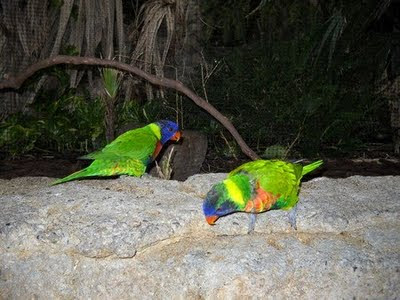
Birds at an aquarium. Whatever.

This guy was mammoth, and was slithering his way through the electric cables in the ceiling, crunching the light fixtures in his way.

The jellyfish display was the nicest part.

Freaky.

A shark ray, pretty rare. She just got a mate, and they are trying to play matchmaker.

Lawyers.

One of the few hands-on displays, you could pet these sharks.

Help, I've fallen and I can't get up. (Which reminds me: What did Jesus say when he wasn't allowed into the Disco club? "Help! I've risen and I can't get down!")
The gift shop through which they force you to walk was ok, but there was only one game on display: Oceanopoly. Hey Z-Man! Try sending them a few copies of Reef Encounter. Actually, I think I'll write to Zev about it.
It's Not Me
After the aquarium I went to the attached mall, which is mostly a waiting room for a multiplex cinema. Not much here, but they had free wifi.
Here is what life is like in America, for those of you who don't know:
Me: "I'd like some water, please."
Pleasant counter person: "I'm sorry. We sell bottled water, so I'm not allowed to give you water."
Me: "The sink is right there. There's a plastic cup right there."
PCP: "I'm sorry. It's not me. Those are the rules."
Me: "You realize that this is not good for PR, or for business?"
PCP: "It's not me."
Me: "Thanks, bye."
PCP: "There's a water fountain right over there."
Me: "So you can't sell me water, but you can point me to the water fountain?"
I sat down and connected to the wifi, but my battery was running low. There was a plug on the wall, behind a stand at which you stamp your parking ticket if you've been to see a movie, so that you can get some of your parking money back. The stand was not really close to the wall or the plug.
I plugged in.
Pleasant Mall Worker: "I'm sorry, sir, but you can't be back here."
Me: "I'm just plugging my computer in."
PMW: "It's not me. They just don't want anyone behind the stand."
Other than the mall work staff, there was no one else in the mall.
Me: "... Ok, I'll just sit here, a few feet away and not actually behind the stand."
PMW: "That's ok then."
I sat on the floor near a doorway into some shop, Christmas lights dripping over my head. Unless they stick a turkey into the manger, I think Thanksgiving decorations are no longer functional. Out came a shop worker.
Pleasant Shop Worker: "I'm sorry, sir, but you can't sit here. You're blocking the shop door."
Me: "I am?"
PSW: "Yes, it's not me. They don't want anyone blocking the door, so that people won't trip."
I scooted a few inches back toward the stand.
Me: "How's that?"
PSW: "That's fine. It's not me, you know. That's the rules."
Game Night at Yottaquest
Yottaquest is a game store in Northern Cincinnati, run by an amiable and well-loved guy named Matthew. Goodman Games chose it as America's favorite game store in 2009. They have plenty of space for gaming, and a newsletter.

And they have good taste in games (note the game on the left).
There were some 20 to 25 people gaming ...

All night gamers playing Descent ...

Euro gamers playing Power Grid ... (including me. I trounced them, playing somewhat unusually. I started with plant 4, and then, seeing the competition for cheap places to build, I rushed to build more cities than I could power. No one contested me for early high capacity plants. That let me rush through to stage 2, and pretty much end the game while others were scrambling for capacity.
The player on the left gave me the most competition, but he hung back in cities, not expecting me to push through to stage 2 so quickly.)

Playing Dungeon Lords ...

Playing Endeavor, which I really wanted to play, rather than Power Grid.

And, in the back room, playing miniatures ...

And role playing.
After Power Grid, I played a filler card game for 2 to 6 players called Alice and Wonderland Parade. The game has zero to do with Alice and Wonderland. It is a simple avoidance card game like Geschenkt.
There are 6 suits, each with cards numbered 0 to 10. On your turn, you add a card to the end of the parade and draw a new one from the deck. You then may have to take cards from the back of the parade and place them in front of you (negative points). You take cards as follows: Let's say you place a card of value N with a color of C. E.g. a 7 Red. You ignore your own card and the most recently placed N (7) cards in the parade. For all other cards in the parade, you take all cards of value N (7) or less, as well as all cards of the same color C (Red) as your card.
The game continues until the deck is exhausted, and then all players play one more turn without drawing any new cards, which leaves them each with four cards in their hand. Each player chooses two of these cards (simultaneous select and reveal) to add to their board in front of them. Then points are counted.
Count the face value of all cards. However, in any color in which you have, or are tied for, the most cards, you score only one per card. Lowest score wins.
On first play, the mechanic, like Geschenkt's, appears to be brilliantly balanced. There are no good or bad cards, but how you play them is quite interesting. It plays quickly and for up to 6 players (though I suspect it is best with 3 to 5). I loved it.
The cards were really thin and pathetic, unfortunately. I'll probably just play it with my set of Sticheln cards. Sorry, designer/publisher. And what's with the meaningless theme?
After this, I joined a Dominion game. Several games had already been played throughout the evening. We played with a mixture of cards, but many were from Seaside, with which I have no experience.

I got thoroughly trounced. The set contained very little in the way of bonus coin value; only Pirate Attacks gave dependable coinage boost, but I didn't recognize that until too late and they were all gone. Some other cards let you draw Silvers and so on, but the Pirate Attacks just robbed them away from you, especially in a five player game where you might be hit by three attacks by the time it's your turn again.
There were also no bonus actions, except for the Pearl Diver, which didn't do enough.
I ended with 6 points, while everyone else had at least double digits. The winner had 24 or 26.
I showed some people how to play It's Alive, but, again, I didn't see how it went, and, again, they didn't choose to play it a second time. Hmmm...
Another nice group of people and some fun gaming.
Half-Priced Books
I drove along small roads, because I couldn't figure out how to get onto and off of the major highways. Cincinnati's highways look like an overturned bowl of spaghetti. Look at your hand with your fingers spread out. That's what the end of I75 looks like, only, each finger has another hand coming off of it, some fingers merge back together, and there's no telling which ones go left or right around the bend.
Driving the small roads was, aside from a lengthier drive, a tour of the underbelly of Cincinnati. It's not pretty, at least the part I drove on (mostly Rt 27). But I discovered a Half-Priced Books. I loved the Half-Priced Books in Dallas. This one was ok, but only a third of the size of the one in Dallas.
I used to buy a lot of audio media: now I cycled through the records (my player doesn't work anymore), the cassettes (too fragile), and the CD's (I'll get these on occasion), and discovered that I'm really not in the market for audio media anymore. It's not that I don't listen to audio. It's that I can find any song for free, legally (a video, a promotional website). And, more importantly, I have access to so much music today, that I don't need any one particular song. I like genres of music now, not particular songs or artists. OK, I still like some artists more than others, but there are so many great artists that I'm not going to miss any one if I don't have their music.
That left games and books. I found one or two things I would consider reading, but nothing I would consider buying.
Newport on the Levee
Newport on the Levee promised shopping, an aquarium, movies, and I wasn't sure what else. Not really a fantastic choice. I think the zoo or Krohn Conservatory would have been better bets (and there's supposedly some downtown fountain area that I don't know much about).
Parking was $2, which was fine. I hit the aquarium, which was $20, which was about 50% too expensive.
It's a nice aquarium. Nice setups, interesting fish and slimy things, with the occasional out of place display (what's an owl doing here?). Staff are friendly. But it's smaller than I was hoping for. No jumping dolphins or whales, no sea shows. Little in the way of hands on exhibits. In short, it was worth $10, not $20.
Some pics:

This display included "four-eyes", little fish that hover at the surface of the water like submarines, their bubble eyes only above the surface, with split vision below the surface as well. You can't really see them in this picture.

I've got Australia and I'm going to wait you out.

Hiss.

Bark bark. (These animals go a bit crazy in here.)

Meow.

Birds at an aquarium. Whatever.

This guy was mammoth, and was slithering his way through the electric cables in the ceiling, crunching the light fixtures in his way.

The jellyfish display was the nicest part.

Freaky.

A shark ray, pretty rare. She just got a mate, and they are trying to play matchmaker.

Lawyers.

One of the few hands-on displays, you could pet these sharks.

Help, I've fallen and I can't get up. (Which reminds me: What did Jesus say when he wasn't allowed into the Disco club? "Help! I've risen and I can't get down!")
The gift shop through which they force you to walk was ok, but there was only one game on display: Oceanopoly. Hey Z-Man! Try sending them a few copies of Reef Encounter. Actually, I think I'll write to Zev about it.
It's Not Me
After the aquarium I went to the attached mall, which is mostly a waiting room for a multiplex cinema. Not much here, but they had free wifi.
Here is what life is like in America, for those of you who don't know:
Me: "I'd like some water, please."
Pleasant counter person: "I'm sorry. We sell bottled water, so I'm not allowed to give you water."
Me: "The sink is right there. There's a plastic cup right there."
PCP: "I'm sorry. It's not me. Those are the rules."
Me: "You realize that this is not good for PR, or for business?"
PCP: "It's not me."
Me: "Thanks, bye."
PCP: "There's a water fountain right over there."
Me: "So you can't sell me water, but you can point me to the water fountain?"
I sat down and connected to the wifi, but my battery was running low. There was a plug on the wall, behind a stand at which you stamp your parking ticket if you've been to see a movie, so that you can get some of your parking money back. The stand was not really close to the wall or the plug.
I plugged in.
Pleasant Mall Worker: "I'm sorry, sir, but you can't be back here."
Me: "I'm just plugging my computer in."
PMW: "It's not me. They just don't want anyone behind the stand."
Other than the mall work staff, there was no one else in the mall.
Me: "... Ok, I'll just sit here, a few feet away and not actually behind the stand."
PMW: "That's ok then."
I sat on the floor near a doorway into some shop, Christmas lights dripping over my head. Unless they stick a turkey into the manger, I think Thanksgiving decorations are no longer functional. Out came a shop worker.
Pleasant Shop Worker: "I'm sorry, sir, but you can't sit here. You're blocking the shop door."
Me: "I am?"
PSW: "Yes, it's not me. They don't want anyone blocking the door, so that people won't trip."
I scooted a few inches back toward the stand.
Me: "How's that?"
PSW: "That's fine. It's not me, you know. That's the rules."
Game Night at Yottaquest
Yottaquest is a game store in Northern Cincinnati, run by an amiable and well-loved guy named Matthew. Goodman Games chose it as America's favorite game store in 2009. They have plenty of space for gaming, and a newsletter.

And they have good taste in games (note the game on the left).
There were some 20 to 25 people gaming ...

All night gamers playing Descent ...

Euro gamers playing Power Grid ... (including me. I trounced them, playing somewhat unusually. I started with plant 4, and then, seeing the competition for cheap places to build, I rushed to build more cities than I could power. No one contested me for early high capacity plants. That let me rush through to stage 2, and pretty much end the game while others were scrambling for capacity.
The player on the left gave me the most competition, but he hung back in cities, not expecting me to push through to stage 2 so quickly.)

Playing Dungeon Lords ...

Playing Endeavor, which I really wanted to play, rather than Power Grid.

And, in the back room, playing miniatures ...

And role playing.
After Power Grid, I played a filler card game for 2 to 6 players called Alice and Wonderland Parade. The game has zero to do with Alice and Wonderland. It is a simple avoidance card game like Geschenkt.
There are 6 suits, each with cards numbered 0 to 10. On your turn, you add a card to the end of the parade and draw a new one from the deck. You then may have to take cards from the back of the parade and place them in front of you (negative points). You take cards as follows: Let's say you place a card of value N with a color of C. E.g. a 7 Red. You ignore your own card and the most recently placed N (7) cards in the parade. For all other cards in the parade, you take all cards of value N (7) or less, as well as all cards of the same color C (Red) as your card.
The game continues until the deck is exhausted, and then all players play one more turn without drawing any new cards, which leaves them each with four cards in their hand. Each player chooses two of these cards (simultaneous select and reveal) to add to their board in front of them. Then points are counted.
Count the face value of all cards. However, in any color in which you have, or are tied for, the most cards, you score only one per card. Lowest score wins.
On first play, the mechanic, like Geschenkt's, appears to be brilliantly balanced. There are no good or bad cards, but how you play them is quite interesting. It plays quickly and for up to 6 players (though I suspect it is best with 3 to 5). I loved it.
The cards were really thin and pathetic, unfortunately. I'll probably just play it with my set of Sticheln cards. Sorry, designer/publisher. And what's with the meaningless theme?
After this, I joined a Dominion game. Several games had already been played throughout the evening. We played with a mixture of cards, but many were from Seaside, with which I have no experience.

I got thoroughly trounced. The set contained very little in the way of bonus coin value; only Pirate Attacks gave dependable coinage boost, but I didn't recognize that until too late and they were all gone. Some other cards let you draw Silvers and so on, but the Pirate Attacks just robbed them away from you, especially in a five player game where you might be hit by three attacks by the time it's your turn again.
There were also no bonus actions, except for the Pearl Diver, which didn't do enough.
I ended with 6 points, while everyone else had at least double digits. The winner had 24 or 26.
I showed some people how to play It's Alive, but, again, I didn't see how it went, and, again, they didn't choose to play it a second time. Hmmm...
Another nice group of people and some fun gaming.
Sunday, September 13, 2009
Lazy Shabbat Gaming
Nadine, Abraham, Eitan, and Emily came over for a game on shabbat afternoon.
Nadine and Abraham are regulars to the group. Abraham's wife is out of the country, so he was bored. Eitan and Emily are a couple that came to a recent group meeting once, and now plan to attend with some frequency.
I chose Power Grid as a good game for a shabbat afternoon for five, including two first-time players (E&E). And Abe had played only once.
Several truism about Power Grid, which we expressed at the beginning of the game: the game is really decided in the last two or three turns, assuming you play reasonably; and everyone falls 1 or 2 dollars short at least once in the game.
Actually, I didn't experience the last one this game. And I also discovered another truism: it's harder to get the plants you need then the goods and cities you need. That's because you can only get one plant at a time, and only a few or no decent one will be available on each turn. Which isn't to say that you can't be locked out of fuel on occasion. But it's a secondary concern to the plants.
In our game, we played without the Southeast on the US map.
Nadine had the plants she needed close to the beginning of the game. I took Pennsylvania as my opening move, and Nadine still insisted on taking New York. As a result, within tow or three turns, she was locked into three cities for all of stage 1. The closest city she could get to after that was at a cost of 51 (Knoxville or somesuch). Despite that, and despite terribly low income as a result of that, she still managed to make it to 14 cities in the last three turns, when she could finally expand.
Abraham took the West and tried valiantly to lock everyone else out of it. Eventually, however, we crept through his wall here and there. Eitan especially found his way from Duluth to Seattle and shot out from there.
Eitan and Emily took most of the the center, Eitan in the north and Emily in the south. Eitan crowded against me and Abraham the most. From my three cities in Pennsylvannia, I also got crowded and jumped into the center south to compete with Emily there. Eitan triggered stage 2 with his leap to Seattle, and stage 3 came a turn later.
Eitan played primarily a green strategy. I took an early nuclear, and Emily took a later one. We were buying them at cost of 1 or 2 the whole game. We also both took hybrids, and Emily also had a garbage.
Nadine had all oil, and Abraham had all coal. Coal shot up in price early on, but as people got out of it, the price fell. Abraham still had a chance to spend a ton of money on the last turn to prevent me from powering my 7/3 coal plant but it wasn't worth his while to do so.
Final scores: Eitan 16+, Emily 16-, Jon 15, Nadine 14+, Abraham 14-
The game took us from around 4:45 to 8:00, breaking for maariv and havdalah. And then followed by dinner.
Also, Friday night I asked my guests some Moot questions. Many of the questions are not all so tough, but the subject is interesting.
Nadine and Abraham are regulars to the group. Abraham's wife is out of the country, so he was bored. Eitan and Emily are a couple that came to a recent group meeting once, and now plan to attend with some frequency.
I chose Power Grid as a good game for a shabbat afternoon for five, including two first-time players (E&E). And Abe had played only once.
Several truism about Power Grid, which we expressed at the beginning of the game: the game is really decided in the last two or three turns, assuming you play reasonably; and everyone falls 1 or 2 dollars short at least once in the game.
Actually, I didn't experience the last one this game. And I also discovered another truism: it's harder to get the plants you need then the goods and cities you need. That's because you can only get one plant at a time, and only a few or no decent one will be available on each turn. Which isn't to say that you can't be locked out of fuel on occasion. But it's a secondary concern to the plants.
In our game, we played without the Southeast on the US map.
Nadine had the plants she needed close to the beginning of the game. I took Pennsylvania as my opening move, and Nadine still insisted on taking New York. As a result, within tow or three turns, she was locked into three cities for all of stage 1. The closest city she could get to after that was at a cost of 51 (Knoxville or somesuch). Despite that, and despite terribly low income as a result of that, she still managed to make it to 14 cities in the last three turns, when she could finally expand.
Abraham took the West and tried valiantly to lock everyone else out of it. Eventually, however, we crept through his wall here and there. Eitan especially found his way from Duluth to Seattle and shot out from there.
Eitan and Emily took most of the the center, Eitan in the north and Emily in the south. Eitan crowded against me and Abraham the most. From my three cities in Pennsylvannia, I also got crowded and jumped into the center south to compete with Emily there. Eitan triggered stage 2 with his leap to Seattle, and stage 3 came a turn later.
Eitan played primarily a green strategy. I took an early nuclear, and Emily took a later one. We were buying them at cost of 1 or 2 the whole game. We also both took hybrids, and Emily also had a garbage.
Nadine had all oil, and Abraham had all coal. Coal shot up in price early on, but as people got out of it, the price fell. Abraham still had a chance to spend a ton of money on the last turn to prevent me from powering my 7/3 coal plant but it wasn't worth his while to do so.
Final scores: Eitan 16+, Emily 16-, Jon 15, Nadine 14+, Abraham 14-
The game took us from around 4:45 to 8:00, breaking for maariv and havdalah. And then followed by dinner.
Also, Friday night I asked my guests some Moot questions. Many of the questions are not all so tough, but the subject is interesting.
Friday, January 09, 2009
Wielding the Decks 2: Power Grid
This post describes how to play Power Grid with two standard decks of playing cards, some tokens, pencil and paper.
NOTE: it is assumed in this post that you know how to play Power Grid; I only describe the adaptation here. If I ever collect these posts into a book, I'll expand this one with a complete set of rules.
Power Grid was designed by Friedemann Friess, and is undoubtedly copyrighted and trademarked by him or his publishers. (Last week's game, Pit, was designed by Edgar Cayce.)
The following has not been playtested. Undoubtedly, some tweaking in the number and/or plant powers will need to occur. This can be discovered during the first play or two. Since the plants are acquired through an auction, this should not prevent the game from being playable as is, because, however good or bad a plant is, there is some price at which you hit the pain point.
How to Adapt
Remove the 10 through A from both decks (these will become the power plants). Shuffle the remaining 64 cards and deal them out in the following pattern (only the letters, not the .'s; you can use some of the extra cards to maintain the other cards' positions):
Set aside any unused cards. Each letter represents a region, each inidividual character is a city. The connections between any two diagonally adjacent cities are the sum of the price of the two cards (i.e. somewhere between 4 and 18). Any two adjacent identical cards represent a metropolis and have a connection cost of 0. Choose the correct number of regions in which to play (3 to 5).
The 10's through A's form the power plants. Clubs are oil, Diamonds are coal, Spades are garbage, and Hearts are nuclear. Prices start at 3, and ascend in order: Clubs, Diamonds, Spades, Hearts, and then skips one. So:
TC = 3
TD = 4
TS = 5
TH = 6
JC = 8
JD = 9
JS = 10
JH = 11
...
The plants are as follows:
* There are two of each card (e.g. two diamond jacks). The second one of any card that shows up is marked with a token; it's the higher cost powered plant.
+ Nuclear plants require one less fuel. Nuclear plants may also be bought as green plants, adding 4 to the cost.
- Whenever two cards of the same exact rank of Clubs and Diamonds are both available, a hybrid plant may be bought for +2 cost over the coal price. Take either one of the two plants and add an unused face down card underneath it to indicate that it is a hybrid.
Starting plants: Arrange 4 10's and J's of each suit for the starting plants. Remove plants as usual according to the number of players. Mix the rest. When placing plants under the deck, place face up. When you reach the first face up plant, mix and start stage 3 as usual. Cycle plants as usual for Power Grid.
Use 4 different colored tokens to represent the four different types of fuel. Group in 3's at the bottom of the board (which has 9 cards width) to indicate prices.
Houses: use the same tokens as you used for fuel, if you're careful to keep them separated. Track money using pencil and paper. Arrange tokens at the left of the board to indicate player order. You can use the top and right of the board to keep count of number of cities, if required.
Replenish fuel supplies according to your favorite Power Grid chart, adding one additional nuclear fuel in the second and third phases. Use the usual payout chart from PG. The win conditions are as usual in PG.
Enjoy.
NOTE: it is assumed in this post that you know how to play Power Grid; I only describe the adaptation here. If I ever collect these posts into a book, I'll expand this one with a complete set of rules.
Power Grid was designed by Friedemann Friess, and is undoubtedly copyrighted and trademarked by him or his publishers. (Last week's game, Pit, was designed by Edgar Cayce.)
The following has not been playtested. Undoubtedly, some tweaking in the number and/or plant powers will need to occur. This can be discovered during the first play or two. Since the plants are acquired through an auction, this should not prevent the game from being playable as is, because, however good or bad a plant is, there is some price at which you hit the pain point.
How to Adapt
Remove the 10 through A from both decks (these will become the power plants). Shuffle the remaining 64 cards and deal them out in the following pattern (only the letters, not the .'s; you can use some of the extra cards to maintain the other cards' positions):
..A...B..
.A.A.B.B.
A.A.A.B.B
.A.E.E.B.
C.E.E.E.B
.C.E.E.D.
C.C.D.D.D
.C.C.D.D.
..C...D..
Set aside any unused cards. Each letter represents a region, each inidividual character is a city. The connections between any two diagonally adjacent cities are the sum of the price of the two cards (i.e. somewhere between 4 and 18). Any two adjacent identical cards represent a metropolis and have a connection cost of 0. Choose the correct number of regions in which to play (3 to 5).
The 10's through A's form the power plants. Clubs are oil, Diamonds are coal, Spades are garbage, and Hearts are nuclear. Prices start at 3, and ascend in order: Clubs, Diamonds, Spades, Hearts, and then skips one. So:
TC = 3
TD = 4
TS = 5
TH = 6
JC = 8
JD = 9
JS = 10
JH = 11
...
The plants are as follows:
| Card | Payout | Prices |
|---|---|---|
| T | 2:1 | (3,4,5,6+) |
| J | 3:2 | (8,9,10,11+) |
| Q | 2:2 | (13,14,15,16+) |
| K | 2:3 | (18,19,20,21+) |
| A | 2:4 | (23,24,25,26+) |
| T* | 3:5 | (28,29,30,31+) |
| J* | 2:5 | (33,34,35,36+) |
| Q* | 3:6 | (38,39,40,41+) |
| K* | 2:6 | (43,44,45,46+) |
| A* | 3:7 | (48,49,50,51+) |
+ Nuclear plants require one less fuel. Nuclear plants may also be bought as green plants, adding 4 to the cost.
- Whenever two cards of the same exact rank of Clubs and Diamonds are both available, a hybrid plant may be bought for +2 cost over the coal price. Take either one of the two plants and add an unused face down card underneath it to indicate that it is a hybrid.
Starting plants: Arrange 4 10's and J's of each suit for the starting plants. Remove plants as usual according to the number of players. Mix the rest. When placing plants under the deck, place face up. When you reach the first face up plant, mix and start stage 3 as usual. Cycle plants as usual for Power Grid.
Use 4 different colored tokens to represent the four different types of fuel. Group in 3's at the bottom of the board (which has 9 cards width) to indicate prices.
Houses: use the same tokens as you used for fuel, if you're careful to keep them separated. Track money using pencil and paper. Arrange tokens at the left of the board to indicate player order. You can use the top and right of the board to keep count of number of cities, if required.
Replenish fuel supplies according to your favorite Power Grid chart, adding one additional nuclear fuel in the second and third phases. Use the usual payout chart from PG. The win conditions are as usual in PG.
Enjoy.
Saturday, May 05, 2007
Viral Marketing Board Games
 It's Alive
I've been thinking of ways to viral market my game It's Alive. It's being produced by Reiver Games in the UK, but only in a limited edition of 300. Jack cuts and assembles all the games himself to assure the high-quality of the finished product.
So, OK, 300 copies of the games will sell and they'll be great. But how can I get 3,000 copies of the games printed and sold? Or 300,000 copies?
Right now, it would technically do no good to get more than 300 pre-orders for the game, or even 300 pre-orders for the game, because Jack needs time to print and cut them all. So I have to consider the timing of the marketing.
But, imagine that Jack did get 300 pre-orders in a few weeks. Or 3,000.
I'm not entirely happy that only 300 games will be produced, and at this speed. I want to sell lots and lots of copies. I want the game to sit in toy stores around the world and have licensed Star Wars and Pokemon versions. I want them produced with poor-quality components and available on sale for $7. Like every other chump game-designer with a dream, I want the proverbial "next Monopoly or Trivial Pursuit".
I'm totally thrilled that the game is going to print, of course. And I should be happy that it's going to be made so nicely, even though it will be targeted at a smaller audience. But I have so many ideas for marketing that I don't get to use, now.
What's a designer to do?
If you're going to be in York this Wednesday evening, you can do a fresh playtest of the game. Playtesters get free beer (I think this was implied, but do confirm) and 20% off the purchase price of the game.
 Viral Marketing
Viral marketing is selling a story attached to a product. In other words, you don't show your product with a lot of happy people playing it. You show a great story that happens to include your product. People with no particular interest in the product will share the story.
The story spreads, and as a side result, you get advertisement beyond what money can buy. Think Coke and Mentos.
I was thinking of making a funny video with my game, or some funny advertisements.
I was thinking of a treasure hunt, where each copy of my game would include a clue on a piece of paper. In this case, the people who own copies of the game would have to communicate to solve the puzzle, thereby forming a community.
Or, similar to the above, each game included a rule to a global game of Haggle, where even people who didn't buy the game could play.
So many ideas, and no products to implement them for. Sigh.
 Apples to Apples Jewish Edition
I went to my cousins for dinner and my brother David and co for lunch and the afternoon. Tal and Saarya were with me.
In the evening, we playtested Apples to Apples - Jewish Edition with my cousins. Naturally, the only issue is how it compares to the Regular Version
 .
.Well, not so great. As I mentioned earlier, a friend of mine playtested it and liked it slightly more than the regular edition because of the Jewishy expressions. I actually missed the more universal and therefore flexible cards. Specific cards, like people, are harder to play.
And the people in the general edition are universally known, and therefore have well-known personalities that you can match against types of cards. The Jewish cards are less well-known, and therefore less useful to play, because people don't know who they are.
I guess they are supposed to be educational. E.g. you get to explain to your children who Sandy Koufax is. But educational cards do not make for good Apple cards.
There are also a few editing problems, in words mis-spelled and poorly chosen descriptive text. They probably should also have made a new Jewishy picture for the apples. It's not bad, and we had fun playing it just like the original, but if I had my choice I would stick to the original, I think.
By the way, I received this copy free-of-charge as a review copy directly from the publisher.
Day of Games
With my brother and family the next day we played a whole bunch of games. I taught my brother and his eldest how to play Power Grid. It looked like either Saarya or I was winning, but David squeaked out a surprise victory at the end after both Saarya and I made some careless mistakes near the end. They both enjoyed the game.
Meanwhile, Tal played Havoc with the younger kids and managed to do her usual win by winning the final three rounds with straight-flushes. They then played Settlers of Catan. My nephew won that one. Both games were well-received.
After that, we seemed to have trouble dividing people into two groups, as everyone wanted to play the same game that everyone else was playing. I have this problem with my game group, too.
Anticipating a larger game group I had brought Saboteur, which we played with eight people. This one also went over well, and my sister-in-law even joined us. I changed the cave in card to only affect the last card of a tunnel, and not somewhere in the middle, which gives the dwarves a slightly better chance.
However, there was unanimous agreement that nobody liked the scoring mechanism.
After that was done, there was some more milling around trying to figure out what to play, until a deck of cards was brought out and I finally learned how to play Spades.
Spade is a cross between Oh Hell and Tichu; my daughter knows both of these games, and had no problem picking up Spades on her first play. Like almost all partnership card games, it's a lot of fun. We couldn't finish an entire set, but we were pretty close to tied by the end of the game.
 Game News
Stephanie Joyce sent me this link to folk art game of Snakes and Ladders which just sold for $64,000.
Matthew Marquand describes his son's experience with his class over a board game design project.
Plenty of people have reviewed the new Settlers on XBox, including Team XBox.
Lucky You, the latest movie revolving around poker, isn't getting hot reviews.
The Eye Judgment is to be a trading card game that comes with a special webcam. In order to play, you hold your card up to the camera, and the corresponding mechmonster appears as if it's standing on your hand on your monitor. (source)
Yehuda
Thursday, August 24, 2006
Board Game Day, Givatayim
Cosmic Encounter
I took a half a day's vacation in order to attend Silver Stars' Board Game day in Tel Aviv. Silver Stars is the only company bringing Euro games into Israel. That's because a) they are the only ones who recognize Euro Games' value, and b) they received exclusive licenses from the publishers to do so.
The latter is not unexpected, since the potential market in Israel is so small. Still, one never knows if this hinders or helps the market for Euro games in Israel. I would love to see general toy stores free to import and carry these games, as they do games by Winning Moves and Foxmind, but if Silver Stars didn't exist, it doesn't mean that the general toy stores would be fighting to carry them. They're not fighting to stock the games that Silver Stars imports.
Anyhoo, I met Johnathan a few weeks ago, and I promised to try to come to the games day in order to help out by teaching some games. If he ended up with a lot of attendees, he wouldn't be able to organize them all.
Even though I was essentially volunteering to help a business, I was happy to do it because the more games grow in Israel, the happier I will be. The general public still doesn't know about them.
Before leaving Jerusalem, I stopped off and picked up the Cosmic, More Cosmic, and four other games that I mentioned in my previous post. The flares were still in shrinkwrap.
Apparently, these games were owned by the now deceased husband, who used to play them 11 years ago. The widow waited until her kids were grown up more to see if they wanted to play them, but they are more interested in computer games. So it came time to get rid of them.
Givatayim
The games day was scheduled from about 10 am until 8 pm. I arrived at around 1:30 pm. It was then that I discovered that Johnathan hadn't done a very good job at advertising the event. He had posted on the board game forums, and he had advertised in one family magazine.
He had paid a medium amount for a very nice and very large space: several rooms, more than enough to hold hundreds of people. Unfortunately, when I arrived, there were only about twelve people there. Some others came in, and some others left, but there were no more than three games going at any one time.
He had out a large table of board games that he imports and/or translates. The table was staffed by his wife and at one point by an employee of his. But they were rather lonely. He sold a few items, actually. Binyamin from my game group arrived and bought four items. And I bought a copy of Quo Vadis. And a few other games were sold, too. Also, he collected some money from some of the players for playing longer games (I'm still not sure exactly how that was supposed to work). In any case, he surely didn't make enough to cover the expenditure.
There was a group playing World of Warcraft the boardgame. Several times people played either Munchkin or a variant, or Citadels. Both of these are available in Hebrew. I also saw a game of Settlers of Catan.
I sat with John and we discussed things. I will try to send him various articles about hosting a games day and ways to get the word out and ensure that it works. He would like to see members of the Jerusalem game group make more of their presence known, both on the Hebrew game forums and to Jerusalem at large, so that more people know about us. He asked if he could translate some of the articles on this blog into Hebrew, because there are no Hebrew equivalents in print right now, and I agreed enthusiastically.
Johnathan decided to pack it up by 7:00 pm. He is still interested in trying another one. He is also scheduled to meet Helena of the EGCI sometime next month. I think, at the very least, the next games day can be scheduled at the ECGI. That would eliminate the cost of the location.
Games Played
Aside from Binyamin, I ran into Tal. I first met Tal at Gilad's house for games, and then he came to Jerusalem once (and ended up buying my game).
I opened up by teaching him, and a guy named Shlomi, how to play Power Grid. We played on the U.S. map in the two central regions and northern Pacific. My experience carried the day; although the game mechanics kept me in check some of the time. By the game end, coal was completely run out, and all of us decided to switch to plants that generated other fuel. Tal and I both had 17 capacity plants and fuel, but I had 17 cities, while he had only 15. Shlomi had 13.
After that, Binyamin and I decided to get Quo Vadis, because it wasn't too expensive, and I recalled some good words about the game. The name of Knizia on the box doesn't tell me that it's a good game, but it does tell me that the game at least will be clean and elegant.
It turned out to be a fairly straightforward negotiation game with a bit of an area-control mechanic. When you don't have the area control, you need to negotiate. You gain points moving from place to place, which you can only do if you have control of your current location, or you negotiate the control.
It's quite clean and elegant, as I expected. With three players, there wasn't much in the way of tension, even though it was still nice. I walked away with the game without any difficulty, 27 to 15 to 13. We added another player for the second game, and it became much better. Four players is definitely better than three. I still managed a win, but it was closer.
The nice part is that the negotiation element is central, but it is still rather limited. It doesn't drag out, or at least it didn't with the group that I played with. I am looking forward to trying it with five players. It might be overkill, or it might be even better. It's hard to tell.
Aside from walking around and checking out the other games and players (about a third of them were female, most were kids up to age eighteen or so), that was the day.
Now I am going to go through the Cosmic games and see if all the pieces are there (I only checked the tokens before I took the game).
Update: The boxes have some scuff marks, but the games are complete and essentially near mint.
Yehuda
I took a half a day's vacation in order to attend Silver Stars' Board Game day in Tel Aviv. Silver Stars is the only company bringing Euro games into Israel. That's because a) they are the only ones who recognize Euro Games' value, and b) they received exclusive licenses from the publishers to do so.
The latter is not unexpected, since the potential market in Israel is so small. Still, one never knows if this hinders or helps the market for Euro games in Israel. I would love to see general toy stores free to import and carry these games, as they do games by Winning Moves and Foxmind, but if Silver Stars didn't exist, it doesn't mean that the general toy stores would be fighting to carry them. They're not fighting to stock the games that Silver Stars imports.
Anyhoo, I met Johnathan a few weeks ago, and I promised to try to come to the games day in order to help out by teaching some games. If he ended up with a lot of attendees, he wouldn't be able to organize them all.
Even though I was essentially volunteering to help a business, I was happy to do it because the more games grow in Israel, the happier I will be. The general public still doesn't know about them.
Before leaving Jerusalem, I stopped off and picked up the Cosmic, More Cosmic, and four other games that I mentioned in my previous post. The flares were still in shrinkwrap.
Apparently, these games were owned by the now deceased husband, who used to play them 11 years ago. The widow waited until her kids were grown up more to see if they wanted to play them, but they are more interested in computer games. So it came time to get rid of them.
Givatayim
The games day was scheduled from about 10 am until 8 pm. I arrived at around 1:30 pm. It was then that I discovered that Johnathan hadn't done a very good job at advertising the event. He had posted on the board game forums, and he had advertised in one family magazine.
He had paid a medium amount for a very nice and very large space: several rooms, more than enough to hold hundreds of people. Unfortunately, when I arrived, there were only about twelve people there. Some others came in, and some others left, but there were no more than three games going at any one time.
He had out a large table of board games that he imports and/or translates. The table was staffed by his wife and at one point by an employee of his. But they were rather lonely. He sold a few items, actually. Binyamin from my game group arrived and bought four items. And I bought a copy of Quo Vadis. And a few other games were sold, too. Also, he collected some money from some of the players for playing longer games (I'm still not sure exactly how that was supposed to work). In any case, he surely didn't make enough to cover the expenditure.
There was a group playing World of Warcraft the boardgame. Several times people played either Munchkin or a variant, or Citadels. Both of these are available in Hebrew. I also saw a game of Settlers of Catan.
I sat with John and we discussed things. I will try to send him various articles about hosting a games day and ways to get the word out and ensure that it works. He would like to see members of the Jerusalem game group make more of their presence known, both on the Hebrew game forums and to Jerusalem at large, so that more people know about us. He asked if he could translate some of the articles on this blog into Hebrew, because there are no Hebrew equivalents in print right now, and I agreed enthusiastically.
Johnathan decided to pack it up by 7:00 pm. He is still interested in trying another one. He is also scheduled to meet Helena of the EGCI sometime next month. I think, at the very least, the next games day can be scheduled at the ECGI. That would eliminate the cost of the location.
Games Played
Aside from Binyamin, I ran into Tal. I first met Tal at Gilad's house for games, and then he came to Jerusalem once (and ended up buying my game).
I opened up by teaching him, and a guy named Shlomi, how to play Power Grid. We played on the U.S. map in the two central regions and northern Pacific. My experience carried the day; although the game mechanics kept me in check some of the time. By the game end, coal was completely run out, and all of us decided to switch to plants that generated other fuel. Tal and I both had 17 capacity plants and fuel, but I had 17 cities, while he had only 15. Shlomi had 13.
After that, Binyamin and I decided to get Quo Vadis, because it wasn't too expensive, and I recalled some good words about the game. The name of Knizia on the box doesn't tell me that it's a good game, but it does tell me that the game at least will be clean and elegant.
It turned out to be a fairly straightforward negotiation game with a bit of an area-control mechanic. When you don't have the area control, you need to negotiate. You gain points moving from place to place, which you can only do if you have control of your current location, or you negotiate the control.
It's quite clean and elegant, as I expected. With three players, there wasn't much in the way of tension, even though it was still nice. I walked away with the game without any difficulty, 27 to 15 to 13. We added another player for the second game, and it became much better. Four players is definitely better than three. I still managed a win, but it was closer.
The nice part is that the negotiation element is central, but it is still rather limited. It doesn't drag out, or at least it didn't with the group that I played with. I am looking forward to trying it with five players. It might be overkill, or it might be even better. It's hard to tell.
Aside from walking around and checking out the other games and players (about a third of them were female, most were kids up to age eighteen or so), that was the day.
Now I am going to go through the Cosmic games and see if all the pieces are there (I only checked the tokens before I took the game).
Update: The boxes have some scuff marks, but the games are complete and essentially near mint.
Yehuda
Thursday, March 16, 2006
Session Report
Session report up here.
Games played: Lord of the Rings: the Confrontation, Yinsh, Amun Re, El Grande, Apples 2 Apples, Puerto Rico, Modern Art.
Earlier in the day I also played a two player Power Grid game with Saarya, home from school on a rare occasion. It's still good, but a bit mechanical with only two players. Possibly that just may be because we're not thinking more than a turn or two in advance.
Now that we both have some experience, the game ended pretty closely. In the last round, there was finally a 7 capacity plant available. If I got it, I would be able to both build and power 21 cities, but I could only bid up to 45. Saarya took it at 46, and he was only able to build and power 20 cities. I decided to end the game, anyway, by building my 21st city. We could both power 20, and we ended the game with him winning by $1. Probably, if I had waited one more round, we would have both ended the game at 21 cities but I would have had slightly more cash.
I went to my brother's for the Purim meal, and my whole family was there. Of course, I brought a few games in case we had some time afterwards. I ended up playing Lord of the Rings: the Confrontation with one of my nephews. The house was too chaotic to allow any further game playing.
And in other news: there really IS a branded version of Settlers of Catan, currently for sale on eBay (at a very high price). An exerpt from the description:
On BGG: Communication in Catan, The
Also a Whisky themed version for the Glen Grant Distillery Company: Wasser des Lebens, Das
I managed to secure Kelly Clarkson tix for my daughter. Visiting superstars are usually very expensive for the average Israeli salary; these were cheaper tickets, only $15. Of course, they were snatched up very quickly. Then the date of the concert changed from Monday night to Saturday night, and some people who had Monday night tickets couldn't go on Saturday night. I managed to buy them from one such person. And she wasn't even scalping them.
This is a great once-in-a-lifetime birthday present for my daughter, who really likes KC's music. Kelly isn't exactly my musical style of choice, but I think she is pretty talented for her style, and considering the very few performers who make it to Israel, this is a great opportunity to see one. And her songs are relatively wholesome, too.
I'm actually impressed that she is including Israel on her first international tour, which also deserves support. Of course, one of her band members (guitarist?) is an Israeli, which may have something to do with it.
Now I just have to figure out how to get her to the concert in Tel Aviv on Sat night by 7:30, when shabbat ends in Jerusalem at 6:30.
Yehuda
Games played: Lord of the Rings: the Confrontation, Yinsh, Amun Re, El Grande, Apples 2 Apples, Puerto Rico, Modern Art.
Earlier in the day I also played a two player Power Grid game with Saarya, home from school on a rare occasion. It's still good, but a bit mechanical with only two players. Possibly that just may be because we're not thinking more than a turn or two in advance.
Now that we both have some experience, the game ended pretty closely. In the last round, there was finally a 7 capacity plant available. If I got it, I would be able to both build and power 21 cities, but I could only bid up to 45. Saarya took it at 46, and he was only able to build and power 20 cities. I decided to end the game, anyway, by building my 21st city. We could both power 20, and we ended the game with him winning by $1. Probably, if I had waited one more round, we would have both ended the game at 21 cities but I would have had slightly more cash.
I went to my brother's for the Purim meal, and my whole family was there. Of course, I brought a few games in case we had some time afterwards. I ended up playing Lord of the Rings: the Confrontation with one of my nephews. The house was too chaotic to allow any further game playing.
And in other news: there really IS a branded version of Settlers of Catan, currently for sale on eBay (at a very high price). An exerpt from the description:
A promotional version of the original Settlers game. Produced by Kosmos for the French telecom company Alcatel. It's the same game but with a telecom theme. The traditional resources are replaced by telephones, cable tv, internet, mobile phone and multimedia. The longest road becomes the longest fibre line and the robber becomes Government regulation! The land types become: rural, residential, metropolitan, industrial and high tech.
On BGG: Communication in Catan, The
Also a Whisky themed version for the Glen Grant Distillery Company: Wasser des Lebens, Das
I managed to secure Kelly Clarkson tix for my daughter. Visiting superstars are usually very expensive for the average Israeli salary; these were cheaper tickets, only $15. Of course, they were snatched up very quickly. Then the date of the concert changed from Monday night to Saturday night, and some people who had Monday night tickets couldn't go on Saturday night. I managed to buy them from one such person. And she wasn't even scalping them.
This is a great once-in-a-lifetime birthday present for my daughter, who really likes KC's music. Kelly isn't exactly my musical style of choice, but I think she is pretty talented for her style, and considering the very few performers who make it to Israel, this is a great opportunity to see one. And her songs are relatively wholesome, too.
I'm actually impressed that she is including Israel on her first international tour, which also deserves support. Of course, one of her band members (guitarist?) is an Israeli, which may have something to do with it.
Now I just have to figure out how to get her to the concert in Tel Aviv on Sat night by 7:30, when shabbat ends in Jerusalem at 6:30.
Yehuda
Sunday, February 19, 2006
Anti-climactic Game Endings
This is what happens when you track too many blogs. Someone started a discussion about board games that peter out with anti-climactic endings, but I can't remember who. I search back a week in bloglines to no avail.
Anyhoo, I just wanted to add a confirmation of this phenomenon. Lately, even some excellent games seem to end with a dawning slow realization that the game is over slightly before it should be.
Examples:
Power Grid. It comes down to some positioning that happens a few rounds before the last. Even if you don't realize this until the last round, once the person with the most plant capacity has built an equivalent amount of cities, everyone else just tosses their cards in without finishing the round. Bleah.
Maharaja. Similar situation. Someone pulls ahead in palaces and then the last three rounds are useless attempts to catch up, since the leader probably has enough money already to drop the last palaces, and it is really difficult to stop this. Again, cards are figuratively tossed in at the beginning of the last round, rather than finishing out the round.
Taj Mahal. Another major offender in runaway leader, if the lead is far enough.
In extreme cases of Settlers of Catan this can also happen, but generally speaking with enough lucky dice and a trade embargo it always remains possible to catch up. In Puerto Rico, you may know that you've lost, but the two leading players almost never know who has won.
So what is wrong here? What is the pattern?
In Power Grid, it's that there is no hidden scoring. In Maharaja, not only is there no hidden scoring, the victory condition is just too easy to fulfill once you are leading. In Taj, it's that there are not enough points to earn each round, even with the hand points (a poor attempt to add hidden points to the game, in my opinion).
There's no pattern. It's just a slight negative feature of otherwise great games. You would think that they could have gone back to the drawing board and added something to fix this, but either it didn't matter enough to them to fix, or they didn't consider it a problem.
Whatever it is, now that it has been pointed out, it bothers me. Don't you hate when that happens?
Yehuda
Anyhoo, I just wanted to add a confirmation of this phenomenon. Lately, even some excellent games seem to end with a dawning slow realization that the game is over slightly before it should be.
Examples:
Power Grid. It comes down to some positioning that happens a few rounds before the last. Even if you don't realize this until the last round, once the person with the most plant capacity has built an equivalent amount of cities, everyone else just tosses their cards in without finishing the round. Bleah.
Maharaja. Similar situation. Someone pulls ahead in palaces and then the last three rounds are useless attempts to catch up, since the leader probably has enough money already to drop the last palaces, and it is really difficult to stop this. Again, cards are figuratively tossed in at the beginning of the last round, rather than finishing out the round.
Taj Mahal. Another major offender in runaway leader, if the lead is far enough.
In extreme cases of Settlers of Catan this can also happen, but generally speaking with enough lucky dice and a trade embargo it always remains possible to catch up. In Puerto Rico, you may know that you've lost, but the two leading players almost never know who has won.
So what is wrong here? What is the pattern?
In Power Grid, it's that there is no hidden scoring. In Maharaja, not only is there no hidden scoring, the victory condition is just too easy to fulfill once you are leading. In Taj, it's that there are not enough points to earn each round, even with the hand points (a poor attempt to add hidden points to the game, in my opinion).
There's no pattern. It's just a slight negative feature of otherwise great games. You would think that they could have gone back to the drawing board and added something to fix this, but either it didn't matter enough to them to fix, or they didn't consider it a problem.
Whatever it is, now that it has been pointed out, it bothers me. Don't you hate when that happens?
Yehuda
Monday, February 13, 2006
2 Player Power Grid
Today was the last day before I start a new job, and also Tu B'Shvat, a Jewish holiday for planting trees.
Many kids go on field trips to plant trees, either through school or with youth groups. I let Tal skip school and we went hiking. Long story short, we hiked around the Ein Gedi area near the Dead Sea. In the evening I brought Saarya home from school and we ended up playing two player Power Grid.
The game works pretty well for two players. Saarya started with some extra cities, but eventually the good prices slowed him down. Coal and oil kept being used faster than they could be replaced and they eventually ran out each round by the first person to pick them. Neither of us could get a nuclear plant running until nuclear fuel had already hit a cost of 1.
The problem was for the person with more cities who couldn't power them because he had no fuel - that was me. I saw this problem coming two rounds earlier and tried to switch to alternate plants of garbage and nuclear but couldn't do it early enough.
Saarya built to and powered 21 cities while I only had 3 plants operating and powering 16 cities.
There you have it. The trick is to work back early enough from the end game to see where that point is that you can establish a victory by running your opponent out of fuel. Of course, it is always possible that other 2 player games will go differently; this was only the first time I tried it.
Quite fun.
Yehuda
Many kids go on field trips to plant trees, either through school or with youth groups. I let Tal skip school and we went hiking. Long story short, we hiked around the Ein Gedi area near the Dead Sea. In the evening I brought Saarya home from school and we ended up playing two player Power Grid.
The game works pretty well for two players. Saarya started with some extra cities, but eventually the good prices slowed him down. Coal and oil kept being used faster than they could be replaced and they eventually ran out each round by the first person to pick them. Neither of us could get a nuclear plant running until nuclear fuel had already hit a cost of 1.
The problem was for the person with more cities who couldn't power them because he had no fuel - that was me. I saw this problem coming two rounds earlier and tried to switch to alternate plants of garbage and nuclear but couldn't do it early enough.
Saarya built to and powered 21 cities while I only had 3 plants operating and powering 16 cities.
There you have it. The trick is to work back early enough from the end game to see where that point is that you can establish a victory by running your opponent out of fuel. Of course, it is always possible that other 2 player games will go differently; this was only the first time I tried it.
Quite fun.
Yehuda
Saturday, January 21, 2006
Weekend Gaming
I include my blog URL in my signature, so whenever I send an email, there's my blog address.
Our guests on Friday night were a mother in her fifties and her twenties son. I sent my dinner invitation via email. During dinner she said that she saw the address at the bottom and though she would check it out, "and the thing that I really want to know is: who in the world would really be interested in all this?"
It was meant to be semi-rhetorical; she was curious about the appeal that this sort of thing had to niches of people interested in a certain subject. But my wife laughed and clapped her on the back and said, "right on!"
Rachel thinks I'm married to my blogging. According to her, I'm on the computer in the morning, and it's last thing I check before going to bed. A spouse just doesn't understand these things, especially one who is working on her doctorate first thing in the morning, and also the last thing before going to bed.
The son stayed after dinner to play Power Grid with Saarya, Tal, and me. As a first game, I decided to try out only Step 1, as is recommended. Unlike the 6 player games I played at BGG.con, I found it a smidgen repetitive, but not enough to make the game unenjoyable. I think that, as in a number of these games, if the game is played politely it doesn't hold a tremendous amount of tension. When played more cutthroat, the game shines. We played politely.
Saarya built early while I hung back. I thought this would be good, but with only 4 players, the good prices never went that high, anyway. Also, with only 1 step, there was less conservation required. Or something. In any case, Saarya bought early and often and sailed into an easy victory. Tal was flush with cash and could have given him more competition if she had bought more.
The next day, Tal had a friend over who was open to trying some games. We played three way China Moon (best with three) which Tal won with a complete set of yellows, the black and the blue. I had four whites and 2 reds.
Then the two of them played Set.
I am reading a trilogy by Julie E. Czerneda called the Trade Pact Universe, books I picked up and Half Priced Books in Dallas. Enjoyable stuff. The telepathy is similar to the type of mental communication I foresee in my Sarah novels.
And to those of you who don't understand why anybody would be interested in this, blah blah gobble gobble blah blah games blah blah blog blah blah gobble gobble blarg blork blarf.
Yehuda
P.S. And I played and won a 2 player PR game with Rachel in the evening. The usual substituted buildings.
Our guests on Friday night were a mother in her fifties and her twenties son. I sent my dinner invitation via email. During dinner she said that she saw the address at the bottom and though she would check it out, "and the thing that I really want to know is: who in the world would really be interested in all this?"
It was meant to be semi-rhetorical; she was curious about the appeal that this sort of thing had to niches of people interested in a certain subject. But my wife laughed and clapped her on the back and said, "right on!"
Rachel thinks I'm married to my blogging. According to her, I'm on the computer in the morning, and it's last thing I check before going to bed. A spouse just doesn't understand these things, especially one who is working on her doctorate first thing in the morning, and also the last thing before going to bed.
The son stayed after dinner to play Power Grid with Saarya, Tal, and me. As a first game, I decided to try out only Step 1, as is recommended. Unlike the 6 player games I played at BGG.con, I found it a smidgen repetitive, but not enough to make the game unenjoyable. I think that, as in a number of these games, if the game is played politely it doesn't hold a tremendous amount of tension. When played more cutthroat, the game shines. We played politely.
Saarya built early while I hung back. I thought this would be good, but with only 4 players, the good prices never went that high, anyway. Also, with only 1 step, there was less conservation required. Or something. In any case, Saarya bought early and often and sailed into an easy victory. Tal was flush with cash and could have given him more competition if she had bought more.
The next day, Tal had a friend over who was open to trying some games. We played three way China Moon (best with three) which Tal won with a complete set of yellows, the black and the blue. I had four whites and 2 reds.
Then the two of them played Set.
I am reading a trilogy by Julie E. Czerneda called the Trade Pact Universe, books I picked up and Half Priced Books in Dallas. Enjoyable stuff. The telepathy is similar to the type of mental communication I foresee in my Sarah novels.
And to those of you who don't understand why anybody would be interested in this, blah blah gobble gobble blah blah games blah blah blog blah blah gobble gobble blarg blork blarf.
Yehuda
P.S. And I played and won a 2 player PR game with Rachel in the evening. The usual substituted buildings.
Saturday, November 05, 2005
BGG.con: Friday, Nov 04
Part 1 ...
Not much to say about today, since it is almost shabbat and I am already back in my friend's house.
I actually made the bus today, getting to the con about 10:30 am. I greeted Chris Brooks again at the Sunriver booth and I saw him introducing someone to Havoc so I joined for a three player game. Still a good game. Not much to say, except I made my first game purchase of the con by buying Havoc. Scores: Yehuda 29, Chris 22, Ava 17.
A little schmoozing around and I managed to play Power Grid, another game high on the hit list. It was good, and I came in last place, which is excellent. Games that I lose in are the best ones to buy, since they will keep me happy for a long time. We played with all six provinces, even though the rules said to play with only five, since it looked tight enough as is.
I played with Chris Trimmer, Bill, Mark, Will, and Marshall. We played on the new French map (didn't make a difference to me, of course). Chris scored the big coup on this map building in Paris, which has three cities with no tariffs between them, and surrounded by lots of other close cities.
Chris ended in first on the money tie breaker, with Marshall second place. I was last, also on a tie breaker. Mark played almost the entire game without buying a single unit of fuel, since all of his plants were wind or fusion. I played the game with the only garbage plant for most of the game, and an early nuke for several rounds.
After Power Grid, I played 1.5 games of Backgammon, but time was just winding down for me and I couldn't really start anything else. I sold my Traumfabrik CD to Derk; the rest of the game is still for sale or trade, along with my other games (Battle Cry, Arab Israeli Wars, David and Goliath, Top Dogs, and a bunch of Magic cards).
I really feel like I'm missing out on a whole lot by not being there for most of today and tomorrow. Sigh. Still willing to entertain visitors in my friend's house tomorrow afternoon - 5806 Willow Lane. Otherwise, I'll be back tomorrow night at about 8:00 pm.
2. Shabbat
Friday night and I have con withdrawal. Well, you do what you got to do.
After dinner, my friend's daughter insisted that we play my game three times in a row, and would have been a fourth except David and I were tired of it by then. So we played 3-way Chinese Checkers, which I managed to lose, somehow, even though I thought I was pretty good at it.
Yehuda
Not much to say about today, since it is almost shabbat and I am already back in my friend's house.
I actually made the bus today, getting to the con about 10:30 am. I greeted Chris Brooks again at the Sunriver booth and I saw him introducing someone to Havoc so I joined for a three player game. Still a good game. Not much to say, except I made my first game purchase of the con by buying Havoc. Scores: Yehuda 29, Chris 22, Ava 17.
A little schmoozing around and I managed to play Power Grid, another game high on the hit list. It was good, and I came in last place, which is excellent. Games that I lose in are the best ones to buy, since they will keep me happy for a long time. We played with all six provinces, even though the rules said to play with only five, since it looked tight enough as is.
I played with Chris Trimmer, Bill, Mark, Will, and Marshall. We played on the new French map (didn't make a difference to me, of course). Chris scored the big coup on this map building in Paris, which has three cities with no tariffs between them, and surrounded by lots of other close cities.
Chris ended in first on the money tie breaker, with Marshall second place. I was last, also on a tie breaker. Mark played almost the entire game without buying a single unit of fuel, since all of his plants were wind or fusion. I played the game with the only garbage plant for most of the game, and an early nuke for several rounds.
After Power Grid, I played 1.5 games of Backgammon, but time was just winding down for me and I couldn't really start anything else. I sold my Traumfabrik CD to Derk; the rest of the game is still for sale or trade, along with my other games (Battle Cry, Arab Israeli Wars, David and Goliath, Top Dogs, and a bunch of Magic cards).
I really feel like I'm missing out on a whole lot by not being there for most of today and tomorrow. Sigh. Still willing to entertain visitors in my friend's house tomorrow afternoon - 5806 Willow Lane. Otherwise, I'll be back tomorrow night at about 8:00 pm.
2. Shabbat
Friday night and I have con withdrawal. Well, you do what you got to do.
After dinner, my friend's daughter insisted that we play my game three times in a row, and would have been a fourth except David and I were tired of it by then. So we played 3-way Chinese Checkers, which I managed to lose, somehow, even though I thought I was pretty good at it.
Yehuda
Subscribe to:
Posts (Atom)