Former JSGC gamer Yitzchak turned 40 today, and his lovely wife Cigal threw him a surprise birthday party. Yitchak only stopped coming to my club because he moved to Beit Shemesh and attends their club.
While waiting for him to show up and be surprised, I taught my brother Ben and one of his neighbors how to play Parade. Avri who runs the Beit Shemesh group joined us. Ben won with 4 points, I had 8, Avri 15, and Rachel 19. 19 for a low score isn't too bad; I often end up in the 40s.
Since I was using a Sticheln deck to play, but had never played Sticheln, Avri taught us how to play. We didn't get through an entire game, but I got the gist. Like David and Goliath, the game doesn't necessarily revolve around having higher or lower cards. However, it definitely relies on what position you are in the trick.
Although I only played half a game, I could already see the patterns forming. I'll have to try a few more times to see how deep the game goes.
Last, someone at the party organized a Newlywed Game with five couples. They ranged in length married from a few years to thirty-five years. Unsurprisingly, the couple married 35 years had a harder time remembering what was worn on their first date.
Some of the questions, such as "What does your spouse find most annoying about you?" are bound to lead to some kind of further discussion between the couples later tonight.
Showing posts with label party games. Show all posts
Showing posts with label party games. Show all posts
Thursday, June 03, 2010


Sunday, February 22, 2009
Getting the Dominion Cards Back in the Box
Rachel returned with my new copy of Dominion, as well as a few other games. I haven't had a chance to play any of them, yet.
Dominion consists of 500 cards and a large box with a strange insert, into which you're supposed to fit all the cards:
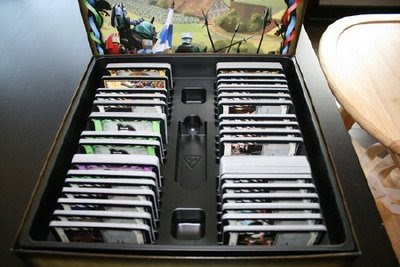
But which cards should go where, and why, is not intuitively obvious. RGG provides a suggested inlay [PDF] which may make sense, eventually.
I didn't get to play anything this shabbat, but we looked through some of the Moot cards. Then Tal (my 15 year old daughter) and hr friend spent a few hours looking through more of the card, learning new vocabulary words all the while. Looks like it's going to be fun going through the cards (I don't actually intend to play the game).
Meanwhile, Ariella (20 year old step-daughter) went to play the latest hit game in Israel, Jungle Speed. She had a great time. Highly recommended for all the non-gamers out there.
Saturday night I went to the annual Mavoi Satum fundraiser quiz night (you can check out all the questions online). Families around the country invite other families to come over, donate, and answer trivia questions. Mavoi Satum does a great job of picking questions that are tough, but not too tough, as well as fun to guess.
Dominion consists of 500 cards and a large box with a strange insert, into which you're supposed to fit all the cards:
But which cards should go where, and why, is not intuitively obvious. RGG provides a suggested inlay [PDF] which may make sense, eventually.
I didn't get to play anything this shabbat, but we looked through some of the Moot cards. Then Tal (my 15 year old daughter) and hr friend spent a few hours looking through more of the card, learning new vocabulary words all the while. Looks like it's going to be fun going through the cards (I don't actually intend to play the game).
Meanwhile, Ariella (20 year old step-daughter) went to play the latest hit game in Israel, Jungle Speed. She had a great time. Highly recommended for all the non-gamers out there.
Saturday night I went to the annual Mavoi Satum fundraiser quiz night (you can check out all the questions online). Families around the country invite other families to come over, donate, and answer trivia questions. Mavoi Satum does a great job of picking questions that are tough, but not too tough, as well as fun to guess.
Thursday, November 13, 2008
The Whining Kids Game, or how to survive your children
The Whining Kids Game
Components
A way to list people in order in the kitchen: a whiteboard, a bulletin board with figures or papers representing each child, etc.
A way to track bonuses: a whiteboard, gold stars, whatever.
Play
Each child gets three stars at the beginning of the week.
When one child wants something, and the parent is able to respond, carry on.
When one child wants something at the same time that another child is being attended to, arrange both the children's names on the list. The second child is attended to after the first one is removed from the list by the parent. If two children come to the parent at the same time, the parent decides on the order.
A child can opt to pay a star to move up in the order at any time. If a child no longer has any stars, he or she cannot use this option.
At the end of the week, a child gets one "X" for each star he or she possesses, where X is a dollar, a cookie, or whatever.
You can accumulate stars from week to week. You can trade 10 stars for a "Y": a doll, or bowling. Or 50 stars for a "Z": an Ipod, or whatever. And so on. The parent can make prizes that can be bought by the children pooling stars together.
Note
Proposed benefits of the game:
1) less arguments over not getting attention; once a name goes onto the list, the child knows that they've been heard and have to wait.
2) the realization that will dawn within the child as to how much attention they actually demand.
Components
A way to list people in order in the kitchen: a whiteboard, a bulletin board with figures or papers representing each child, etc.
A way to track bonuses: a whiteboard, gold stars, whatever.
Play
Each child gets three stars at the beginning of the week.
When one child wants something, and the parent is able to respond, carry on.
When one child wants something at the same time that another child is being attended to, arrange both the children's names on the list. The second child is attended to after the first one is removed from the list by the parent. If two children come to the parent at the same time, the parent decides on the order.
A child can opt to pay a star to move up in the order at any time. If a child no longer has any stars, he or she cannot use this option.
At the end of the week, a child gets one "X" for each star he or she possesses, where X is a dollar, a cookie, or whatever.
You can accumulate stars from week to week. You can trade 10 stars for a "Y": a doll, or bowling. Or 50 stars for a "Z": an Ipod, or whatever. And so on. The parent can make prizes that can be bought by the children pooling stars together.
Note
Proposed benefits of the game:
1) less arguments over not getting attention; once a name goes onto the list, the child knows that they've been heard and have to wait.
2) the realization that will dawn within the child as to how much attention they actually demand.
Thursday, October 23, 2008
BGG.con Game #2
I've designed another game for BGG.con, even though I won't be going to the con unless some kind soul hands me the airfare. I've passed the idea on to Aldie, but have yet to hear if he will be implementing it, as it involves him having to print the cards again like he did last year, and they already have a lot of extra work to do.
Like the first game (Piratenhandler on BGG), this game had to fulfill the following conditions:
- Playable by 6-700 people simultaneously over the course of 3 days. Playable also by a fraction of those who will be interested.
- Don't have to see every card to play the game.
- Involves strategy, not simply chance (like a lottery).
- Easy to create, understand, and play. Doesn't require extensive (*cough* any) playtesting.
- Fosters fun and socializing, doesn't require rules brokering.
This year there was one other additional criteria: easy to score. I spent 3 hours totaling the scores of the 56 participants last year, and I didn't think any of the administrators were going to want to do that this year.
Core Design (#1):
- Object of the game: Help return Aldie's games to the game library.
- Each player gets 3 random cards out of three sets of 1000 cards. Each card features a single game on one side of the card. On the other side of the card is a list of games in a bundle.
- You win by handing in to an admin a) a card with a game bundle with b) all the games that fit into the bundle. The first N players win prizes (subsequent players receive lesser prizes such as geekgold).
Ideally, I would like people to combine efforts, trade cards with each other, trade information, use the cards as betting objects in other games played, etc...
The elegance of this design is that I can make the game bundles larger or smaller in order to make the game harder or easier. Furthermore, I can arrange to have only N number of possible victors. Furthermore, games can belong to more than one game bundle.
While I like this idea, I thought of another version of the idea which may be even easier to implement:
Core Design (#2):
- Object of the game: Help return Aldie's games to the game library.
- Each player gets 3 random cards out of three sets of 1000 cards. Each card features a single game on one side of the card.
- On the wall of the game room are five lists of games missing from the library, each rather long.
- You win by handing in to an admin as many cards as possible in one or more of the lists. The player who hands in the longest list of games on each list wins.
The benefit that this design has over the first design is that it's slightly easier for more people to play, and might also be less frustrating. On the other hand, it's likely that the winner of one list will probably be the winner of more than one. To avoid that, you could specify that each player can only submit to one list.
Anyway, let's see if Aldie bites.
Yehuda
Like the first game (Piratenhandler on BGG), this game had to fulfill the following conditions:
- Playable by 6-700 people simultaneously over the course of 3 days. Playable also by a fraction of those who will be interested.
- Don't have to see every card to play the game.
- Involves strategy, not simply chance (like a lottery).
- Easy to create, understand, and play. Doesn't require extensive (*cough* any) playtesting.
- Fosters fun and socializing, doesn't require rules brokering.
This year there was one other additional criteria: easy to score. I spent 3 hours totaling the scores of the 56 participants last year, and I didn't think any of the administrators were going to want to do that this year.
Core Design (#1):
- Object of the game: Help return Aldie's games to the game library.
- Each player gets 3 random cards out of three sets of 1000 cards. Each card features a single game on one side of the card. On the other side of the card is a list of games in a bundle.
- You win by handing in to an admin a) a card with a game bundle with b) all the games that fit into the bundle. The first N players win prizes (subsequent players receive lesser prizes such as geekgold).
Ideally, I would like people to combine efforts, trade cards with each other, trade information, use the cards as betting objects in other games played, etc...
The elegance of this design is that I can make the game bundles larger or smaller in order to make the game harder or easier. Furthermore, I can arrange to have only N number of possible victors. Furthermore, games can belong to more than one game bundle.
While I like this idea, I thought of another version of the idea which may be even easier to implement:
Core Design (#2):
- Object of the game: Help return Aldie's games to the game library.
- Each player gets 3 random cards out of three sets of 1000 cards. Each card features a single game on one side of the card.
- On the wall of the game room are five lists of games missing from the library, each rather long.
- You win by handing in to an admin as many cards as possible in one or more of the lists. The player who hands in the longest list of games on each list wins.
The benefit that this design has over the first design is that it's slightly easier for more people to play, and might also be less frustrating. On the other hand, it's likely that the winner of one list will probably be the winner of more than one. To avoid that, you could specify that each player can only submit to one list.
Anyway, let's see if Aldie bites.
Yehuda
Monday, October 20, 2008
Couples Party Breaker
I went to an evening of "secret creativity", in which volunteers were supposed to bring their creative work. Being the hippie dippy group that we are, everyone was sure to be accepted, regardless of quality. Everyone had only 5 minutes.
There were several moments of music, reading from poetry or short stories, the intro to a book, and art passed around. There would have been dance, but the dancer had hurt her back.
I brought a game, of course, and it was the opener to the evening.
The question is what to bring to a group of people vastly uninterested in traditional gaming. The answer: a hippy dippie social game.
I brought pens and index cards. I asked everyone to write down a famous couple, real (dead only) or fictitious, with one on one side of the card and the other on the other side. I then took half the cards, tore them up, and randomly handed out singles of each couple to each person.
The game: find your partner without mentioning names. It was a quick game, around 30 seconds. There were 15 of us, so one person was without a partner. And one couple (Fred Astaire and Ginger Rogers) had been repeated. As an aside, all the couples ended up as same-sex. :-)
Call it an icebreaker.
Doing it gave me several ideas for improvement. First of all, we could do it next time with pantomimes, only, although how you would pantomime Simone de Beauvoir is beyond me. Another idea was to use animals, and you could only speak your animal voice.
Which gave me an even better idea: Have Adam be the only one without a partner, and then dramatize his falling asleep and waking up with an Eve next to him.
Yehuda
There were several moments of music, reading from poetry or short stories, the intro to a book, and art passed around. There would have been dance, but the dancer had hurt her back.
I brought a game, of course, and it was the opener to the evening.
The question is what to bring to a group of people vastly uninterested in traditional gaming. The answer: a hippy dippie social game.
I brought pens and index cards. I asked everyone to write down a famous couple, real (dead only) or fictitious, with one on one side of the card and the other on the other side. I then took half the cards, tore them up, and randomly handed out singles of each couple to each person.
The game: find your partner without mentioning names. It was a quick game, around 30 seconds. There were 15 of us, so one person was without a partner. And one couple (Fred Astaire and Ginger Rogers) had been repeated. As an aside, all the couples ended up as same-sex. :-)
Call it an icebreaker.
Doing it gave me several ideas for improvement. First of all, we could do it next time with pantomimes, only, although how you would pantomime Simone de Beauvoir is beyond me. Another idea was to use animals, and you could only speak your animal voice.
Which gave me an even better idea: Have Adam be the only one without a partner, and then dramatize his falling asleep and waking up with an Eve next to him.
Yehuda
Sunday, March 23, 2008
Weekend Gaming
I had a great gaming weekend.
Talking About Games
I was invited out for both meals. In both meals, my hosts or the other guests were fascinated by the idea of someone interested in board and card games, and I ended up talking about them a lot. I wasn't trying to monopolize the conversation, I promise; they were just excited to talk about it.
Something about the idea of taking games and fun seriously just gives some people a thrill. Others think the idea is silly; for those people, I can talk about less important things like politics, religion, literature, and so on.
Word Games
After dinner, I had a willing group of participants eager to play games. Luckily, I always have a head full of games, the easiest of which are word games. No components needed, easy to understand, and fun for non-gamers. My group was two thirteen years old girls, a seventeen year old girl, and a mom.
The first two games I tried were Opposites and Alphabet Minute. Both of these games really need to be played with rigid time constraints for each move; otherwise they just drag on and peter off. That's what they did here. My trouble is that I let people get the feel for the game by taking as much time as they need to come up with a word/sentence on their turn, and then never force them into playing with the time limit.
It also didn't help that they had trouble remembering in which order the alphabet was and a hard time creating sentences starting with a certain letter of the alphabet altogether, let alone one that continued the conversation of the previous player.
I decided to move on to Password, which turned out to be a HUGH hit. I don't know if I'd ever gotten a chance to actually play the game, and I always suspected that it would be really good. And wow, it was really good.
Password requires 5 players, optimally. There are two teams of two players each, and one manager. The manager creates the words or phrases that have to be guessed and then whispers the word or phrase to the hint giver on each team. The manager also judges and penalizes play violations.
Each round works as follows: the manager whispers a word or phrase to one member of each team. Starting with the team that lost the previous round, the member who knows the word or phrase speaks a single word (can't be a word from the answer, of course) in order to help his or her teammate guess the hidden word or phrase. The other team member has one shot to guess. If he or she gets it wrong, the other team has a go, and so on until one team gets the correct answer.
The intriguing part of the game is that you can listen to the clues and mistaken guesses of the other team. And you get to laugh at the weird clues and guesses that everyone makes.
We had a blast; lots of great clues, lots of great hints, lots of great guesses. And of course, lots of really bad hints and guesses. We played twice. And from what I hear, they were still playing it the next day.
Board Games
The next day was at Nadine's. She brought out It's Alive for the first game, which was fun.
The second game was 1960: The Making of the President. This was my first play.
1960 is a two-player area control election game. The only other election game I have played is Die Macher, and there are some similarities, but not many.
I enjoyed myself. We probably played a few things wrong. There was a lot of strategy and tactics; yet, I can see how familiarity with the cards and possible events will lead to deeper understanding of the workability of some strategies over others.
Without that understanding - possibly with the understanding anyway - there was a tad too much luck with the card draw. Some cards are just too good to be allowed to end up in only one player's hand throughout the course of the game. It would be nice to draw twice the number of cards each round and discard half of them; but then the tight decision of which cards to play and which cards to save for the debate wouldn't work.
On the plus side you have lots of possibilities with each card, and even bad cards can be used in good ways; or they're bad in one way but better in another. There are dozens of avenues to explore. You get to learn a great deal about the events from 1960.
It's a tad longer than the two player games I tend to play. But first game: I'm fascinated. Enjoyed it. Looking forward to playing again.
Yehuda
Talking About Games
I was invited out for both meals. In both meals, my hosts or the other guests were fascinated by the idea of someone interested in board and card games, and I ended up talking about them a lot. I wasn't trying to monopolize the conversation, I promise; they were just excited to talk about it.
Something about the idea of taking games and fun seriously just gives some people a thrill. Others think the idea is silly; for those people, I can talk about less important things like politics, religion, literature, and so on.
Word Games
After dinner, I had a willing group of participants eager to play games. Luckily, I always have a head full of games, the easiest of which are word games. No components needed, easy to understand, and fun for non-gamers. My group was two thirteen years old girls, a seventeen year old girl, and a mom.
The first two games I tried were Opposites and Alphabet Minute. Both of these games really need to be played with rigid time constraints for each move; otherwise they just drag on and peter off. That's what they did here. My trouble is that I let people get the feel for the game by taking as much time as they need to come up with a word/sentence on their turn, and then never force them into playing with the time limit.
It also didn't help that they had trouble remembering in which order the alphabet was and a hard time creating sentences starting with a certain letter of the alphabet altogether, let alone one that continued the conversation of the previous player.
I decided to move on to Password, which turned out to be a HUGH hit. I don't know if I'd ever gotten a chance to actually play the game, and I always suspected that it would be really good. And wow, it was really good.
Password requires 5 players, optimally. There are two teams of two players each, and one manager. The manager creates the words or phrases that have to be guessed and then whispers the word or phrase to the hint giver on each team. The manager also judges and penalizes play violations.
Each round works as follows: the manager whispers a word or phrase to one member of each team. Starting with the team that lost the previous round, the member who knows the word or phrase speaks a single word (can't be a word from the answer, of course) in order to help his or her teammate guess the hidden word or phrase. The other team member has one shot to guess. If he or she gets it wrong, the other team has a go, and so on until one team gets the correct answer.
The intriguing part of the game is that you can listen to the clues and mistaken guesses of the other team. And you get to laugh at the weird clues and guesses that everyone makes.
We had a blast; lots of great clues, lots of great hints, lots of great guesses. And of course, lots of really bad hints and guesses. We played twice. And from what I hear, they were still playing it the next day.
Board Games
The next day was at Nadine's. She brought out It's Alive for the first game, which was fun.
The second game was 1960: The Making of the President. This was my first play.
1960 is a two-player area control election game. The only other election game I have played is Die Macher, and there are some similarities, but not many.
I enjoyed myself. We probably played a few things wrong. There was a lot of strategy and tactics; yet, I can see how familiarity with the cards and possible events will lead to deeper understanding of the workability of some strategies over others.
Without that understanding - possibly with the understanding anyway - there was a tad too much luck with the card draw. Some cards are just too good to be allowed to end up in only one player's hand throughout the course of the game. It would be nice to draw twice the number of cards each round and discard half of them; but then the tight decision of which cards to play and which cards to save for the debate wouldn't work.
On the plus side you have lots of possibilities with each card, and even bad cards can be used in good ways; or they're bad in one way but better in another. There are dozens of avenues to explore. You get to learn a great deal about the events from 1960.
It's a tad longer than the two player games I tend to play. But first game: I'm fascinated. Enjoyed it. Looking forward to playing again.
Yehuda
Friday, February 15, 2008
A Kit an' Kaboodle from McNeill Designs
 I gave the game You've Been Sentenced a brief mention and link on my blog a few weeks ago. As a token of thanks, the publisher McNeill Designs told me they would send me a copy of the game to review. I just got it.
But not only did they send YBS, they sent all five new YBS expansion sets, as well as another new game of theirs, Reader's Digest Nation Word Power Challenge: Set 1. That's their entire catalog, pretty much, except for a Go Fish-like kids game Twisted Fish and a family chore assignment spinner called Wheel of Chore-ture.
YBS is a sentence forming game. It consists of a boatload of pentangular cards, each side of which hold a word and a value. Each round, you get ten cards and have a short time in which to form them into grammatically correct sentences. A player can challenge your sentence and the other players then vote on whether or not to accept it.
You get the point value of your words, plus a bonus for forming your word first and another bonus for using all ten cards. Rinse and repeat up to 200 points.
It actually looks pretty good. One of the major advantages of a game like this for me is that it doesn't require writing so can be played on shabbat.
Along with the already voluminous amount of cards in the original set, I also have all five current expansion decks, each of which adds an additional 80 cards around some theme, such as sci-fi/fantasy, cooking, entertainment, etc...
A little plus: McNeill Designs donates part of their proceeds to Success Won't Wait, a non-profit literacy program. I don't play party games too often, but I'm looking forward to giving this one a try.
The Reader's Digest game is really just plain old Go Fish. The box claims to be Set 1 of a series and comes with three decks of cards. Each deck contains 64 cards, 4 cards in each of 16 sets, and is its own game of Go Fish around a certain theme.
The quirk is that each 4 card set is a word from one of Reader's Digest's Word Challenge columns, and the four parts you need to collect are its definition, origin (e.g. Latin root), synonyms, and Fill in the Blank, the latter of which is a sentence with a blank where the word goes.
On your turn, you ask for a card whose [part] is [part answer], e.g. "I'm looking for a card whose synonyms are adjacent, next to, and near".
I'm not going to play this, but some grade-schoolers might get enjoyment from it. I king of think they would learn more playing YBS, and one of the bonus card sets for YBS is a Reader's Digest Word Challenge deck, anyway.
Shabbat's coming, and I need to get going. See you on the other side. And then Sunday, I'm off to Canada.
Yehuda
Friday, June 08, 2007
Games, Games, Everywhere You Turn
Everyone loves and plays games, even those who think they don't. They just don't call them games.
They're, uh, group activities. Competitions. Social events. Etcetera. Etcetera. The same people don't read science fiction or fantasy, but do read speculative fiction, 1984, and A Midsummer Night's Dream.
Sheva Brachot
Yesterday evening we went to a sheva brachot for Dylan and Genia, two of our occasional game groupies, and the hostess organized "an activity". To be fair, she told me explicitly that she likes games, but doesn't have time for them right now. I can't speak for the rest of the people there, but they certainly got into "the activity".
Our hostess had drawn pictures of objects onto posters and we had to guess what the phrase was (i.e. like a picture of a screw followed by a picture of a ball makes "screwball"). Each item had to do with happy couple, of course.
Since we all tried to guess at once, I suppose it really would be classified as "an activity" rather than a game. To be a game, you would have had to divide the guessers into two or more groups, or to time the group to see how long it took them to guess, or something else that required a number to affix as a score. Can't be a "game" without a score, right? *cough*
Alea Games Coming to Israel?
During the evening I fielded a call from some guy in Zichron Yaakov who was given my number by Gilad of the Modiin group. He wanted to know which Alea games would be worth bringing in to Israel for translation.
After getting assured that his business model wasn't going to rely on selling these games cold to the casual pedestrian on the street (he is targeting people who specifically want "something else" to play), I assured him that all Alea games are worth importing.
I put him in touch with John from Silver Stars who is importing Mayfair games, as well as other stuff. Either their business conflicts, in which case they should know about each other, or it doesn't, in which case they can help each other or join forces, if mutually beneficial. If I hear anything about the results of this, you'll be the first to know.
Music to Game By
The music group Pax Dei has created a musical interpretation of Settlers of Catan.
Calgary Game Nights points us to three articles on how gaming fights Alzheimer's.
Yehuda
They're, uh, group activities. Competitions. Social events. Etcetera. Etcetera. The same people don't read science fiction or fantasy, but do read speculative fiction, 1984, and A Midsummer Night's Dream.
Sheva Brachot
Yesterday evening we went to a sheva brachot for Dylan and Genia, two of our occasional game groupies, and the hostess organized "an activity". To be fair, she told me explicitly that she likes games, but doesn't have time for them right now. I can't speak for the rest of the people there, but they certainly got into "the activity".
Our hostess had drawn pictures of objects onto posters and we had to guess what the phrase was (i.e. like a picture of a screw followed by a picture of a ball makes "screwball"). Each item had to do with happy couple, of course.
Since we all tried to guess at once, I suppose it really would be classified as "an activity" rather than a game. To be a game, you would have had to divide the guessers into two or more groups, or to time the group to see how long it took them to guess, or something else that required a number to affix as a score. Can't be a "game" without a score, right? *cough*
Alea Games Coming to Israel?
During the evening I fielded a call from some guy in Zichron Yaakov who was given my number by Gilad of the Modiin group. He wanted to know which Alea games would be worth bringing in to Israel for translation.
After getting assured that his business model wasn't going to rely on selling these games cold to the casual pedestrian on the street (he is targeting people who specifically want "something else" to play), I assured him that all Alea games are worth importing.
I put him in touch with John from Silver Stars who is importing Mayfair games, as well as other stuff. Either their business conflicts, in which case they should know about each other, or it doesn't, in which case they can help each other or join forces, if mutually beneficial. If I hear anything about the results of this, you'll be the first to know.
Music to Game By
The music group Pax Dei has created a musical interpretation of Settlers of Catan.
Calgary Game Nights points us to three articles on how gaming fights Alzheimer's.
Yehuda
Friday, February 23, 2007
12 Games With No Components For Large Groups
 I sometimes need to be ready with a game in unusual circumstances. Especially on shabbat, this can mean a large group of people and with no components (including paper and pen).
The following games can help you in a pinch. They are also good for corporations that need something to do for team building exercises.
Alphabet Minute
To say sentences where the first letter of each sentence begins with a successive letter of the alphabet within an alloted period of time.
Play
Choose a pair or group of people, a starting letter, and a topic or scene. One player starts off with a sentence whose first word begins with the chosen letter, on the topic specified, or acting in the scene specified. Another player (possibly in order) must continue the scene with a sentence whose first word begins with the next letter of the alphabet. If you reach the end of the alphabet (because you didn't start with A) continue from the beginning.
The group has 60 or 90 seconds to reach 27 sentences, beginning and ending on the same letter.
Charades
The most well-known of these games, Charades was actually a different game way back when, more like the riddle game from The Hobbit.
Play
Each team is given a word or phrase to act out, and his teammates must guess the item within a certain time limit. The actor may not speak or sign words or letters. If his team cannot guess, the other team may guess the same word or phrase.
Induction
Players must guess a rule invented by one player using their own correct and incorrect guesses as clues.
Play
One player picks a rule and indicates whether the rule applies to words, items, or something else (for instance, the players themselves). For instance, that the name includes an "A".
Players try to guess the rule by suggesting items or rules. Each time they suggest an item, the player says whether or not the item is in accordance with the rule or not. Each time they suggest the rule, the player either confirms the guess, or names an item that matches the suggested incorrect rule but is not correct, or an item that does not match the suggested incorrect rule but is correct.
Play continues until the rule is guessed. Players have a limit of time or number of guesses allowed.
Lecturer
Players have to lecture on a topic without hesitating or repeating.
Play
One player from each team is chosen. A topic is selected. Each player has one minute to lecture on the subject without hesitating, repeating, or veering off topic. If they do, the next player takes up the topic with the remaining time left. The player speaking when the minute ends is the winner.
Players can challenge other players for breaking the rules, and a moderator may be necessary.
Opposites
To provide the opposite of the last word in a chain of words without repeating. Opposites can be in any sense that a player can reasonably explain.
Play
One player picks a word (it may be a simple two word phrase). The next player must say the opposite of this word, defending his choice if necessary. Continue until a player cannot say an opposite without repeating.
Extra
An unproven theory suggests that all games of Opposites can eventually come to the word "light". See how many opposites are required to do so from a given word or phrase.
Party Quirks
Players act out strange secret characteristics, and others must guess what they are acting.
Play
A few people are given strange personalities or roles to play in secret, and must act them out in an incongruous scene. After the scene is over, other players try to guess what their personality or role was. Example characteristics: an angry bowler, a depressed clown, ...
Password
Guess words given clues by your teammates and opponents.
Play
Players divide into teams. Each round, representatives from each team either receive a word from a moderator, pick a word from a dictionary, or choose a word together.
One representative starts by saying a single word as a clue. His teammates have to guess the selected word using the clue. If they can't, play passes to the next team who are given a single word clue by their representative. Play continues with both teams hearing all clues by both representatives until the word is guessed.
Extra
Passwords can also be proper names.
Picnic
Players must repeat an ever expanding list of items. A well-known game for children.
Play
One person begins "I went on a picnic and brought an " and then names something beginning with an A, such as "apple". The next player must repeat all items the previous player said, and add another item from the next letter of the alphabet. Continue until a player can't remember one or more items.
Extra
There are many thematic variations of this, including names beginning with letter of the alphabet, adjectives, and so on.
Questions
Players are eliminated if they talk but do not phrase a question.
Play
Either all players play simultaneously, or one player from each team plays at a time.
Players must not hesitate overly much, and all talk must be phrased as a question. When playing with teams, an eliminated teammate is replaced with another, and this continues until one team is entirely eliminated. Otherwise, play until only one person remains.
Simon Says
The well-known game of knowing when to take orders.
Play
One person is Simon. He gives all other players instruction as to what to do, prefacing all things that they must do with "Simon Says" (e.g. "Simon says touch your head"). He attempts to trick them up by doing things incorrectly himself or slipping in orders that do not include "Simon says". Anyone doing the wrong thing, of following an order that does not begin "Simon Says" is out of the game.
Werewolf/Mafia
In this game, hungry werewolves are hidden among a town of villagers. Every night, they eat one villager. Every day, the villagers pick someone who they think is a werewolf and lynch him. The object of the game is to catch the werewolves before everyone in the town is dead. The werewolves win if one or more werewolves are the last ones standing.
Play
One person acts as a narrator. All players sit in a circle with their eyes closed. The narrator begins with a lyric description of the situation. As he does so, he picks the werewolves by tapping them on their right shoulders.
He also selects someone to be a seer by tapping them on the left shoulder.
After he finishes the description, he asks the werewolves to open their eyes and choose a victim by pointing. The werewolves do so and close their eyes and he asks the seer to open his eyes and choose any other player. The narrator indicates silently whether or not the person pointed to is a werewolf or regular villager.
All players then open their eyes. The death is announced (that player is out) and all other players must decide as a group who to lynch. If they cannot decide within a certain amount of time, they vote. If the vote is tied, no lynching takes place (optionally, more discussion takes place, if this doesn't drag on too long).
Repeat each nighttime death and seer guess until the game is over.
Extra
This is a very popular game among gamers, and gamers have added many many additional roles to the game, such as renegades, priests, ghosts (so that those who were killed can do more than watch) and so on. You can easily find these on the internet.
The same game under the name Mafia involves killings by Mafia criminals instead of werewolves. The seer is then a detective.
Yes-No-Black-White
Players are eliminated if they use the forbidden words during conversation.
Play
All players play simultaneously. Players engage in conversation with each other. Any player using the forbidden words (exactly these words; synonyms are permitted), or refusing to talk, are eliminated from the game. Continue until only one player remains. A traditional set of forbidden words is "yes", "no", "black", and "white".
Yehuda
Subscribe to:
Posts (Atom)