Just imagine.
Imagine that you didn't live in darkness. Imagine that you had organs to sense colors and light, distance, beauty, ugliness. Imagine that you had eyes. Imagine that you could see.
Imagine what you would do with them. Would you waste them? Or would you use them to see the vibrant beauty of the world? Imagine that you could see rich colors of the people around you. The flush of skin. The crisp green and brown woods, and indigo mountains. Imagine that you could see the towering wood, earthy bricks, and straight steel beams of our cities. What could you do with eyes? What would you do with them?
Imagine that you didn't live in silence. Imagine that you had organs to sense vibrations and sound, music and wind, distance, beauty, ugliness. Imagine that you had ears. Imagine that you could hear.
Imagine what you would do with them. Would you waste them? Or would you use them to hear beauty all around you? Imagine that you could hear brooks, trees, sounds of love and anger, hopes and passion, laughter and despair. Imagine what sweet music could do to your heart. What could you do with ears? What would you do with them?
Imagine that you didn't live unvoiced. Imagine that you had organs to speak, sing, call, love, sway, calm, and comfort. Imagine that you had a mouth, tongue, and teeth. Imagine that you could speak.
Imagine what you would do with them. Would you waste them? Or would you use them to create beauty around you? Imagine that you could give pleasure, love, comfort, assistance. Imagine that you could make others feel loved, understood, touched, or believed, or guided, or happy. Imagine that you could create sweet song. What could you do with a mouth? What would you do with one?
Imagine that you didn't live stationary. Imagine that you could move about, run, bend, jump, dance. Imagine that you had legs. Imagine that you could walk.
Imagine what you could do with them. Would you waste them? Or would you use them to find beauty? Imagine that you could make others laugh or feel through dance, or you could travel to places with joy, beauty, or awe. Imagine that you could bring these to other people, or feel your body swaying. What could you do with them? What would you do with them?
Imagine that you didn't live separated. Imagine that you could feel, hold, embrace, scratch, carry, caress, and tantalize. Imagine that you had skin and hands. Imagine that you could touch.
Imagine what you could do with them. Would you waste them? Or would you touch beauty, create happiness, and hold, comfort, and connect? Imagine that you could feel things smooth, supple, rough, and ragged, skin, food, cloth, leaves, and rocks. Water and ice. Heat and hair. Imagine that you could enfold and hold, carry, reach, and move. What could you do with hands? What would you do with them?
Imagine that you didn't live purposeless. Imagine that you could sense right from wrong, better from worse, less loved from more loved, less helpful from more helpful. Imagine that you had a heart. Imagine that you had a conscience.
Imagine what you could do with them. Would you waste them? Or would you see, hear, speak, walk, and touch everything that you could to make the world a better place? Imagine that you could help, show love, give happiness, give comfort, see needs, correct wrongs, hear cries, make things better, foster understanding, build a community, gather friends, erase loneliness, feed the hungry, clothe the needy, offer rest, judge kindly, feel, do, and be in this world. Imagine you could make one or more lives better today. What could you do with this power? What would you do with this power?
Tuesday, November 04, 2008


Ben Kenobi, Private Jedeye
Have to pass on viral videos once in a while, just to keep up with the Joneses.
(via, via)
Yehuda
P.S. You may also like Sith'd, by the same team.
See more funny videos at Funny or Die
(via, via)
Yehuda
P.S. You may also like Sith'd, by the same team.
Monday, November 03, 2008
Selling Oxford History of Board Games
I'm selling my copy of Oxford History of Board Games. It often sells for around $100 to $200, but I sometimes see it for as low as $70.
My copy is here, on eBay for $50 plus shipping. If you're reading this, worldwide shipping's on me (just let me know when you win).
Yehuda
My copy is here, on eBay for $50 plus shipping. If you're reading this, worldwide shipping's on me (just let me know when you win).
Yehuda
Sunday, November 02, 2008
October Board and Card Game Patents
Card game - Poker game. Each player gets five hole cards. Three sets of three cards are revealed, eventually forming a 3x3 square. After each three cards are revealed, a player discards one of his hole cards.
I think it would work better if you discarded a hole card before each reveal, rather than after.
 Floating poker table - For use in swimming pools.
Game piece - Thank goodness for pictures. This patent is entirely incomprehensible without the accompanying pictures.
Abstract:
So you take your piece, which doesn't have a ball, and you press it on top of your opponent's piece, which has a ball, and presto! You capture the ball from your opponent.
Still no? Here are the pictures:


Assigned to Designomite.
Method for playing a wagering game - Deal each player five cards, each player discards one, and then turn over the top card. Score according to Cribbage scoring rules.
Educational question and answer escape game having an antagonist element - Some kind of trivia game with a theme-related reason for occasionally sending your piece back to the start. Pretty design:

Folding trading card with magnifying region - The card becomes a little house with a magnifier on the front to look into it.

Assigned to Upper Deck.
Organizer for board games - This:

Method for playing a card game - "While the game of blackjack is well known, it is regarded by many as being boring, especially if played for a relatively long period of time... Additionally, there exist known games and/or methods for playing games which typically combine some of the elements of the game of blackjack (both "conventional" versions and variants) with elements of another known card game and/or other game. While these 'combination' games typically do somewhat entertain players, they are often considered to be boring..."
So let's add poker to blackjack. If a player folds his poker hand, he continues as if he's playing blackjack.
Question: Why not just play poker?
Multi-game playing surface and associated methods - This patent starts us off with a history lesson:
The game board is two sides, and "each of the first and second playing surfaces conveniently has a plurality of intersecting columns and rows defining at least nine spots." Conveniently! And the game requires just such a surface. What luck!
Four games are included, including Tic Tac Roll, Advanced Tic Tac Roll, Kockout, and Gamble. Not to be confused with the game called Tic Tac Roll from Dreammakers.
Board game - A trivia game called Maven Haven by Patrick Kilbane. Not his first board game patent, either.
Blackjack push - An unusually clear abstract:
Method of play and game surface for a dice game - A dice table with various payouts for rolling certain numbers.
Taraccab or Baccarat table card game with Chinese deck - Taraccab, or baccarat spelled backwards, is baccarat played with a Mah-Jong deck of cards.
This patent also comes with a lengthy history and political lesson:

Intelligent baccarat shoe - A shoe more intelligent than the typical baccarat player. I believe that I can find prior art for this.
Method of conducting a wagering game with continuous depletion - Not mixing the cards from the first game back into the deck, and, in fact, marking which cards have already been played on subsequent deals. This is to create "suspense".
Card game with blackjack and poker aspects - Oh lookie. Another attempt to combine blackjack with poker, this time with Brag.
Creating notable nonrandom patterns in games to encourage play - A method of adding a statistical non-random element to an online poker game system. Players are encouraged to discover these elements and gain advantage accordingly.
Honestly, I don't see the point. Something to do with cheating by using automated bots. However, we get another history lesson and a story:
Card game device, card data reader, card game control method, recording medium, program, and card - A bloody large game system for many people and trading card recognition software. Looks like a multi-player arcade system. From SEGA.
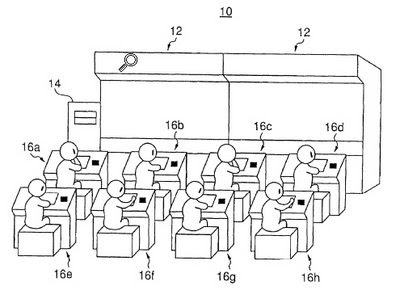
Gaming apparatus and method - The idea of a dice game using "dice" that are made from interlocking panels of the correct shape for whatever type of die you're rolling (e.g. d6, d12, ...) In this way, you can turn one of the panels on the die around when required (such as when the area associated with that die face becomes destroyed).
I think it would work better if you discarded a hole card before each reveal, rather than after.
 Floating poker table - For use in swimming pools.
Game piece - Thank goodness for pictures. This patent is entirely incomprehensible without the accompanying pictures.
Abstract:
A game piece for transferring an object across the surface of a board game or the like. The game piece generally comprises a carrier body having an upper end, a lower end, an entry opening proximate the lower end, and a socket in communication with the entry opening. The entry opening is sized to allow the transfer object to pass therethrough so that the transfer object is thereafter retained within the socket. Additionally, the socket is adapted to receive a second game piece having a similarly configured socket and entry opening. When the entry opening of the second game piece is pushed over the transfer object, the object is transferred from the socket of the original game piece to the socket of the second game piece.Make sense? The rest of it is just as unclear, but it sure is funny. Some examples:
Although many different types of board games and game pieces exist, very few of these game pieces are designed to do anything more than travel across the game's playing surface [examples given include the dog, car, iron, and shoe from Monopoly]. New games and new forms of entertainment would be possible if game pieces were designed to achieve additional functions...So what the heck is all this? It's a basket shaped game piece with a large hole in the top and a small hole in the bottom. The bottom hole is large enough to let a ball through when pressed onto the ball, but not let it fall out again.
The carrier body of the game piece may be configured to nest with the second game piece. This enables the second game piece to be stacked on top of the first game piece when transferring or "capturing" the object therefrom. Additionally, the game piece may incorporate various safety features to prevent a person from having his or her finger get caught in the entry opening. For example, the socket may include a cut-out portion or the carrier body may be constructed from separate, detachable components.
So you take your piece, which doesn't have a ball, and you press it on top of your opponent's piece, which has a ball, and presto! You capture the ball from your opponent.
Still no? Here are the pictures:


Assigned to Designomite.
Method for playing a wagering game - Deal each player five cards, each player discards one, and then turn over the top card. Score according to Cribbage scoring rules.
Educational question and answer escape game having an antagonist element - Some kind of trivia game with a theme-related reason for occasionally sending your piece back to the start. Pretty design:

Folding trading card with magnifying region - The card becomes a little house with a magnifier on the front to look into it.

Assigned to Upper Deck.
Organizer for board games - This:

Method for playing a card game - "While the game of blackjack is well known, it is regarded by many as being boring, especially if played for a relatively long period of time... Additionally, there exist known games and/or methods for playing games which typically combine some of the elements of the game of blackjack (both "conventional" versions and variants) with elements of another known card game and/or other game. While these 'combination' games typically do somewhat entertain players, they are often considered to be boring..."
So let's add poker to blackjack. If a player folds his poker hand, he continues as if he's playing blackjack.
Question: Why not just play poker?
Multi-game playing surface and associated methods - This patent starts us off with a history lesson:
For centuries games have been a favorite pastime of adults as well as children. In fact, the earliest form of the familiar checkers can be traced to the Egyptians as early as 600 B.C. Other popular games, such as backgammon and chess, have also provided years of fun and excitement for families and friends. Traditional board, card, and trivia games continue to flourish, despite the foreboding in recent years that these would suffer in popularity from the onslaught of computer, video and hand-held forms of play. According to the NPD Group, which tracks retail sales for board games, sales were up 23% during the first 10 months of 2003, compared with the same period in 2002. Culture-watchers further stipulate that in these especially trying times, with terrorism looming and an uncertain economy, traditional games encourage relaxed, comfortable social interchange. Proving that nothing can equate the interaction of people in a common recreational pursuit, these tried-and-true diversions are certain to be around for a long time to come.His game is a Tic Tac Toes variant for multiple players, whose benefits include "The method advantageously offers consumers a reprieve from the stresses of daily life, and effectively encourages positive social and family interaction through good-natured competition."
The game board is two sides, and "each of the first and second playing surfaces conveniently has a plurality of intersecting columns and rows defining at least nine spots." Conveniently! And the game requires just such a surface. What luck!
Four games are included, including Tic Tac Roll, Advanced Tic Tac Roll, Kockout, and Gamble. Not to be confused with the game called Tic Tac Roll from Dreammakers.
Board game - A trivia game called Maven Haven by Patrick Kilbane. Not his first board game patent, either.
Blackjack push - An unusually clear abstract:
A modification to the card game blackjack in which bets are pushed, if the total of the cards in the player's and the dealer's hands are of equal value and add up to 21 or less, or if the total of the cards in the dealer's hand equals a predetermined value between 22 and 26 and the total of the cards in the player's hand is 21 or less.Method and apparatus for playing blackjack with active working wagers - A system for side betting on the dealer's hand results in blackjack.
Method of play and game surface for a dice game - A dice table with various payouts for rolling certain numbers.
Taraccab or Baccarat table card game with Chinese deck - Taraccab, or baccarat spelled backwards, is baccarat played with a Mah-Jong deck of cards.
This patent also comes with a lengthy history and political lesson:
As we enter into the 21'st century, the world as we have known it for many decades is undergoing profound changes right in front of our eyes that severely impact the well-being of our society. First and foremost is the end of the cold war between the Soviet Union and the United States which led indirectly to the breakup of the Soviet Empire. This event has changed many lives, both within and without the former Soviet Union. Many people living formerly under the Soviet rule are today enjoying their political freedom for the first time after many decades. More importantly, they have now become productive and free citizens once again in their new environments leading to significant economical gain because of their entrepreneurship and hard work.Chess variant and method of play thereof - 1) A new rule that assigns 3/4 of a win for perpetual check, rather than a draw. 2) A boatload of new pieces and a larger funky board.
The second profound change is the advent of the Internet starting as early as in the late 1970s. Although it took more than two decades including the notorious "WWW or World Wide Wait" period instead of "World Wide Web" for its ridiculously slow services in the beginning, and a gigantic bubble burst in the capital investment community shortly after the turn of the last century to prove to everybody that it is indeed one of the most important events that has taken place. The Internet, together with the tremendous advances in the silicon chip and the computer software technologies during the past two decades have literally ushered the world into the so-called Information Age. Today virtually everything in private and public commerce is done on the Internet leading to an unprecedented productivity gain in many sectors of industry.
The third event is the crystallization of a globalization process as a direct result of the coming of the Information Age. This globalization process simply means that all activities involving international commerce, trade, finance, communication and production of goods and services are taking place irrespective of continental, national, demographic or geographical boundaries as long as they are done in the most efficient and cost-effective manner. The globalization process is actually a two-edged sword. Whereas countries like China and India, whose economies have been benefited tremendously by the effects of globalization, other countries like the United States, European Union countries and even Japan have suffered significant negative effects like the loss of employment and the closing down of many factories that are no longer competitive in the world scene. Globalization is today an on-going process and nobody knows for sure what will eventually become of our world. One thing, however, is amply clear. China is presently experiencing a strong rise in its economical fortune.
During the past two decades, as more and more affluent Chinese and Asian gamblers, a direct result of the globalization process discussed above, came to Las Vegas and Atlantic City to play, there has been a growing sense of opportunity for the casinos to come up with new games in order to attract the attention of these new customers. If these new games can be devised based upon the cultural folklores and ancient concepts that the Chinese and Asian revere, such as Yin Yang (two opposing forces) and Feng Shui (wind and water), the chance of these new games being enthusiastically accepted by the new comers will be greatly enhanced. Furthermore, if these new games can blend the old and popular Chinese gambling games such as Mahjongg, Tin Gau, Sic Bo and Fan Tan (the so-called "Big Four"), with the traditional Western style gambling games such as Roulette, Poker, Blackjack etc., the so-called gaming fusion of the East and West, then the chance of success should even be greater.
While the need to create new games for casinos in the U.S., based upon the fusion of the culture and gambling methods of both the East and the West, is pretty much a no-brainer, its realization might not be as simple as one is led to believe. However, the observation that one of the gambling tools that is conspicuously missing in the East is the counterpart of the West's international 52-card pack which anchors many favorite Western gambling games, led the current inventor to recognize this unique opportunity and capture it by inventing a novel Chinese style poker deck called the "Chinese Poker Deck". The construct of this poker deck reflects not only its Western origin, but also allows the permeation of the Eastern culture by using elements of Mahjongg, the most beloved gambling game of the Chinese that dates back hundred of years, and also the ageless Chinese practice of Feng Shui, a revered cultural concept of the Chinese people throughout their more than 5,000 years of civilization.

Intelligent baccarat shoe - A shoe more intelligent than the typical baccarat player. I believe that I can find prior art for this.
Method of conducting a wagering game with continuous depletion - Not mixing the cards from the first game back into the deck, and, in fact, marking which cards have already been played on subsequent deals. This is to create "suspense".
Card game with blackjack and poker aspects - Oh lookie. Another attempt to combine blackjack with poker, this time with Brag.
Creating notable nonrandom patterns in games to encourage play - A method of adding a statistical non-random element to an online poker game system. Players are encouraged to discover these elements and gain advantage accordingly.
Honestly, I don't see the point. Something to do with cheating by using automated bots. However, we get another history lesson and a story:
Too much predictability in the order of shuffled cards--particularly if that order favors one player--may well be seen as proof of cheating. Cheating is taken seriously. In the American West in the 1800's, card cheats were routinely shot dead. Even as recently as the 1970's, a United States Supreme Court case discussed the fatal shooting of a card cheat: The story began in June 1970, when one William Douglas, a professional gambler from Las Vegas, Nev., arrived in Memphis, Tenn., calling himself Ray Blaylock and carrying a gun and a deck of cards. It ended on the evening of Jul. 6, 1970, when Douglas was shot and killed in a Memphis apartment. Testimony at the trial in the Tennessee state court showed that one Woppy Gaddy, who was promised a cut of Douglas' take, arranged a game of chance between Douglas and Robert Wood, a sometime Memphis gambler. Unwilling to trust the outcome of the contest entirely to luck or skill, Douglas marked the cards, and by game's end Robert Wood and his money had been separated. A second encounter between the two men yielded similar results, and Wood grew suspicious of Douglas' good fortune. In order to determine whether and how Douglas was cheating, Wood brought to the third game an acquaintance named Tommy Thomas, who had a reputation of being a "pretty good poker player." Unknown to Wood, however, Thomas' father and Douglas had been close friends; Thomas, predictably, threw in his lot with Douglas, purposefully lost some $1,000, and reported to Wood that the game was clean. Wood nonetheless left the third game convinced that he was being cheated and intent on recouping his now considerable losses. He explained the situation to his brother, Joe E. Wood, and the two men decided to relieve Douglas of his ill-gotten gains by staging a robbery of the upcoming fourth game. At this juncture respondents Randolph, Pickens, and Hamilton entered the picture. To carry out the staged robbery, Joe Wood enlisted respondent Hamilton, who was one of his employees, and the latter in turn associated respondents Randolph and Pickens. Douglas and Robert Wood sat down to the fourth and final contest on the evening of Jul. 6, 1970. Joe Wood and Thomas were present in the room as spectators. During the course of the game, Douglas armed himself with a .38-caliber pistol and an automatic shotgun; in response to this unexpected development Joe Wood pulled a derringer pistol on Douglas and Thomas, gave the gun to Robert Wood, and left to tell respondents to move in on the game. Before respondents arrived, however, Douglas reached for his pistol and was shot and killed by Robert Wood. Parker v. Randolph, 442 U.S. 62 (1979)Method and device for playing a game using remainder values - A betting card game where you have to guess the remainder after dividing two cards.
Card game device, card data reader, card game control method, recording medium, program, and card - A bloody large game system for many people and trading card recognition software. Looks like a multi-player arcade system. From SEGA.

Gaming apparatus and method - The idea of a dice game using "dice" that are made from interlocking panels of the correct shape for whatever type of die you're rolling (e.g. d6, d12, ...) In this way, you can turn one of the panels on the die around when required (such as when the area associated with that die face becomes destroyed).
Downtown in Jerusalem 2
Sitting in Masryk cafe, listening to good music across the road. There are musicians up and down the road, and if you're standing in the middle between two crosswalks, it can be quite dissonant.
Stalls of food dot the road, alongside booths of crafts and political advocates. People dressed as brides or flowers, wearing big heads, or walking on stilts.
It's nice to be out and about. Along with 5,000 other people.
Yehuda
Stalls of food dot the road, alongside booths of crafts and political advocates. People dressed as brides or flowers, wearing big heads, or walking on stilts.
It's nice to be out and about. Along with 5,000 other people.
Yehuda
Downtown in Jerusalem
Here I am in downtown Jerusalem on Emek Refaim, leeching a connection outside of Masryk and listening to the bands tune up for an annual free concert / fair / food festival in honor of something or other.
I've never live-blogged, and I doubt I'll start now. I'm just waiting for my daughter to show up.
Applause Kills Conversation
I was listening to a BBC political discussion. Panel of five insiders across the political spectrum, and an audience of a hundred or so students. It was an hour long.
In the first five minutes, the questions were intelligent and the responses from the panel equally so; long and full of substance. Then the applause started.
It wasn't an immediate shift, but a few minutes after the first applause came the next applause. From then on, bouts of applause followed every thirty to forty seconds.
It wasn't that the panelists became more brilliant. Quite the opposite. As the applause became more frequent, the panelists became worse: more polarized, more sound bites, more extreme, less nuanced, more throwing down gauntlets. It was a feedback of descending value.
This is the death of political conversation: applause. This is why politics are the way they are: we are trying to win, rather than to inform. Impress rather than convince. Steal elections, rather than implement what the majority think is correct. The audience responds to simplistic sound bytes and fear, the politicians win by fortunately timed approval.
There are going to be a lot of people waking up on November 5 to find that the world hasn't changed much. Governments, problems, opinions, wars, and economies tend to move slowly, even with the occasional rapid descent into chaos. Save your applause for later.
Saturday, November 01, 2008
Shabbat Gaming: Sanctuary
Shabbat lunch I went to Elijah and family, and after lunch we played Sanctuary.
Elijah and his father were old-style gamers before meeting me, and now they have a mixture of old and new style games in their house. The Settlers of Catan sits on the shelf on top of Illuminati, The Princes of Florence on top of Divine Right, and Die Macher next to various war games.
Sanctuary is a roll-and-move game from 1982 based on the Thieves' World series from Robert Asprin and Lynn Abbey. As far as roll and move games go, it's ok. You get to roll three dice - 2d6 and a d10 - and then take two of the dice of your choice to move your piece and the other one to move one of the five bad guys closer to one of your opponents (or away from you).
That pretty much wraps up the neat factor of the game. The rest is cards with locations to which you have to go to collect money, bad guys who may move on you and send you to jail, and cards which cause random effects or can be saved to do random actions. Lots of dice rolling, lots of luck, a number of "take that" mechanics, and no strategy. There's a noticeable theme, but it's pretty thin. I won.
We had a political discussion during lunch which I kind of regretted. The vast majority of people around fanatically favor McCain, citing fears and apocalyptic scenarios should Obama win, and that kind of drives me a little crazy, and my denial of this apocalyptic vision seemed to drive my host a little crazy, too.
Yehuda
Subscribe to:
Posts (Atom)