James L. Kugel (1945-) is chair of the Institute for the History of the Jewish Bible at Bar Ilan University in Israel and the Harry M. Starr Professor Emeritus of Classical and Modern Hebrew Literature at Harvard University. (Wikipedia) He's also an Orthodox Jew.
Prof Kugel has written 15 books; his latest is How to Read the Bible: A Guide to Scripture, Then and Now.
Kugel demonstrates not only thorough and exhaustive research, but an open and accessible writing style. I heard him speak tonight about his new book at a lecture given on behalf of the Bat Kol Institute (website currently down). My only previous reading of his work was his book In Potiphar's House, which examines how midrashim originate and change over time.
Midrashim are interpretive texts on the bible written throughout history. In particular, important midrashim were written from two to three centuries B.C.E. until a few hundred years C.E. These midrashim form the basis of how nearly all Christians and Jews interpret the bible today.
According to Kugel, the basic texts' original meanings may have had nothing to do with our current interpretations.
For instance, using the same text we have today, the original Adam and Eve story, when compared with similar texts and similar versions of the text in the same period, is a story about moving from a hunter/gatherer culture to an agricultural one, from naked beasts to humans in clothes. Today, it is nearly universal to read this story as a tale of "the fall" from a state of innocence to sin. How did this happen? Gradually; and amazingly, without changing the text.
As what we come to know as the biblical texts were brought together, assumptions as to how to treat the texts crept in. These assumptions caused textual problems and that's when the midrashim arose.
The four assumptions are:
1) The texts are cryptic and symbolic.
2) The texts are prophetic and homiletic.
3) The texts are consistent.
4) The texts are divinely inspired/given.
Give these assumptions, interpretations were needed to explain when the plain meaning of the texts didn't appear to reconcile with these assumptions.
For instance, in the Adam and Eve story is the sentence by God that "on the day they eat of the Tree, they will surely die". This didn't happen in the narrative, so what gives? How do you interpret the text so that it's perfectly consistent? Was God making an idle threat? Was it God's mercy? Can we use the interpretation that a unit of time "day" is not meant in human terms (which we can pull from various sources in the Prophets: 1000 years = day to God)? The latter doesn't answer why the delay of the punishment. The Rabbinic midrashic answer which best fits became the standard interpretation: the text means "you shall become mortal" i.e. a dying creature, not "you shall die".
A later question then asks (as now the interpretation gives rise to its own problem): why did their descendants become mortal? Is mortality hereditary? The answer that fit best: sinfulness was heredity (so, in fact, the punishment is continuous onto each generation). Sinlessness is not possible outside garden.
Early Jewish, pre-Cristian sources agreed with this; in the battle of interpretations, this won out, like a Darwinian species. 4th Ezra, a Jewish text, concurs with this interpretation, for example. Later, the rise of Christianity forced this interpretation out of Rabbinic interpretation.
The text is now no longer about hunting and agriculture, but about morality. The same text, with a different interpretation.
Similar re-interpretations can be made for Abraham being the father of monotheism, Jacob being a "good guy" (and King David), and texts such as "eye for eye", various prophesies, the Psalms, and so on.
Modern biblical scholarship in a product of the Renaissance. Knowledge of Hebrew and Greek began spreading to Christian scholars. They became the first challenges to Jerome's Latin translation of the bible from the 4th century; people could now do their own translations and decide that Jerome was wrong. Protestantism met this movement, putting interpretation into individual hands (scripture is holy, not the pope).
Then these hit the enlightenment and science (Hume, et al). Protestantism had no easy answers to radical interpretations by individuals (hoist on its own petard, so to speak). Then came modern archaeology. Then came biblical critical scholarship which matched and compared biblical texts to other ancient texts. Biblical texts now just looked like one set of texts among many others from the same period.
For a man of faith, how do we deal with these four assumptions and yet also accept modern scholarship about biblical texts?
Kugel's suggested answer is that what you read depends on what meaning you're looking for in a text. Text is interactive between a reader and a text. The original texts didn't change, but the interpretive reading of them did. That means that "The Bible" didn't exist until interpretation was imposed onto a text. Bible scholarship is not about "The Bible", it's about the biblical texts, which are not the same thing as "The Bible". When a critical scholar drops the four assumptions to critically read the text, he or she is dealing with a different entity than The Bible.
In my view, it's still a hard leap from there to divinely inspired interpretation imposed onto a set of texts. It means that the texts were divinely inspired when written but only recognized for what they meant when they fell into the right hands; or that the divine inspiration was taking the tools (texts) that were lying around and forming them into what was required.
Kugel's answer to the question as to how he remains Orthodox, is that the early Talmudic scholars were aware of all this. They took texts, decided what to keep and what not (sometimes changing their minds), imposed interpretations on what they knew wasn't the original interpretation, and were fine with it. Consider the midrash about Moses looking into a class by Rabbi Akiba, and not being able to follow along. So if they could do it and be religious, so can we.
Yehuda
Sunday, July 06, 2008


Shabbat Gaming: Coloretto Review
I went to Beit Shemesh for the shabbat and played Coloretto for the first time with my friend Gavriel. Gavriel sometimes makes it to the Beit Shemesh game group.
Coloretto is a simple card game for 3-5 players that will appeal to children but can also be enjoyed on a light level by adults. The cards contain chamelions in sveen different colors, three "joker" chamelions, and around a dozen "+2" cards. There is also an "end of the game coming" card that is placed 15 cards from the bottom of the deck after shuffling.
Each player starts off with one chamelion card of any color, so long as no two players have the same color. In the middle of the table, there is one virtual stack for each player (five players = five virtual stacks). The stacks start empty.
On your turn, you have two choices: 1) take a stack of cards. 2) flip the top card of the deck and add it to one of the stacks.
No stack can have more than three cards in it, so once all the remaining stacks have three cards, you are force to take stack. Once you have taken a stack, you cannot play again until all other players have also taken one, at which point the last player to take a stack starts the next "round" with a fresh set of empty stacks.
That's it. The important part is the scoring.
For the three colors in which you have the most cards, you score 1, 3, 6, 10, 15, or 21 points for 1, 2, 3, 4, 5, or 6 or more cards in that color. You then subtract a similar amount from your score for all other colors you have. Jokers count as any color card, and +2 cards simply ad 2 points to your score each. Highest scoe wins.
This is like a cross between Ra and Geschenkt, nearly as simply as Geschenkt but just a tad less elegant. The basic decision is whether to take a stack that weakly helps you but doesn't harm you or to risk flipping more cards and hoping an even better stack will come back to you again on your turn.
The slightly obvious tactics have to do with where you put your card when you flip it. If it helps you, add it to a stack that helps you, if it doesn't also help your neighbor. If it doesn't, use it to sink a stack that will otherwise help a neighbor.
Beyond that, there's not much to think about, and the decisions aren't that difficult. Which makes it an ok, kinda brainless filler for gamers, or fun for the younger or non-gamer set.
We played with Gav's three daughters and ended up in a three-way tie or first place at 25 points.
Gav, two daughters, and I then played Carcassonne, the original without any expansions (not even the River). This game also ended in a three way tie for first place, with the fourth only two points behind.
Coloretto is a simple card game for 3-5 players that will appeal to children but can also be enjoyed on a light level by adults. The cards contain chamelions in sveen different colors, three "joker" chamelions, and around a dozen "+2" cards. There is also an "end of the game coming" card that is placed 15 cards from the bottom of the deck after shuffling.
Each player starts off with one chamelion card of any color, so long as no two players have the same color. In the middle of the table, there is one virtual stack for each player (five players = five virtual stacks). The stacks start empty.
On your turn, you have two choices: 1) take a stack of cards. 2) flip the top card of the deck and add it to one of the stacks.
No stack can have more than three cards in it, so once all the remaining stacks have three cards, you are force to take stack. Once you have taken a stack, you cannot play again until all other players have also taken one, at which point the last player to take a stack starts the next "round" with a fresh set of empty stacks.
That's it. The important part is the scoring.
For the three colors in which you have the most cards, you score 1, 3, 6, 10, 15, or 21 points for 1, 2, 3, 4, 5, or 6 or more cards in that color. You then subtract a similar amount from your score for all other colors you have. Jokers count as any color card, and +2 cards simply ad 2 points to your score each. Highest scoe wins.
This is like a cross between Ra and Geschenkt, nearly as simply as Geschenkt but just a tad less elegant. The basic decision is whether to take a stack that weakly helps you but doesn't harm you or to risk flipping more cards and hoping an even better stack will come back to you again on your turn.
The slightly obvious tactics have to do with where you put your card when you flip it. If it helps you, add it to a stack that helps you, if it doesn't also help your neighbor. If it doesn't, use it to sink a stack that will otherwise help a neighbor.
Beyond that, there's not much to think about, and the decisions aren't that difficult. Which makes it an ok, kinda brainless filler for gamers, or fun for the younger or non-gamer set.
We played with Gav's three daughters and ended up in a three-way tie or first place at 25 points.
Gav, two daughters, and I then played Carcassonne, the original without any expansions (not even the River). This game also ended in a three way tie for first place, with the fourth only two points behind.
Friday, July 04, 2008
Roundup: Three Years of Twenty Seventh Week Posts
 What makes a game elegant?
Ethics in Gaming 2.0 - Playing games without buying them
My first blog posts, four years ago, were about:
(Happy blog birthday to me)
The story of Little Stick Man and his various bouts with disaster and death. Interestingly enough, the same sign in Israel, that in Britain shows LSM getting electrocuted on a pole, shows LSM not climbing the pole. In Britain slipping on the floor; in Israel pushing the mop. Britain falling off a cliff; Israel staying away from the edge. Curious.
More about London: stories, travel tips, and photos
Perhaps my most popular non-gaming post ever: The U.S. Copyright Code, in verse
June Board and Card Game Patents
Method and system to incorporate game play into product transactions - A method of playing a game at the supermarket checkout, where if you win the game you get the product for the entry fee, and if you lose you simply get the product for it's usual price. Supposedly, this type of game of chance will not be considered "gambling" in those places that disallow gambling.
Method, apparatus and article for random sequence generation and playing card distribution - Card shufflers were invented to speed up and more thoroughly implement card shuffling at casino tables. This patent thinks they're not fast enough, and wants to simply generate a pseudo-random deck arrangement via computer and then either sort the cards to this arrangement, or print a brand spanking new deck in this arrangement.
But it doesn't stop there. I said pseudo-random, right? That's because the patent also specifies that the arrangement can be created with a house advantage.
Method of playing a card game involving a dealer - Place a bet. Deal one card. Pay out rewards. Place another bet. Deal another card. Pay out rewards. Repeat up to five times, depending on results.
Casino card game having Mahjong attributes - A card game with Mah-Jong symbols and a poker-like game to go with it.
Dice board game - You conceal point markers on your side of the board. Then a die is rolled, and each player moves a pawn according to the game's markings. When you reach the far end, you get the concealed point value. You win when you get a predetermined number of points. If the value is "Game Over" you win, regardless of the current point score.
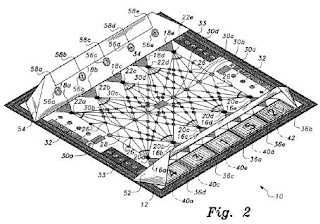
Player-banked four card poker game - A four player poker game, where each player and the dealer gets an additional card and discards it, and then you have to beat the dealer. I'm unsure how the odds are kept in the dealer's favor this way.
Method for providing a blackjack double down wager - Probably the worst excuse for a patent I've yet seen this year.
You already have the option of splitting cards in a blackjack game, if the cards are below a certain value or are doubles. This patent lets you split your cards in other situations and for additional ante.
Modified method of playing blackjack - Blackjack, where an additonal bet is placed that your hand will be the highest valued hand at the table. I must admit, this one comes close to the last one in terms of an absurd excuse for a patent.
Marble board game - A Pachisi game, where the board is a track for marbles and the movement is played with a hand of five standard playing cards.
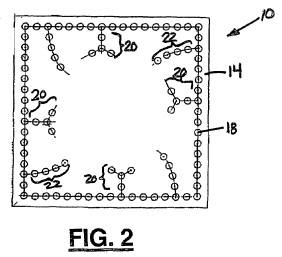
Method, apparatus and article for random sequence generation and playing card distribution - Card shufflers were invented to speed up and more thoroughly implement card shuffling at casino tables. This patent thinks they're not fast enough, and wants to simply generate a pseudo-random deck arrangement via computer and then either sort the cards to this arrangement, or print a brand spanking new deck in this arrangement.
But it doesn't stop there. I said pseudo-random, right? That's because the patent also specifies that the arrangement can be created with a house advantage.
Method of playing a card game involving a dealer - Place a bet. Deal one card. Pay out rewards. Place another bet. Deal another card. Pay out rewards. Repeat up to five times, depending on results.
Casino card game having Mahjong attributes - A card game with Mah-Jong symbols and a poker-like game to go with it.
Dice board game - You conceal point markers on your side of the board. Then a die is rolled, and each player moves a pawn according to the game's markings. When you reach the far end, you get the concealed point value. You win when you get a predetermined number of points. If the value is "Game Over" you win, regardless of the current point score.

Player-banked four card poker game - A four player poker game, where each player and the dealer gets an additional card and discards it, and then you have to beat the dealer. I'm unsure how the odds are kept in the dealer's favor this way.
Method for providing a blackjack double down wager - Probably the worst excuse for a patent I've yet seen this year.
You already have the option of splitting cards in a blackjack game, if the cards are below a certain value or are doubles. This patent lets you split your cards in other situations and for additional ante.
Modified method of playing blackjack - Blackjack, where an additonal bet is placed that your hand will be the highest valued hand at the table. I must admit, this one comes close to the last one in terms of an absurd excuse for a patent.
Marble board game - A Pachisi game, where the board is a track for marbles and the movement is played with a hand of five standard playing cards.

Movie Theater Games
Here's my next brilliant idea: movie theaters are losing money, but people are looking for new ways to play video games and socialize.
How hard would it be to create multi-player games playable from all seats in a movie theater on the screen before a game starts? Or, dare I suggest, even turn one theater in a cinema-plex over to full-time massive gaming?
They wouldn't even have to be online, although they could be. Think about a game of 100 versus 100 in some other theater. Charge per hour, per day, per month. Make guilds, have ads, sell pop-corn. Etc..
More people can play in a movie theater than can fit around my TV screen.
While we're at it, how come arcades (what's left of them) aren't doing this? Is anyone?
Yehuda
How hard would it be to create multi-player games playable from all seats in a movie theater on the screen before a game starts? Or, dare I suggest, even turn one theater in a cinema-plex over to full-time massive gaming?
They wouldn't even have to be online, although they could be. Think about a game of 100 versus 100 in some other theater. Charge per hour, per day, per month. Make guilds, have ads, sell pop-corn. Etc..
More people can play in a movie theater than can fit around my TV screen.
While we're at it, how come arcades (what's left of them) aren't doing this? Is anyone?
Yehuda
Thursday, July 03, 2008
Session Report, in which everyone seems to have disappeared
The latest Jerusalem Strategy Gaming Club session report is up. Games played: Magic: the Gathering x 3, Power Grid (Italy).
Only David showed up to play. Very strange.
Only David showed up to play. Very strange.
Tuesday, July 01, 2008
Review: Star Wars
I just saw a series of six movies called Star Wars , directed by George Lucas (American Graffiti).It's a science fiction adventure series set, or so it tells us at the beginning of each movie, "a long time ago in a galaxy far, far away." But it's not steampunk or alternate history; it's your basic futuristic space opera.
There are six movies that follow roughly one main story arc through two generations of characters, approximately 30 odd years, in total. The main character of the first three films is a boy soldier who becomes evil owing to his own character flaws and the machinations of a tyrannical man. The second three films focus on the soldier's son, who, through various coincidences, ends up fighting his father in an attempt to overthrow the tyrant.
The Plot (contains spoilers)
The main story takes place against the backdrop of an historical war, which goes as follows: Tens of thousands of planets across the galaxy form a great Republic. So great, that the Senate which allegedly governs them is ineffectual. One man, Palpatine, decides to take over the Republic and set himself up as Emperor.
Palpatine has mystical telekinetic powers, having been trained to exert mental control over tiny sub-microscopic bacteria that exist in literally every corner of the galaxy. The ability to exert this control is called "The Force".
A select group called Jedi learn how to control this Force. Jedi act as advisers to the Senate, and occasionally assassin, diplomat, or armed guard. They wield nifty energy swords called light-sabers. Palpatine was once Jedi, but used his powers for selfishness, hate, anger, and so on, which is called "the dark side of the Force", a Jedi no-no. People who use the dark side of the Force can shoot lightning bolts with their fingers.
Where was I?
Palpatine commissions some cloners to create an army out of someAustralian New Zealand dude named Jango Fett. The clones are altered to be crack military troops, but Jango gets to keep a little, unaltered, clone for himself, name Boba.
Palpatine (aka Sidius) establishes control over a few dozen member of the Senate, including members of something called the Trade Federation. He has the Trade Federation invade a planet called Naboo.
The point of this arranged invasion is to show up the powerlessness of the Senate in dealing with it. When this happens, he manipulates a vote for a new Senate leader, and gets himself elected. While secretly strengthening the Trade Federation and other separatists, he complains to the Senate that they need to give him emergency powers to control the "uprising".
They do, whereupon he brings in his clone army, dissolves the Republic and establishes himself as Emperor, all the while in the name of bringing "peace" to the galaxy.
The empire levels martial law around the galaxy, and everyone begins to realize their mistake, but it is too late. The emperor builds a big moon/weapon called the Death Star which can blow up an entire planet. The separatists become "the Rebellion", led by a number of star systems and some sympathetic senators.
They steal plans for the Death Star, and are chased around the galaxy. Eventually, the rebels blow up the Death Star, but still have to flee as the Emperor still has general control and a vastly larger clone military.
The rebellion get chased around again, only to discover that the Emperor has yet another Death Star in development. This time they manage to destroy it with the Emperor on it, and then the last movie ends and you don't really find out what happens next.
So who is this father and son dude?
Anakin Skywalker is a young boy when the Naboo crisis happens. He joins the story when two Jedi - master Qui Gon Jinn and apprentice Obi-Wan Kenobi - are sent to Naboo to defuse the crisis. They fail but succeed in getting Naboo's queen, Padme, off Naboo. They stop on a planet called Tatooine to repair their ship, and discover Anakin, who is strong with the Force. They collect him on their way to the Senate.
The Senate is useless, as predicted, so they head back to Naboo, and chase the Federation away. (Movie 1)
Padme's term as queen ends and she become senator. Ten years later she and Anakin meet again, and Anakin is now a Jedi apprentice to master Obi-Wan. Unfortunately, Anakin is a thick-headed ill-willed, arrogant, fearful and hateful young man, which anyone except for Obi-Wan and Padme could see in a moment.
Anakin is sent to protect Padme who is receiving assassination attempts, and so takes her home to a remote country where the two of them fall in love. Since a Jedi is supposed to remain free of relations, and a Senator is a busy person, they resolve to put their feelings on hold.
Meanwhile, Obi-Wan discovers the clone army, and gets captured by the separatists who are planning their next moves (under coordination from Palpatine). Anakin goes to rescue his mother he left behind on Tatooine, and fails. She dies. This begins his slide into the dark side of the Force. He and Padme go to rescue Obi-Wan but get captured.
Yoda, head of the Jedi council, swoops in at the last minute with the clone army and all the Jedi to rescue them and to fight the separatists. The war between the clone army of the Republic and the separatists commences. Anakin and Padme, seizing the day, secretly marry and Padme becomes pregnant. (Movie 2)
Palpatine finds Anakin teetering on the dark side of the Force and turns him completely by promising him the ability to save his wife who is augered to die in childbirth. He can do this only with the powers he can learn from the dark side of the Force; Anakin longs for this power as he was unable to save his mother from dying. Palpatine/Sidius renames Anakin "Darth Vader" and takes him as his new apprentice. Anakin/Vader, and the clone army, turn on the Jedi, killing all of them except for Yoda and Obi-Wan, who escape. Palpatine and Anakin "crush" the separatists, but the Emperor, who has complete military power, won't give it back, citing threats and traitors to the Republic.
Obi-Wan and Padme show up to confront Anakin/Vader about his actions. Anakin, in his madness, nearly chokes Padme to death, thus ensuring that she will die in childbirth. He blames Obi-Wan, and they fight. Obi-Wan wins and leave Anakin/Vader cut up and burning at the edge of a lava pit. Palpatine/Sidius saves Vader and dresses him up in a black electronic suit within which he must live for the rest of his life. Anakin/Vader is crushed when he finds out that Padme died after all.
Before she died, she gave birth to twins; a boy, named Luke, who is hidden with Anakin's mother's husband and kids on Tatooine, and a girl, named Leia, who is hidden with the leaders of the rebellion, Senator and Lady Organa. Yoda flies off to hide on a planet in Degobas, and Obi-Wan changes his name to Ben and settles on Tatooine to watch over Luke from a distance. (Movie 3)
Leia grows up as a princess and takes her part in the rebellion. She is caught smuggling plans to the Death Star while (coincidentally) flying over Tatooine, but ejects them onto the surface, where they are found (coincidentally) by Luke. She also sends a message for Obi-Wan to deliver the plans to the rebellion as she has failed. Luke and Obi-Wan meet, while the empire searches for them.
They escape with a space pilot named Han Solo who is on the run from a mafia guy named Jabba the Hutt. Together they get caught on the Death Star where they rescue Leia. Obi-Wan fights Darth Vader again, but this time purposely loses the fight. Somehow, although he dies, this allows him to go on living as a spirit who visits Luke intermittently over the course of the rest of the movies.
Luke, Han, Leia, et al escape the Death Star and bring the plans to the rebellion and then Luke, aided at the last moment by Han, blows up the Death Star. Luke, under tutelage and guidance from Obi-Wan's spirit, is beginning to learn how to use the Force. (Movie 4)
The rebellion jumps around, with the Empire always hot on their heels. Eventually Luke gets a message from Obi-Wan's spirit to go to Yoda and learn how to be a Jedi from him. Han and Leia begin to fall in love, but get caught in a trap by Vader. Han is tortured so that his pain will spiritually call to Luke to come rescue him, which he does despite Yoda warning him not to go before he had completed his training.
Vader freezes Han in carbonate and sends him off with Boba Fett who was sent by Jabba the Hutt to capture Han. Luke confronts Vader and learns that Vader is his father. He is bested by Vader, but he and Leia escape. (Movie 5)
They go to rescue and unfreeze Han, and it appears that Luke is now nearly fully-trained in his Jedi powers. Boba Fett and Jabba the Hutt die during the rescue.
The Emperor purposely leaked fake plans for his new Death Star in order to lure the rebellion into attacking it. Han, Luke and Leia go to take down the defenses, but before they do, Luke realizes that he has to confront Vader and see if he can get him back from the dark side of the Force. Before he goes to do this, he tells Leia that she is his sister, which he learned from Obi-Wan's spirit.
Luke surrenders to Vader, sure that Anakin, his father, can't kill him. Vader and the Emperor are counting on Luke turning to the dark side, while Luke presses Anakin/Vader to find the good within him. Luke won't turn, so the Emperor begins torturing Luke, who pleads with his father for help. Anakin/Vader decides to kill the Emperor rather than let his son suffer, which supposedly brings him back from the dark side just before he dies.
Meanwhile, Han and Leia disable the Death Star's defenses, the rebellion blows up the new Death Star with the Emperor still on it (already dead), and Luke manages to escape at the last minute. Han and Leia begin a new relationship. Some scenes show people on different planets celebrating the death of the Emperor, but it's not clear exactly what will happen next to the vast army and empire that remain. (Movie 6)
Reactions to the Story
First movie (The Phantom Menace)
This was a neat movie. The good guys and their light swords are ubercool. Obi-Wan, Qui Jon, Yoda, and Palpatine are all played well enough, although they don't exhibit much more than one-dimensional personalities. Padme is a feisty heroine, but she really doesn't have much to do or say in the movie. She just wanders around.
It culminates in a battle to recapture the Naboo palace, and a wicked fight scene with light sabers.
Unfortunately, the actors who play Anakin and his mother are pretty bad, as are some of the hokey lines of dialog. Some of the dialog is inconsistent. For instance, the mother lets Anakin go off with Qui Gon Jinn to be a Jedi, and then two seconds later Anakin asks if he can go. Du-uh.
The Trade Federation's droids are supposed to be menacing, but they're fairly ineffective and say a lot of things that don't make sense for a droid, such as "Uh oh". And there's a race of annoying aquatic people on Naboo who talk with Jamaican accents and blubber a lot, added as comic relief. They were dispensable.
Second movie (Attack of the Clones)
This one is about the same as the first, with the light-saber coolness ratcheted up a notch. Palpatine and Obi-Wan are the same as the last movie, and Yoda also does some serious butt-kicking. The Fetts are introduced but don't add much to the movie. The fight scenes are elaborate and engaging.
This time Anakin is played so poorly, I found myself squirming when he was on screen. His delivery is constantly like a pouting crybaby, and he so overdoes his spoiled arrogant nasty behavior it's inconceivable that anyone would allow him to continue to be a Jedi in training.
His partner, Padme, is just as difficult to watch, but this seems more to do with the stupid lines she is given to deliver. And let's not forget that she's not supposed to be leading him on, but they spend their time in hiding together barely dressed, romping around, play fighting, and saying mushy things to each other; big surprise that they fall in love. When not in a love scene, Padme's back to feisty and gets to kick some serious butt.
All signs point to various lapsed Jedis causing havoc, but each time they discover something gone wrong that only a Jedi could have done, Obi-Wan and the rest of the Jedi are surprised and confused.
Third movie (Revenge of the Sith)
This was a pretty dark movie, with lots of dying and betrayal. Anakin still doesn't know how to act, although now he can glare with his eyes rolled up into his head. Palpatine spends a lot of time transparently telling him how wonderful he is and how little the Jedi really care for him. Anakin laps it up, as if Obi-Wan never told him to beware of flattery.
Anakin's conversion to the dark side was somewhat lame. Anakin is this arrogant guy who thinks he should be emperor, but then he meekly submits himself to obeying any orders the Emperor gives him. He's still asking himself why he did such bad things, but immediately becomes an automaton and goes off and does even worse things.
Padme now has not much to do.
The fight scenes in this movie don't add much to the ones that were in the previous one. It just seemed like they were hurrying to finish the movie and get on with the next one. And how Obi-Wan could walk away from a dying, but not dead, Anakin to slowly burn up on the shores of a lava lake makes no sense to me. Kill him and put him out of his misery, or rescue him while he's crippled; but leave him to slowly burn to death? Sheesh.
Fourth movie (A New Hope)
This movie introduces the second main set of characters: Luke, Leia, and Han. This trio has a lot more on-screen charisma than the first trilogy's (Anakin, Padme, Obi-Wan) does. Obi-Wan has turned into a kindly old man. Leia is a serious fighter, although she ends up having to be rescued. Han is a reluctant hero.
The pacing is slower in many areas, and the film quality is dirtier but richer for that.
The movie introduces a number of new inconsistencies with the previous movies. For instance, Obi-Wan meets a droid he met many times in the first few movies but can't remember it. Also, he's been hiding out on Tatooine for thirty years not doing anything about the Empire because he and Yoda couldn't face the Emperor on their own, and now he expects Luke to get involved and learn to be a Jedi and fight the empire, on his own.
Also, if Luke is supposed to be hiding from Anakin/Vader, why did he adopt the name "Skywalker", which was Anakin's last name?
The light-saber fight scenes and the space combat scenes have slowed down considerably since the first trilogy, and were not impressive.
Fifth Movie (The Empire Strikes Back)
Another dark episode, although not as dark as the third movie. The characters continue to appeal, and the acting is generally ok. But Yoda, who was a wise and awesome figure in the first three movies now looks like a Muppet and appears to be half-crazed.
The plot in this movie is tight. Like the second movie, you get to see a Jedi in training (Luke), who is tempted to the dark side. Only this time, it's not a foregone conclusion that he is going to fail (as his father did).
The light-saber fight scene is back to being cool, as is an asteroid chase scene midway through the movie. But the battle scene at the beginning of the movie where the empire rides around in clumsy armored elephants with no maneuverability and the ability to only see and shoot forwards was just plain silly. Even more silly that the rebellion fighters fly at them from the front and sides, instead of just parking behind them and shooting.
More inconsistencies: Obi-Wan in spirit form implies that Yoda is the one who taught him how to be a Jedi, when we already saw that Obi-Wan learned from Qui Gon, who learned from Duku, who learned from Yoda. A few teacher/student relations seem to have gotten lost.
And the timing seems to be off, too. Han escapes from a planet at the same time that Luke does at the beginning of the movie. Han seems to take about one or two days to get to a scene near the end of the movie, while Luke seems to take a few months to get to the same place at the same time.
Once again, it's not clear why Yoda (and Obi-Wan's spirit) are training Luke to face Vader and the Emperor when they both ran away from him in the prime of their powers thirty years earlier.
Sixth movie (Return of the Jedi)
The fight scenes are pretty cool, but the acting suddenly got really bad. In particular, Leia, who was once a feisty fighter is now a maudlin soap-opera actress.
The opening scenes at Jabba's estate in particular were pretty nifty, except for a horrid horrid dance and musical number at the beginning, which looked like a Pixar movie superimposed on the real movie.
Vader/Anakin's propitious turn from the dark side to suddenly turning on the Emperor seemed as unbelievable as his turn to the dark side was thirty years earlier. I guess we are supposed to believe that he saved his son because he failed to save his mother and wife?
The cute little furry characters who help Han and Leia deactivate the Death Star's shields for a good fifth of screen-time were also pretty annoying; like watching the Teletubbies.
Update: forgot another big inconsistency: Leia claims to have vague memories of her mother, when her mother died while giving birth to her.
The Characters
Palpatine/Sidius - This guy's character is pretty straightforward, but no reason is given for his intense evil. He's acted well enough.
Anakin/Vader - From boy to dying, he's supposed to be the complex character, but he's simply jolting. He was born to follow the dark side, and it seems impossible for no one to have noticed it until it was too late. Then he tromps around outrageously for thirty years serving a master even less generous than Obi-Wan, until the very last second where he kills the Emperor and himself at the same time. It's a nice idea, but some actual conversation and believability would have been nicer.
Obi-Wan/Ben - He sees most things except his student's character flaws. His single-minded devotion to his job gives us little insight to his character. Think paladin.
Padme - Eminantly watchable, except when on-screen with Anakin. But aside from her devotion to being a senator, some nice gymnastics and shooting, and then a lot of fretting at home pregnant, she doesn't get a lot to do.
Yoda - Short and cerebral, Yoda can soar and fight like a whirling dervish when he has to. He spends more time thinking than doing, however. At the end, he became a bit crazed. Well acted, I guess.
Luke - Innocent and determined, he radiates hero. He struggles through many battles and emerges changed after each one. And he's well acted, too.
Leia - Leia starts off fierce and commanding in the fourth film, then becomes a bit of a tagalong in the fifth film, and a hopeless wreck in the last one. Great to watch in the fourth and fifth, painful to watch in the sixth.
Han - Han is a "scoundrel", the reluctant hero, in the fourth movie. He tries to stay the reluctant hero in the next two movies, too, but it becomes less believable each time. This is not a problem, however, as that is exactly his character, becoming more and more involved with what he claims to not care for. He's also well acted, and pretty cute sometimes, too.
Droids - The two main droids in the movie are C3PO and R2D2, They're kind of a Rosencrantz and Guildenstern to the main action. C3PO especially just wanders around, on and off the screen, being frightened and saying double-entedres. R2D2 actually plays a helpful role on occasion, usually with a spare arm ready to hold down a broken wing on a spaceship, blow a smokescreen, or tap into some computer and do something ridiculous. Other droids also wander around, mostly in order to get blown up.
Minor characters: Lando is a pilot friend of Han's who helps rescue him in the fifth movie and then helps the rebellion in the sixth; not much to say about him. Jango/Boba are the models for the clones. Jango tries to kill Obi-Wan at one point, and Obi-Wan has surprising difficulty dealing with him for some reason. Later on Boba is a bit of a nusiance, but then dies. Chewbacca is Han's tall furry co-pilot. He yowls and yips a lot, but doesn't do much else. And many others.
Overall
It's flawed, and has some bad acting, but overall the story is mythic and rich and the action scenes are fun to watch. The ideas behind the characters succeed somewhat more than the characters do themselves, leaving you to wish that they had been acted and/or written somewhat better in this regard (Luke and Han being the exceptions). The movies, although paced differently in different movies, tell really good stories, and reach tension and climaxes at all the right times.
Many of the lines are great, but many are forced or just painful. I wish the movie would have slowed down for a few scenes here or there and given the characters consistantly better lines. And too much of the movies seems aimed at small children.
There's also a rich and varied world of technology (ships, weapons, and so on) and aliens (all types, shapes, and sizes, although most have plastic faces and little facial expressions, and the others move and act like cartoons), which should please some people.
Overall recommendation is positive, especially if you're into action scenes.
There are six movies that follow roughly one main story arc through two generations of characters, approximately 30 odd years, in total. The main character of the first three films is a boy soldier who becomes evil owing to his own character flaws and the machinations of a tyrannical man. The second three films focus on the soldier's son, who, through various coincidences, ends up fighting his father in an attempt to overthrow the tyrant.
The Plot (contains spoilers)
The main story takes place against the backdrop of an historical war, which goes as follows: Tens of thousands of planets across the galaxy form a great Republic. So great, that the Senate which allegedly governs them is ineffectual. One man, Palpatine, decides to take over the Republic and set himself up as Emperor.
Palpatine has mystical telekinetic powers, having been trained to exert mental control over tiny sub-microscopic bacteria that exist in literally every corner of the galaxy. The ability to exert this control is called "The Force".
A select group called Jedi learn how to control this Force. Jedi act as advisers to the Senate, and occasionally assassin, diplomat, or armed guard. They wield nifty energy swords called light-sabers. Palpatine was once Jedi, but used his powers for selfishness, hate, anger, and so on, which is called "the dark side of the Force", a Jedi no-no. People who use the dark side of the Force can shoot lightning bolts with their fingers.
Where was I?
Palpatine commissions some cloners to create an army out of some
Palpatine (aka Sidius) establishes control over a few dozen member of the Senate, including members of something called the Trade Federation. He has the Trade Federation invade a planet called Naboo.
The point of this arranged invasion is to show up the powerlessness of the Senate in dealing with it. When this happens, he manipulates a vote for a new Senate leader, and gets himself elected. While secretly strengthening the Trade Federation and other separatists, he complains to the Senate that they need to give him emergency powers to control the "uprising".
They do, whereupon he brings in his clone army, dissolves the Republic and establishes himself as Emperor, all the while in the name of bringing "peace" to the galaxy.
The empire levels martial law around the galaxy, and everyone begins to realize their mistake, but it is too late. The emperor builds a big moon/weapon called the Death Star which can blow up an entire planet. The separatists become "the Rebellion", led by a number of star systems and some sympathetic senators.
They steal plans for the Death Star, and are chased around the galaxy. Eventually, the rebels blow up the Death Star, but still have to flee as the Emperor still has general control and a vastly larger clone military.
The rebellion get chased around again, only to discover that the Emperor has yet another Death Star in development. This time they manage to destroy it with the Emperor on it, and then the last movie ends and you don't really find out what happens next.
So who is this father and son dude?
Anakin Skywalker is a young boy when the Naboo crisis happens. He joins the story when two Jedi - master Qui Gon Jinn and apprentice Obi-Wan Kenobi - are sent to Naboo to defuse the crisis. They fail but succeed in getting Naboo's queen, Padme, off Naboo. They stop on a planet called Tatooine to repair their ship, and discover Anakin, who is strong with the Force. They collect him on their way to the Senate.
The Senate is useless, as predicted, so they head back to Naboo, and chase the Federation away. (Movie 1)
Padme's term as queen ends and she become senator. Ten years later she and Anakin meet again, and Anakin is now a Jedi apprentice to master Obi-Wan. Unfortunately, Anakin is a thick-headed ill-willed, arrogant, fearful and hateful young man, which anyone except for Obi-Wan and Padme could see in a moment.
Anakin is sent to protect Padme who is receiving assassination attempts, and so takes her home to a remote country where the two of them fall in love. Since a Jedi is supposed to remain free of relations, and a Senator is a busy person, they resolve to put their feelings on hold.
Meanwhile, Obi-Wan discovers the clone army, and gets captured by the separatists who are planning their next moves (under coordination from Palpatine). Anakin goes to rescue his mother he left behind on Tatooine, and fails. She dies. This begins his slide into the dark side of the Force. He and Padme go to rescue Obi-Wan but get captured.
Yoda, head of the Jedi council, swoops in at the last minute with the clone army and all the Jedi to rescue them and to fight the separatists. The war between the clone army of the Republic and the separatists commences. Anakin and Padme, seizing the day, secretly marry and Padme becomes pregnant. (Movie 2)
Palpatine finds Anakin teetering on the dark side of the Force and turns him completely by promising him the ability to save his wife who is augered to die in childbirth. He can do this only with the powers he can learn from the dark side of the Force; Anakin longs for this power as he was unable to save his mother from dying. Palpatine/Sidius renames Anakin "Darth Vader" and takes him as his new apprentice. Anakin/Vader, and the clone army, turn on the Jedi, killing all of them except for Yoda and Obi-Wan, who escape. Palpatine and Anakin "crush" the separatists, but the Emperor, who has complete military power, won't give it back, citing threats and traitors to the Republic.
Obi-Wan and Padme show up to confront Anakin/Vader about his actions. Anakin, in his madness, nearly chokes Padme to death, thus ensuring that she will die in childbirth. He blames Obi-Wan, and they fight. Obi-Wan wins and leave Anakin/Vader cut up and burning at the edge of a lava pit. Palpatine/Sidius saves Vader and dresses him up in a black electronic suit within which he must live for the rest of his life. Anakin/Vader is crushed when he finds out that Padme died after all.
Before she died, she gave birth to twins; a boy, named Luke, who is hidden with Anakin's mother's husband and kids on Tatooine, and a girl, named Leia, who is hidden with the leaders of the rebellion, Senator and Lady Organa. Yoda flies off to hide on a planet in Degobas, and Obi-Wan changes his name to Ben and settles on Tatooine to watch over Luke from a distance. (Movie 3)
Leia grows up as a princess and takes her part in the rebellion. She is caught smuggling plans to the Death Star while (coincidentally) flying over Tatooine, but ejects them onto the surface, where they are found (coincidentally) by Luke. She also sends a message for Obi-Wan to deliver the plans to the rebellion as she has failed. Luke and Obi-Wan meet, while the empire searches for them.
They escape with a space pilot named Han Solo who is on the run from a mafia guy named Jabba the Hutt. Together they get caught on the Death Star where they rescue Leia. Obi-Wan fights Darth Vader again, but this time purposely loses the fight. Somehow, although he dies, this allows him to go on living as a spirit who visits Luke intermittently over the course of the rest of the movies.
Luke, Han, Leia, et al escape the Death Star and bring the plans to the rebellion and then Luke, aided at the last moment by Han, blows up the Death Star. Luke, under tutelage and guidance from Obi-Wan's spirit, is beginning to learn how to use the Force. (Movie 4)
The rebellion jumps around, with the Empire always hot on their heels. Eventually Luke gets a message from Obi-Wan's spirit to go to Yoda and learn how to be a Jedi from him. Han and Leia begin to fall in love, but get caught in a trap by Vader. Han is tortured so that his pain will spiritually call to Luke to come rescue him, which he does despite Yoda warning him not to go before he had completed his training.
Vader freezes Han in carbonate and sends him off with Boba Fett who was sent by Jabba the Hutt to capture Han. Luke confronts Vader and learns that Vader is his father. He is bested by Vader, but he and Leia escape. (Movie 5)
They go to rescue and unfreeze Han, and it appears that Luke is now nearly fully-trained in his Jedi powers. Boba Fett and Jabba the Hutt die during the rescue.
The Emperor purposely leaked fake plans for his new Death Star in order to lure the rebellion into attacking it. Han, Luke and Leia go to take down the defenses, but before they do, Luke realizes that he has to confront Vader and see if he can get him back from the dark side of the Force. Before he goes to do this, he tells Leia that she is his sister, which he learned from Obi-Wan's spirit.
Luke surrenders to Vader, sure that Anakin, his father, can't kill him. Vader and the Emperor are counting on Luke turning to the dark side, while Luke presses Anakin/Vader to find the good within him. Luke won't turn, so the Emperor begins torturing Luke, who pleads with his father for help. Anakin/Vader decides to kill the Emperor rather than let his son suffer, which supposedly brings him back from the dark side just before he dies.
Meanwhile, Han and Leia disable the Death Star's defenses, the rebellion blows up the new Death Star with the Emperor still on it (already dead), and Luke manages to escape at the last minute. Han and Leia begin a new relationship. Some scenes show people on different planets celebrating the death of the Emperor, but it's not clear exactly what will happen next to the vast army and empire that remain. (Movie 6)
Reactions to the Story
First movie (The Phantom Menace)
This was a neat movie. The good guys and their light swords are ubercool. Obi-Wan, Qui Jon, Yoda, and Palpatine are all played well enough, although they don't exhibit much more than one-dimensional personalities. Padme is a feisty heroine, but she really doesn't have much to do or say in the movie. She just wanders around.
It culminates in a battle to recapture the Naboo palace, and a wicked fight scene with light sabers.
Unfortunately, the actors who play Anakin and his mother are pretty bad, as are some of the hokey lines of dialog. Some of the dialog is inconsistent. For instance, the mother lets Anakin go off with Qui Gon Jinn to be a Jedi, and then two seconds later Anakin asks if he can go. Du-uh.
The Trade Federation's droids are supposed to be menacing, but they're fairly ineffective and say a lot of things that don't make sense for a droid, such as "Uh oh". And there's a race of annoying aquatic people on Naboo who talk with Jamaican accents and blubber a lot, added as comic relief. They were dispensable.
Second movie (Attack of the Clones)
This one is about the same as the first, with the light-saber coolness ratcheted up a notch. Palpatine and Obi-Wan are the same as the last movie, and Yoda also does some serious butt-kicking. The Fetts are introduced but don't add much to the movie. The fight scenes are elaborate and engaging.
This time Anakin is played so poorly, I found myself squirming when he was on screen. His delivery is constantly like a pouting crybaby, and he so overdoes his spoiled arrogant nasty behavior it's inconceivable that anyone would allow him to continue to be a Jedi in training.
His partner, Padme, is just as difficult to watch, but this seems more to do with the stupid lines she is given to deliver. And let's not forget that she's not supposed to be leading him on, but they spend their time in hiding together barely dressed, romping around, play fighting, and saying mushy things to each other; big surprise that they fall in love. When not in a love scene, Padme's back to feisty and gets to kick some serious butt.
All signs point to various lapsed Jedis causing havoc, but each time they discover something gone wrong that only a Jedi could have done, Obi-Wan and the rest of the Jedi are surprised and confused.
Third movie (Revenge of the Sith)
This was a pretty dark movie, with lots of dying and betrayal. Anakin still doesn't know how to act, although now he can glare with his eyes rolled up into his head. Palpatine spends a lot of time transparently telling him how wonderful he is and how little the Jedi really care for him. Anakin laps it up, as if Obi-Wan never told him to beware of flattery.
Anakin's conversion to the dark side was somewhat lame. Anakin is this arrogant guy who thinks he should be emperor, but then he meekly submits himself to obeying any orders the Emperor gives him. He's still asking himself why he did such bad things, but immediately becomes an automaton and goes off and does even worse things.
Padme now has not much to do.
The fight scenes in this movie don't add much to the ones that were in the previous one. It just seemed like they were hurrying to finish the movie and get on with the next one. And how Obi-Wan could walk away from a dying, but not dead, Anakin to slowly burn up on the shores of a lava lake makes no sense to me. Kill him and put him out of his misery, or rescue him while he's crippled; but leave him to slowly burn to death? Sheesh.
Fourth movie (A New Hope)
This movie introduces the second main set of characters: Luke, Leia, and Han. This trio has a lot more on-screen charisma than the first trilogy's (Anakin, Padme, Obi-Wan) does. Obi-Wan has turned into a kindly old man. Leia is a serious fighter, although she ends up having to be rescued. Han is a reluctant hero.
The pacing is slower in many areas, and the film quality is dirtier but richer for that.
The movie introduces a number of new inconsistencies with the previous movies. For instance, Obi-Wan meets a droid he met many times in the first few movies but can't remember it. Also, he's been hiding out on Tatooine for thirty years not doing anything about the Empire because he and Yoda couldn't face the Emperor on their own, and now he expects Luke to get involved and learn to be a Jedi and fight the empire, on his own.
Also, if Luke is supposed to be hiding from Anakin/Vader, why did he adopt the name "Skywalker", which was Anakin's last name?
The light-saber fight scenes and the space combat scenes have slowed down considerably since the first trilogy, and were not impressive.
Fifth Movie (The Empire Strikes Back)
Another dark episode, although not as dark as the third movie. The characters continue to appeal, and the acting is generally ok. But Yoda, who was a wise and awesome figure in the first three movies now looks like a Muppet and appears to be half-crazed.
The plot in this movie is tight. Like the second movie, you get to see a Jedi in training (Luke), who is tempted to the dark side. Only this time, it's not a foregone conclusion that he is going to fail (as his father did).
The light-saber fight scene is back to being cool, as is an asteroid chase scene midway through the movie. But the battle scene at the beginning of the movie where the empire rides around in clumsy armored elephants with no maneuverability and the ability to only see and shoot forwards was just plain silly. Even more silly that the rebellion fighters fly at them from the front and sides, instead of just parking behind them and shooting.
More inconsistencies: Obi-Wan in spirit form implies that Yoda is the one who taught him how to be a Jedi, when we already saw that Obi-Wan learned from Qui Gon, who learned from Duku, who learned from Yoda. A few teacher/student relations seem to have gotten lost.
And the timing seems to be off, too. Han escapes from a planet at the same time that Luke does at the beginning of the movie. Han seems to take about one or two days to get to a scene near the end of the movie, while Luke seems to take a few months to get to the same place at the same time.
Once again, it's not clear why Yoda (and Obi-Wan's spirit) are training Luke to face Vader and the Emperor when they both ran away from him in the prime of their powers thirty years earlier.
Sixth movie (Return of the Jedi)
The fight scenes are pretty cool, but the acting suddenly got really bad. In particular, Leia, who was once a feisty fighter is now a maudlin soap-opera actress.
The opening scenes at Jabba's estate in particular were pretty nifty, except for a horrid horrid dance and musical number at the beginning, which looked like a Pixar movie superimposed on the real movie.
Vader/Anakin's propitious turn from the dark side to suddenly turning on the Emperor seemed as unbelievable as his turn to the dark side was thirty years earlier. I guess we are supposed to believe that he saved his son because he failed to save his mother and wife?
The cute little furry characters who help Han and Leia deactivate the Death Star's shields for a good fifth of screen-time were also pretty annoying; like watching the Teletubbies.
Update: forgot another big inconsistency: Leia claims to have vague memories of her mother, when her mother died while giving birth to her.
The Characters
Palpatine/Sidius - This guy's character is pretty straightforward, but no reason is given for his intense evil. He's acted well enough.
Anakin/Vader - From boy to dying, he's supposed to be the complex character, but he's simply jolting. He was born to follow the dark side, and it seems impossible for no one to have noticed it until it was too late. Then he tromps around outrageously for thirty years serving a master even less generous than Obi-Wan, until the very last second where he kills the Emperor and himself at the same time. It's a nice idea, but some actual conversation and believability would have been nicer.
Obi-Wan/Ben - He sees most things except his student's character flaws. His single-minded devotion to his job gives us little insight to his character. Think paladin.
Padme - Eminantly watchable, except when on-screen with Anakin. But aside from her devotion to being a senator, some nice gymnastics and shooting, and then a lot of fretting at home pregnant, she doesn't get a lot to do.
Yoda - Short and cerebral, Yoda can soar and fight like a whirling dervish when he has to. He spends more time thinking than doing, however. At the end, he became a bit crazed. Well acted, I guess.
Luke - Innocent and determined, he radiates hero. He struggles through many battles and emerges changed after each one. And he's well acted, too.
Leia - Leia starts off fierce and commanding in the fourth film, then becomes a bit of a tagalong in the fifth film, and a hopeless wreck in the last one. Great to watch in the fourth and fifth, painful to watch in the sixth.
Han - Han is a "scoundrel", the reluctant hero, in the fourth movie. He tries to stay the reluctant hero in the next two movies, too, but it becomes less believable each time. This is not a problem, however, as that is exactly his character, becoming more and more involved with what he claims to not care for. He's also well acted, and pretty cute sometimes, too.
Droids - The two main droids in the movie are C3PO and R2D2, They're kind of a Rosencrantz and Guildenstern to the main action. C3PO especially just wanders around, on and off the screen, being frightened and saying double-entedres. R2D2 actually plays a helpful role on occasion, usually with a spare arm ready to hold down a broken wing on a spaceship, blow a smokescreen, or tap into some computer and do something ridiculous. Other droids also wander around, mostly in order to get blown up.
Minor characters: Lando is a pilot friend of Han's who helps rescue him in the fifth movie and then helps the rebellion in the sixth; not much to say about him. Jango/Boba are the models for the clones. Jango tries to kill Obi-Wan at one point, and Obi-Wan has surprising difficulty dealing with him for some reason. Later on Boba is a bit of a nusiance, but then dies. Chewbacca is Han's tall furry co-pilot. He yowls and yips a lot, but doesn't do much else. And many others.
Overall
It's flawed, and has some bad acting, but overall the story is mythic and rich and the action scenes are fun to watch. The ideas behind the characters succeed somewhat more than the characters do themselves, leaving you to wish that they had been acted and/or written somewhat better in this regard (Luke and Han being the exceptions). The movies, although paced differently in different movies, tell really good stories, and reach tension and climaxes at all the right times.
Many of the lines are great, but many are forced or just painful. I wish the movie would have slowed down for a few scenes here or there and given the characters consistantly better lines. And too much of the movies seems aimed at small children.
There's also a rich and varied world of technology (ships, weapons, and so on) and aliens (all types, shapes, and sizes, although most have plastic faces and little facial expressions, and the others move and act like cartoons), which should please some people.
Overall recommendation is positive, especially if you're into action scenes.
Subscribe to:
Posts (Atom)